THE CLASSIC COLLECTION✦My diaries, being a personal narrative of events 1888-1914, Part 2 (1900-1914)CLASSIC FREE BOOKS
My diaries, being a personal narrative of events 1888-1914, Part 2 (1900-1914)
Wilfrid Scawen Blunt
THE CLASSIC COLLECTION · 1915
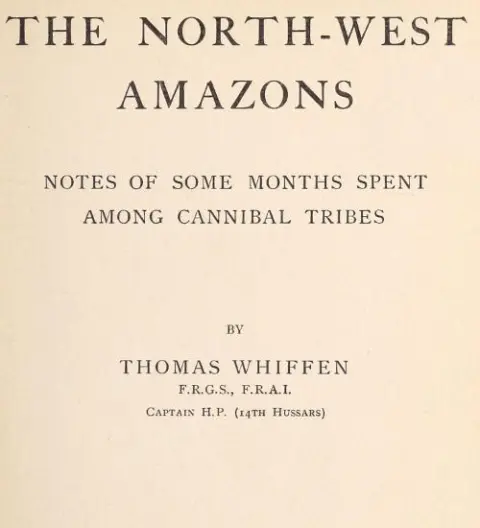
"The North-West Amazons: Notes of some months spent among cannibal tribes" by Thomas Whiffen is a historical account written in the early 20th century. The work details the author's months spent exploring the remote regions near the upper Amazon River, specifically focusing on the cannibal tribes and their cultures. Whiffen shares his observations of the tribes' customs, daily life, and interactions with nature, providing readers with an ethnographic glimpse into a largely untouched world. At the start of the narrative, Whiffen recounts his motivations for embarking on this journey following a period of unemployment due to ill health. He reflects on previous travel experiences and the influence of Dr. Alfred Russel Wallace's writings, which inspired him to explore the Amazon. Arriving in Manaos, he quickly realizes the challenges of accessing the interior and securing a reliable party, and the narrative unfolds with his detailed accounts of the difficulties faced in navigating the forest, river routes, and the dynamics with local tribes. The opening section sets the stage for an immersive exploration of the Amazonian wilderness and the indigenous peoples residing there, capturing both the allure and the difficulties of his expedition.
Introduction adapted from the source catalogue; source summaries may be automatically generated.
Free to read · English · 110,454 words · No account needed
MAKE TIME FOR A GOOD BOOK
On by default. Untick to stop anonymous reading totals. Each page counts after 10 seconds in view. How this works.
Anonymous counting is on unless you have switched it off.
[41] im Thurn, p. 173. Joyce locates the original Caribs on the upper Xingu, from whence, he considers, they spread over Guiana and the lesser Antilles (South American Archæology, p. 256). Rodway, on the authority of Spanish chronicled Arawak information, suggests they were the original inhabitants of the north-west coast, migrant from Mexico (Guiana, pp. 41, 45).
[42] Ibid. pp. 171-2.
[43] Crevaux, Fleuves de l’Amérique du Sud, Yapura, F. 5 et 7.
[44] Crevaux, Vocabulaire français-roucouyenne.
[45] Koch-Grünberg, Journal de la Société des Américainistes de Paris, tome iii. No. 2 (1906).
[46] Koch-Grünberg, Zeitschrift für Ethnologie, xxxviii, 189.
[47] It must be remembered that I came to all these people from the
Witoto country.
[48] Crevaux, Voyages dans l’Amérique du Sud, p. 368.
[49] Martius, Beiträge, ii. 340.
[50] The Inca were called Orejones by the Spaniards on account of the large studs they wore in the lobes of their ears. See Joyce, p. 110; Ratzel, ii. 172.
[51] Simson, p. 210.
[52] Koch-Grünberg, Zeitschrift für Ethnologie, xxxviii. 188 (1906).
[53] Cd. 6266, pp. 9, 10, 12, 25, 26.
[54] Rice, p. 690.
[55] Wallace, p. 354.
[56] See Appendix.
[57] Hardenburg, Man, p. 134.
[58] This combination is of so exceptional a character that it is hardly to be recognised as a definite trait of organisation, and it follows that though such exceptional cases may point to a possible past unity of clans as a tribe, these clans are now practically small tribes, being incapable of combining for common action. The expressions language-group, tribe, and tribesman are therefore more correct than tribe, clan, and clansman would be.
[59] Cf. im Thurn, p. 185.
[60] This is exactly the reverse of the matrilocal customs related by Sir
Everard im Thurn.
[61] Or their artists and publishers.
[62] “The natives are ashamed, as they say, to be clothed” (Humboldt, Travels, iii. 230; cf. also Wallace, p. 357). Clothes, in fact, are often donned by savages at periods of license only. See Westermarck, History of Human Marriage, chap. ix.
[63] There are several trees in these forests that supply the needed fibrous bark. im Thurn suggests that the bark used is that of the Lecythis ollaria, but Spruce states that tauari is made from the bark of certain species of Tecoma of the Bignoniaceae order, and tururi, a thinner bark-cloth, from various figs and Artocarps. Naturally natives use the tree that is handiest when required (cf. im Thurn, pp. 194, 291; Spruce, i. 27).
[64] Dr. de Lacerda in his journal for July 22, 1798, describes just such a manufacture of bark-cloth carried on by the Muizas, who traded this with their neighbours the Maraves. See Land of Carembe, R.G.S., 1873, p. 71. Loin-cloths made from the bark of the Artocarps are also found among the Semang of Kedah and other wild tribes of the Malay Peninsula. See Skeat and Blagden, i. 143-4, 157, 376, etc.
Your reading position is saved on this browser. Take it to another device with a library code. Reading pages adapt to text, rather than matching a printed edition.
BEHIND THE BOOK
This eBook is for the use of anyone anywhere in the United States and most other parts of the world at no cost and with almost no restrictions whatsoever. You may copy it, give it away or re-use it under the terms of the Project Gutenberg License included with this eBook or online at www.gutenberg.org. If you are not located in the United States, you will have to check the laws of the country where you are located before using this eBook. Read the source licence.
The original source file, including credits and licence, is retained by this library. Request an original-format copy at no charge. Please include the book title and Project Gutenberg identifier #55540.
KEEP YOUR CURIOSITY GOING
Wilfrid Scawen Blunt
Wilfrid Scawen Blunt

E. W. (Edgar Watson) Howe
Cécile Tormay

Moritz Busch
John L. Ransom