THE CLASSIC COLLECTION✦My diaries, being a personal narrative of events 1888-1914, Part 2 (1900-1914)CLASSIC FREE BOOKS
My diaries, being a personal narrative of events 1888-1914, Part 2 (1900-1914)
Wilfrid Scawen Blunt
THE CLASSIC COLLECTION · 1915
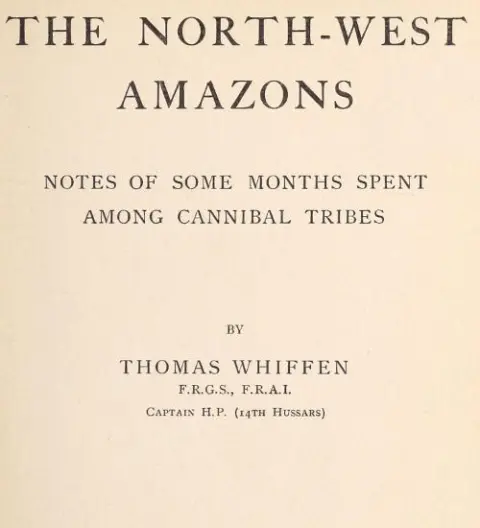
"The North-West Amazons: Notes of some months spent among cannibal tribes" by Thomas Whiffen is a historical account written in the early 20th century. The work details the author's months spent exploring the remote regions near the upper Amazon River, specifically focusing on the cannibal tribes and their cultures. Whiffen shares his observations of the tribes' customs, daily life, and interactions with nature, providing readers with an ethnographic glimpse into a largely untouched world. At the start of the narrative, Whiffen recounts his motivations for embarking on this journey following a period of unemployment due to ill health. He reflects on previous travel experiences and the influence of Dr. Alfred Russel Wallace's writings, which inspired him to explore the Amazon. Arriving in Manaos, he quickly realizes the challenges of accessing the interior and securing a reliable party, and the narrative unfolds with his detailed accounts of the difficulties faced in navigating the forest, river routes, and the dynamics with local tribes. The opening section sets the stage for an immersive exploration of the Amazonian wilderness and the indigenous peoples residing there, capturing both the allure and the difficulties of his expedition.
Introduction adapted from the source catalogue; source summaries may be automatically generated.
Free to read · English · 110,454 words · No account needed
MAKE TIME FOR A GOOD BOOK
On by default. Untick to stop anonymous reading totals. Each page counts after 10 seconds in view. How this works.
Anonymous counting is on unless you have switched it off.
[65] A similar geographical progression has been noted among the women of British New Guinea. See Williamson, The Mafulu, p. 28.
[66] Sandals known as alparagatas, with soles of plaited aloe-fibre, are usually worn by travellers in the Amazons. These can be cleaned and washed in the same way. See also Simson, p. 83.
[67] Wallace, p. 351.
[68] Feather ruffs are worn by Napo Indians, but not by these tribes.
[69] im Thurn, p. 305.
[70] One feather head-dress in my possession is made with rough cotton yarn, obtained presumably by barter, for none of these tribes make cotton yarn themselves, and it is very rarely to be found among them. The feathers are bound into the hank with very fine fibre.
[71] Oenocarpus distichus.
[72] Wallace, p. 351.
[73] According to Koch-Grünberg the Yahabana and other Kuretu-speaking tribes part the hair in the middle and plait it with bast. After bathing, the hair is dried, combed, and arranged with a bandage.
[74] Red was the favourite colour for a djibbeh. White ones were not much
liked.
[75] This corresponds with the bead tanga described by Wallace, but the Uaupes’ apron is “only about six inches square,” and these girdles or garlands are two feet long or more (Wallace, p. 343).
[76] Value, I believe, about ninepence exchange or less.
[77] So uncommon is it that I was under the impression that it was entirely unknown until I examined the necklace in question very carefully after my return to England. Certainly I never saw any of these tribes preparing cotton or making use of it in any way except in its natural state to tip their blow-pipe arrows. String or yarn of any sort, except the fibre thread, I always found to be absolutely unobtainable anywhere throughout these districts.
[78] Possibly one of the Histeridae mentioned by Bates, i. 211.
[79] Pace Maw, p. 226.
[80] Belts of apparently similar minute plaiting are worn by the Mafula of British New Guinea. These natives also wear armlets and leglets of the same material, but not tightened to swell the muscles. The thread these are made of is manufactured from vegetable fibre in the identical manner employed by the Issa-Japura Indians (Williams, The Mafula of British New Guinea, pp. 32, 53, 54).
[81] Compare illustration with pictures of ligatures in D. Rannie’s My Adventures among South Sea Cannibals, pp. 80, 170, 179.
[82] The Spaniards called the Inca Orejones on account of the large studs worn by them in the lobes of their ears. See Joyce, p. 110.
[83] Wallace states that all the Indians “have a row of circular punctures along the arm” (Wallace, p. 345). These tribes have nothing of the sort.
[84] Wallace describes the mark as “three vertical blue lines on the chin” (Wallace, p. 345). This is not correct; vide drawing.
[85] Crevaux, p. 264.
[86] The Bixa Orellana (Spix and von Martius, p. 228).
Your reading position is saved on this browser. Take it to another device with a library code. Reading pages adapt to text, rather than matching a printed edition.
BEHIND THE BOOK
This eBook is for the use of anyone anywhere in the United States and most other parts of the world at no cost and with almost no restrictions whatsoever. You may copy it, give it away or re-use it under the terms of the Project Gutenberg License included with this eBook or online at www.gutenberg.org. If you are not located in the United States, you will have to check the laws of the country where you are located before using this eBook. Read the source licence.
The original source file, including credits and licence, is retained by this library. Request an original-format copy at no charge. Please include the book title and Project Gutenberg identifier #55540.
KEEP YOUR CURIOSITY GOING
Wilfrid Scawen Blunt
Wilfrid Scawen Blunt

E. W. (Edgar Watson) Howe
Cécile Tormay

Moritz Busch
John L. Ransom