THE CLASSIC COLLECTION✦My diaries, being a personal narrative of events 1888-1914, Part 2 (1900-1914)CLASSIC FREE BOOKS
My diaries, being a personal narrative of events 1888-1914, Part 2 (1900-1914)
Wilfrid Scawen Blunt
THE CLASSIC COLLECTION · 1915
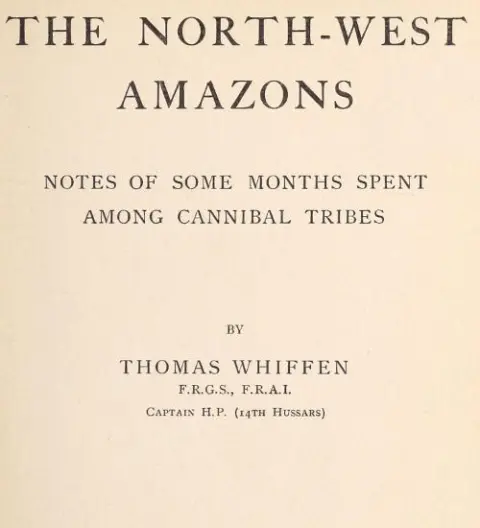
"The North-West Amazons: Notes of some months spent among cannibal tribes" by Thomas Whiffen is a historical account written in the early 20th century. The work details the author's months spent exploring the remote regions near the upper Amazon River, specifically focusing on the cannibal tribes and their cultures. Whiffen shares his observations of the tribes' customs, daily life, and interactions with nature, providing readers with an ethnographic glimpse into a largely untouched world. At the start of the narrative, Whiffen recounts his motivations for embarking on this journey following a period of unemployment due to ill health. He reflects on previous travel experiences and the influence of Dr. Alfred Russel Wallace's writings, which inspired him to explore the Amazon. Arriving in Manaos, he quickly realizes the challenges of accessing the interior and securing a reliable party, and the narrative unfolds with his detailed accounts of the difficulties faced in navigating the forest, river routes, and the dynamics with local tribes. The opening section sets the stage for an immersive exploration of the Amazonian wilderness and the indigenous peoples residing there, capturing both the allure and the difficulties of his expedition.
Introduction adapted from the source catalogue; source summaries may be automatically generated.
Free to read · English · 110,454 words · No account needed
MAKE TIME FOR A GOOD BOOK
On by default. Untick to stop anonymous reading totals. Each page counts after 10 seconds in view. How this works.
Anonymous counting is on unless you have switched it off.
[21] These tribal houses differ from the communal long-houses of the Fly Delta, British New Guinea, not only in shape, but in that there are no platforms and no divisions for each family; the whole interior is open. For description of Kiwai and Daudai long-houses see Expedition to Torres Straits, iv. 112-117.
[22] Maloka = Indian lodge or tribal house (lingoa-geral).
[23] Manicaria saccifera (cf. Spruce, i. 56).
[24] Eugene André noted that two kinds were commonly used on the Causa, the mulato, a kind of Aroideae, and the murcielago, which belongs to the Bignoniaceae family.
[25] Several kinds of palm-leaves are used for this purpose, and whichever was most easily procurable in the district where the house was built would be used by the tribe. Hardenburg mentions the leaves of the Phytelephas macrocarpa, the vegetable ivory-tree, as in use among the Witoto, and the Bactris ciliata or Chonta palm for the posts and rafters (p. 135). The leaves of the Bussu palm, Manicaria saccifera, will make a thatch that lasts for ten or twelve years, by some accounts (cf. Waterton, p. 479).
[26] Wallace, p. 341.
[27] This is architecturally interesting in view of Foucart’s theory of the evolution of the Egyptian grooved stone pillar from wooden originals, bundles of reeds.
[28] Simson mentions such a “door,” p. 237.
[29] Wallace, p. 341.
[30] Among the Jivaro one partitioned half of the house is kept for the women (Orton, p. 171). There is no such distinction among the Issa-Japura tribes.
[31] Cf. Wallace, p. 354.
[32] Crevaux has described the process. He watched an Indian “qui fait du feu en roulant vivement un roseau dans une cavité creusée dans une tige de roncon” (Voyage dans l’Amérique du sud, p. 214). Wallace mentions this method among the Kuretu, op. cit. 355.
[33] If a jigger is removed at once with a needle it will not hurt, and scarcely makes a puncture.
[34] Vampires in this country are few and far between, but Simson mentions them as a plague at Agnano (Simson, p. 131).
[35] Bates, i. 246. For the taming of a full-grown Coita see p. 247. Another pet mentioned by Bates, a “strange kind of wood-cricket,” is also unknown to me as a pet, and though I have often heard loud-voiced insects of the cricket class they have never been in captivity (cf. Bates, i. 250).
[36] Cf. Martius, P.R.G.S. ii. 192.
[37] See Appendix.
[38] Deniker, p. 552.
[39] Marriage by capture was a Carib custom (Westermarck, p. 383). It is unknown nowadays to the tribes south of the Japura.
[40] Partial couvade is found also among tribes in the north of America, that is to say, certain things are tabu to the father after the child’s birth. Cf. Dorsey, Siouan Cults, p. 511; Venegas, i. 94; Tylor, pp. 294-7.
Your reading position is saved on this browser. Take it to another device with a library code. Reading pages adapt to text, rather than matching a printed edition.
BEHIND THE BOOK
This eBook is for the use of anyone anywhere in the United States and most other parts of the world at no cost and with almost no restrictions whatsoever. You may copy it, give it away or re-use it under the terms of the Project Gutenberg License included with this eBook or online at www.gutenberg.org. If you are not located in the United States, you will have to check the laws of the country where you are located before using this eBook. Read the source licence.
The original source file, including credits and licence, is retained by this library. Request an original-format copy at no charge. Please include the book title and Project Gutenberg identifier #55540.
KEEP YOUR CURIOSITY GOING
Wilfrid Scawen Blunt
Wilfrid Scawen Blunt

E. W. (Edgar Watson) Howe
Cécile Tormay

Moritz Busch
John L. Ransom