THE CLASSIC COLLECTION✦Ghosts and Family Legends: A Volume for ChristmasCLASSIC FREE BOOKS
Ghosts and Family Legends: A Volume for Christmas
Catherine Crowe
THE CLASSIC COLLECTION · 1856
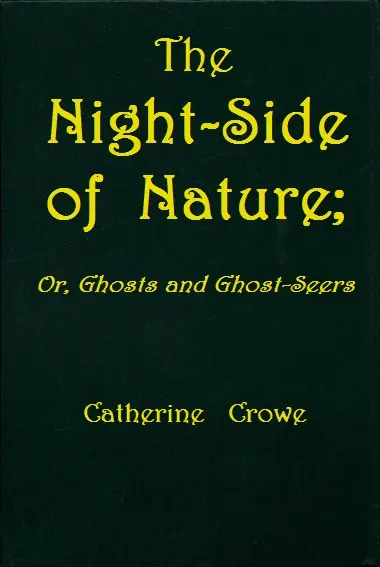
"The Night-Side of Nature; Or, Ghosts and Ghost-Seers" by Catherine Crowe is a philosophical exploration written in the mid-19th century. This work investigates supernatural phenomena, particularly ghosts and their significance, alongside dreams, presentiments, and the nature of the human soul. Crowe's approach reflects a blend of inquiry and skepticism, aiming to illuminate what remains hidden about the spiritual and psychical aspects of existence. At the start of the book, the author introduces her intentions by discussing the lack of attention given to spiritual topics by the scientific community. She draws parallels between the obscurity of the "night-side" of nature, as understood by German astronomers, and humanity's ignorance of spiritual truths. The opening emphasizes the importance of observing and reflecting on the common occurrences of dreams and apparitions throughout history. Crowe outlines her goal of prompting inquiry rather than dictating beliefs, hoping that by doing so, readers might reconsider their views on the paranormal and their implications for understanding the existence of the soul and life after death.
Introduction adapted from the source catalogue; source summaries may be automatically generated.
Free to read · English · 170,037 words · No account needed
MAKE TIME FOR A GOOD BOOK
On by default. Untick to stop anonymous reading totals. Each page counts after 10 seconds in view. How this works.
Anonymous counting is on unless you have switched it off.
All people and all ages have believed, more or less, in prophetic dreams, presentiments, and apparitions; and all historians have furnished examples of them. That the truths may be frequently distorted and mingled with fable, is no argument against those traditions; if it were, all history must be rejected on the same plea. Both the Old and New Testaments furnish numerous examples of these phenomena; and although Christ and the apostles reproved all the superstitions of the age, these persuasions are not included in their reprehensions.
Neither is the comparative rarity of these phenomena any argument against their possibility. There are many strange things which occur still more rarely, but which we do not look upon as supernatural or miraculous. Of nature’s ordinary laws, we yet know but little; of their aberrations and perturbations, still less. How should we, when the world is a miracle and life a dream, of which we know neither the beginning nor the end! We do not even know that we see anything as it is, or rather, we know that we do not. We see things but as our visual organs represent them to us; and were those organs differently constructed, the aspect of the world would to us be changed. How, then, can we pretend to decide upon what is and what is not?
Nothing could be more perplexing to any one who read them with attention, than the trials for witchcraft of the seventeenth century. Many of the feats of the ancient thaumaturgists and wonder-workers of the temples might have been nearly as much so, but these were got rid of by the easy expedient of pronouncing them fables and impostures; but, during the witch-mania, so many persons proved their faith in their own miraculous powers by the sacrifice of their lives, that it was scarcely possible to doubt their having some foundation for their own persuasion, though what that foundation could be, till the late discoveries in animal magnetism, it was difficult to conceive; but here we have a new page opened to us which concerns both the history of the world and the history of man, as an individual; and we begin to see that that which the ignorant thought supernatural, and the wise impossible, has been both natural and true. While the scientific men of Great Britain, and several of our journalists, have been denying and ridiculing the reports of these phenomena, the most eminent physicians of Germany have been quietly studying and investigating them, and giving to the world, in their works, the results of their experience. Among the rest, Dr. Joseph Ennemoser, of Berlin, has presented to us in his two books on “Magic,” and on “The Connection of Magnetism with Nature and Religion,” the fruits of his thirty years’ study of this subject—during the course of which he has had repeated opportunities of investigating all the phenomena, and of making himself perfectly familiar with even the most rare and perplexing. To any one who has studied these works, the mysteries of the temples and of the witch-trials are mysteries no longer; and he writes with the professed design, not to make science mystical, but to bring the mysterious within the bounds of science. The phenomena, as he justly says, are as old as the human race. Animal magnetism is no new development, no new discovery. Inseparable from life, although, like many other vital phenomena, so subtle in its influences, that only in abnormal cases it attracts attention, it has exhibited itself more or less in all ages and in all countries. But its value as a medical agent is only now beginning to dawn on the civilized world, while its importance in a higher point of view is yet perceived by but few. Every human being who has ever withdrawn himself from the strife, and the turmoil, and the distraction, of the world without, in order to look within, must have found himself perplexed by a thousand questions with regard to his own being, which he would find no one able to solve. In the study of animal magnetism, he will first obtain some gleams of a light which will show him that he is indeed the child of God! and that, though a dweller on the earth, and fallen, some traces of his divine descent, and of his unbroken connection with a higher order of being, still remain to comfort and encourage him. He will find that there exists in his species the germs of faculties that are never fully unfolded here on earth, and which have no reference to this state of being. They exist in all men, but in most cases are so faintly elicited as not to be observable; and when they do shoot up here and there, they are denied, disowned, misinterpreted, and maligned. It is true that their development is often the symptom and effect of disease, which seems to change the relations of our material and immaterial parts; it is true that some of the phenomena resulting from these faculties are stimulated by disease, as in the case of spectral illusions; and it is true that imposture and folly intrude their unhallowed footsteps into this domain of science, as into that of all others; but there is a deep and holy well of truth to be discovered in this neglected by-path of nature, by those who seek it, from which they may draw the purest consolations for the present, the most ennobling hopes for the future, and the most valuable aid in penetrating through the letter into the spirit of the Scriptures.
Your reading position is saved on this browser. Take it to another device with a library code. Reading pages adapt to text, rather than matching a printed edition.
BEHIND THE BOOK
This eBook is for the use of anyone anywhere in the United States and most other parts of the world at no cost and with almost no restrictions whatsoever. You may copy it, give it away or re-use it under the terms of the Project Gutenberg License included with this eBook or online at www.gutenberg.org. If you are not located in the United States, you will have to check the laws of the country where you are located before using this eBook. Read the source licence.
The original source file, including credits and licence, is retained by this library. Request an original-format copy at no charge. Please include the book title and Project Gutenberg identifier #54532.
KEEP YOUR CURIOSITY GOING

David Patterson (Spirit) Hatch

David Patterson (Spirit) Hatch

David Patterson (Spirit) Hatch
Coulson Kernahan

Ralph Waldo Emerson
Frances Wright