THE CLASSIC COLLECTION✦Ghosts and Family Legends: A Volume for ChristmasCLASSIC FREE BOOKS
Ghosts and Family Legends: A Volume for Christmas
Catherine Crowe
THE CLASSIC COLLECTION · 1856
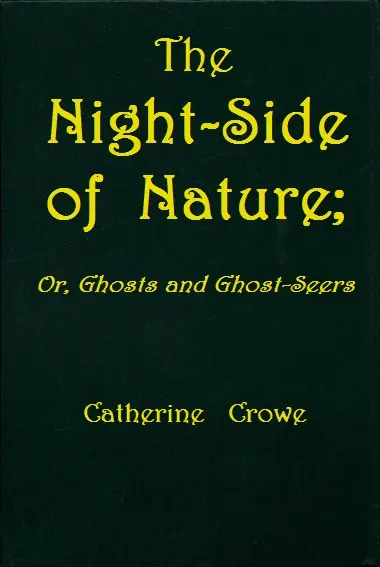
"The Night-Side of Nature; Or, Ghosts and Ghost-Seers" by Catherine Crowe is a philosophical exploration written in the mid-19th century. This work investigates supernatural phenomena, particularly ghosts and their significance, alongside dreams, presentiments, and the nature of the human soul. Crowe's approach reflects a blend of inquiry and skepticism, aiming to illuminate what remains hidden about the spiritual and psychical aspects of existence. At the start of the book, the author introduces her intentions by discussing the lack of attention given to spiritual topics by the scientific community. She draws parallels between the obscurity of the "night-side" of nature, as understood by German astronomers, and humanity's ignorance of spiritual truths. The opening emphasizes the importance of observing and reflecting on the common occurrences of dreams and apparitions throughout history. Crowe outlines her goal of prompting inquiry rather than dictating beliefs, hoping that by doing so, readers might reconsider their views on the paranormal and their implications for understanding the existence of the soul and life after death.
Introduction adapted from the source catalogue; source summaries may be automatically generated.
Free to read · English · 170,037 words · No account needed
MAKE TIME FOR A GOOD BOOK
On by default. Untick to stop anonymous reading totals. Each page counts after 10 seconds in view. How this works.
Anonymous counting is on unless you have switched it off.
It is by the hypothesis of this universal sense, latent within us—an hypothesis which, whoever believes that we are immortal spirits, incorporated for a season in a material body, can scarcely reject—that I seek to explain those perceptions which are not comprised within the functions of our bodily organs. It seems to me to be the key to all or nearly all of them, as far as our own part in the phenomena extends. But, supposing this admitted, there would then remain the difficulty of accounting for the partial and capricious glimpses we get of it; while in that department of the mystery which regards apparitions, except such as are the pure result of disease, we must grope our way, with very little light to guide us, as to the conditions and motives which might possibly bring them into any immediate relation with us.
To any one who has been fortunate enough to witness one genuine case of clairvoyance, I think the conception of this universal sense will not be difficult, however the mode of its exercise may remain utterly incomprehensible. As I have said above—to the great Spirit and Fountain of life, all things, in both space and time, must be present. However impossible it is to our finite minds to conceive this, we must believe it. It may, in some slight degree, facilitate the conception to remember that action, once begun, never ceases—an impulse given is transmitted on for ever; a sound breathed reverberates in eternity; and thus the past is always present, although, for the purpose of fitting us for this mortal life, our ordinary senses are so constituted as to be unperceptive of these phenomena. With respect to what we call the future, it is more difficult still for us to conceive it as present; nor, as far as I know, can we borrow from the sciences the same assistance as mechanical discoveries have just furnished me with in regard to the past. How a spirit sees that which has not yet, to our senses, taken place, seems certainly inexplicable. Foreseeing it is not inexplicable: we foresee many things by arguing on given premises, although, from our own finite views, we are always liable to be mistaken. Louis Lambert says: “Such events as are the product of humanity, and the result of its intelligence, have their own causes, in which they lie latent, just as our actions are accomplished in our thoughts previous to any outward demonstration of them; presentiments and prophecies consist in the intuitive perception of these causes.” This explanation, which is quite conformable with that of Cicero, may aid us in some degree as regards a certain small class of phenomena; but there is something involved in the question much more subtle than this. Our dreams can give us the only idea of it; for there we do actually see and hear, not only that which never was, but that which never will be. Actions and events, words and sounds, persons and places, are as clearly and vividly present to us as if they were actually what they seem; and I should think that most people must be somewhat puzzled to decide in regard to certain scenes and circumstances that live in their memory, whether the images are the result of their waking or sleeping experience. Although by no means a dreamer, and without the most remote approximation to any faculty of presentiment, I know this is the case with myself. I remember also a very curious effect being produced upon me, when I was abroad, some years ago, from eating the unwholesome bread to which we were reduced, in consequence of a scarcity. Some five or six times a day I was seized with a sort of vertigo, during which I seemed to pass through certain scenes, and was conscious of certain words, which appeared to me to have a strange connection, with either some former period of my life, or else some previous state of existence. The words and the scenes were on each occasion precisely the same: I was always aware of that, and I always made the strongest efforts to grasp and retain them in my memory, but I could not. I only knew that the thing had been; the words and the scenes were gone. I seemed to pass momentarily into another sphere and back again. This was purely the result of disorder; but, like a dream, it shows how we may be perceptive of that which is not, and which never may be; rendering it, therefore, possible to conceive that a spirit may be equally perceptive of that which shall be. I am very far from meaning to imply that these examples remove the difficulty: they do not explain the thing; they only show somewhat the mode of it. But it must be remembered that when physiologists pretend to settle the whole question of apparitions by the theory of spectral illusions, they are exactly in the same predicament. They can supply examples of similar phenomena; but how a person, perfectly in his senses, should receive the spectral visits of, not only friends, but strangers, when he is thinking of no such matter—or by what process, mental or optical, the figures are conjured up—remains as much a mystery as before a line was written on the subject.
Your reading position is saved on this browser. Take it to another device with a library code. Reading pages adapt to text, rather than matching a printed edition.
BEHIND THE BOOK
This eBook is for the use of anyone anywhere in the United States and most other parts of the world at no cost and with almost no restrictions whatsoever. You may copy it, give it away or re-use it under the terms of the Project Gutenberg License included with this eBook or online at www.gutenberg.org. If you are not located in the United States, you will have to check the laws of the country where you are located before using this eBook. Read the source licence.
The original source file, including credits and licence, is retained by this library. Request an original-format copy at no charge. Please include the book title and Project Gutenberg identifier #54532.
KEEP YOUR CURIOSITY GOING

David Patterson (Spirit) Hatch

David Patterson (Spirit) Hatch

David Patterson (Spirit) Hatch
Coulson Kernahan

Ralph Waldo Emerson
Frances Wright