THE CLASSIC COLLECTION✦Ghosts and Family Legends: A Volume for ChristmasCLASSIC FREE BOOKS
Ghosts and Family Legends: A Volume for Christmas
Catherine Crowe
THE CLASSIC COLLECTION · 1856
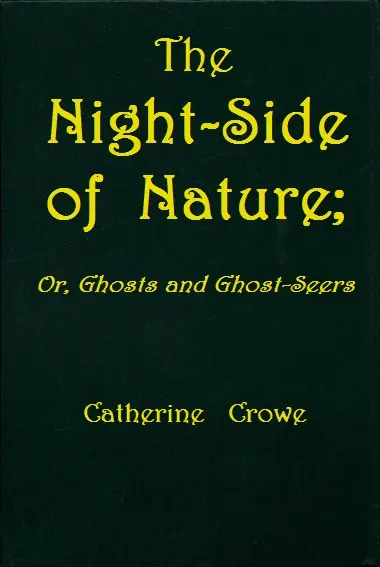
"The Night-Side of Nature; Or, Ghosts and Ghost-Seers" by Catherine Crowe is a philosophical exploration written in the mid-19th century. This work investigates supernatural phenomena, particularly ghosts and their significance, alongside dreams, presentiments, and the nature of the human soul. Crowe's approach reflects a blend of inquiry and skepticism, aiming to illuminate what remains hidden about the spiritual and psychical aspects of existence. At the start of the book, the author introduces her intentions by discussing the lack of attention given to spiritual topics by the scientific community. She draws parallels between the obscurity of the "night-side" of nature, as understood by German astronomers, and humanity's ignorance of spiritual truths. The opening emphasizes the importance of observing and reflecting on the common occurrences of dreams and apparitions throughout history. Crowe outlines her goal of prompting inquiry rather than dictating beliefs, hoping that by doing so, readers might reconsider their views on the paranormal and their implications for understanding the existence of the soul and life after death.
Introduction adapted from the source catalogue; source summaries may be automatically generated.
Free to read · English · 170,037 words · No account needed
MAKE TIME FOR A GOOD BOOK
On by default. Untick to stop anonymous reading totals. Each page counts after 10 seconds in view. How this works.
Anonymous counting is on unless you have switched it off.
TO begin with the most simple—or rather, I should say, the most ordinary—class of phenomena, for we can scarcely call that simple, the mystery of which we have never been able to penetrate—I mean dreaming—everybody’s experience will suffice to satisfy them that their ordinary dreams take place in a state of imperfect sleep, and that this imperfect sleep may be caused by any bodily or mental derangement whatever, or even from an ill-made bed, or too much or too little covering; and it is not difficult to conceive that the strange, confused, and disjointed visions we are subject to on these occasions, may proceed from some parts of the brain being less at rest than the others; so that, assuming phrenology to be fact, one organ is not in a state to correct the impressions of another. Of such vain and insignificant visions, I need scarcely say it is not my intention to treat; but, at the same time, I must observe, that when we have admitted the above explanation, as far as it goes, we have not, even in regard to them, made much progress toward removing the difficulty. If dreaming resembled thinking, the explanations might be quite satisfactory; but the truth is, that dreaming is not thinking, as we think in our waking state, but is more analogous to thinking in delirium or acute mania, or in that chronic condition which gives rise to sensuous illusions. In our ordinary normal state, conceiving of places or persons does not enable us to see them or hold communion with them, nor do we fancy that we do either. It is true, that I have heard some painters say that, by closing their eyes and concentrating their thoughts on an object, they can bring it more or less vividly before them, and Blake professed actually to see his sitters when they were not present; but whatever interpretations we may put upon this curious faculty, his case was clearly abnormal, and connected with some personal peculiarity, either physical or psychical; and, after making the most of it, it must be admitted that it can enter into no sort of comparison with that we possess in sleep, when, in our most ordinary dreams, untrammelled by time or space, we visit the uttermost ends of the earth, fly in the air, swim in the sea, listen to beautiful music and eloquent orations, behold the most charming as well as the most loathsome objects; and not only see, but converse with our friends, absent or present, dead or alive. Every one, I think, will grant that there is the widest possible difference between conceiving of these things when awake, and dreaming them. When we dream, we do, we see, we say, we hear, &c., &c., that is, we believe at the time we do so; and what more can be said of us when we are awake, than that we believe we are doing, seeing, saying, hearing, &c. It is by external circumstances, and the results of our actions, that we are able to decide whether we have actually done a thing or seen a place, or only dreamt that we have done so; and as I have said above, after some lapse of time we are not always able to distinguish between the two. While dreaming, we frequently ask ourselves whether we are awake or asleep; and nothing is more common than to hear people say, “Well, I think I did, or heard, so and so; but I am not sure whether it was so, or whether I dreamt it.” Thus, therefore, the very lowest order of dreaming, the most disjointed and perplexed, is far removed from the most vivid presentations of our waking thoughts; and it is in this respect, I think, that the explanations of the phenomena hitherto offered by phrenologists, and the metaphysicians of this country, are inadequate and unsatisfactory; while, as regards the analogy between the visions of sleep and delirium, whatever similarity there may be in the effects, we can not suppose the cause to be identical: since, in delirium the images and delusions are the result of excessive action of the brain, which we must conclude to be the very reverse of its condition in sleep. Pinel certainly has hazarded an opinion that sleep is occasioned by an efflux of blood to the head, and consequent compression of the brain—a theory which would have greater weight were sleep more strictly periodical than it is; but which, at present, it seems impossible to reconcile with many established facts.
Your reading position is saved on this browser. Take it to another device with a library code. Reading pages adapt to text, rather than matching a printed edition.
BEHIND THE BOOK
This eBook is for the use of anyone anywhere in the United States and most other parts of the world at no cost and with almost no restrictions whatsoever. You may copy it, give it away or re-use it under the terms of the Project Gutenberg License included with this eBook or online at www.gutenberg.org. If you are not located in the United States, you will have to check the laws of the country where you are located before using this eBook. Read the source licence.
The original source file, including credits and licence, is retained by this library. Request an original-format copy at no charge. Please include the book title and Project Gutenberg identifier #54532.
KEEP YOUR CURIOSITY GOING

David Patterson (Spirit) Hatch

David Patterson (Spirit) Hatch

David Patterson (Spirit) Hatch
Coulson Kernahan

Ralph Waldo Emerson
Frances Wright