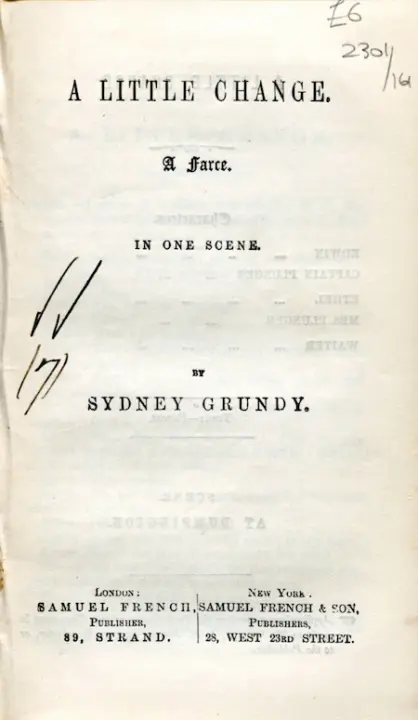
A Little Change: A Farce in One Scene
Sydney Grundy
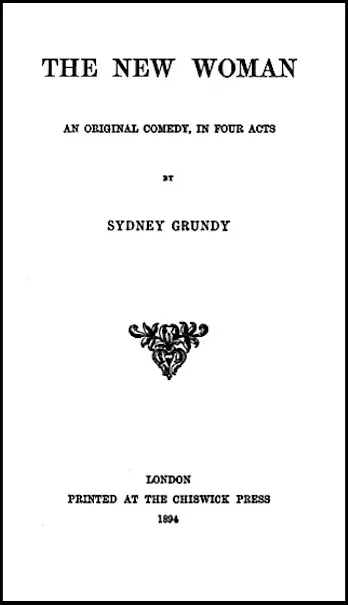
THE CLASSIC COLLECTION · 1894
"The New Woman: An Original Comedy, in Four Acts" by Sydney Grundy is a theatrical play written in the late 19th century. It delves into the social changes and evolving gender roles of the time, particularly through the characters and conversations that reflect contemporary debates about women's rights and identity. The story primarily revolves around Gerald Cazenove and his interactions with various figures in his life, highlighting his relationships with women who embody the ideals and struggles of the New Woman archetype. At the start of the play, we are introduced to Gerald Cazenove and his uncle, Colonel Cazenove, who discuss Gerald’s recent experiences and the influence of women in his life, particularly in the context of education and social expectations. Their dialogue sets the stage for exploring themes of love, societal pressures, and the notion of masculinity, as Gerald reveals that he is in love with a woman named Margery who, while socially beneath him, challenges his previous notions of love and companionship. As guests enter, representing a variety of perspectives on the evolving nature of relationships and feminism, the opening portion establishes a comedic yet critical tone that centers on the complexities of marriage and identity during a time of significant social change.
Introduction adapted from the source catalogue; source summaries may be automatically generated.
Free to read · English · 19,082 words · No account needed
MAKE TIME FOR A GOOD BOOK
On by default. Untick to stop anonymous reading totals. Each page counts after 10 seconds in view. How this works.
Anonymous counting is on unless you have switched it off.
Happily the weeks are not all over yet. In a few more you will have forgotten her as completely as she will have forgotten you.
In a few more, I hope that she will be my wife.
You contemplate a mésalliance?
There is no mésalliance where there's love.
You, of whom everyone expects so much, to throw away your
opportunities, and to begin your life hindered and hampered by a
foolish marriage.
If she will only marry me.
MRS. SYLVESTER [looks at him, pained].
I may still be your friend?
[Offers him her hands, which he takes a little reluctantly.
Re-enter WELLS.
Lady Wargrave.
[Exit.
Enter LADY WARGRAVE leaning on the COLONEL'S arm. She walks with a crutch-stick, and is followed by MARGERY, who carries a cushion. MRS. SYLVESTER retires up, so that she is not immediately seen by LADY WARGRAVE.
GERALD [a little tentatively].
My dear aunt!
[They shake hands.
You may kiss me.
[He kisses her, then casts a glance of gratitude at MARGERY. Meanwhile MARGERY has prepared a chair for her, into which she is placed by GERALD and the COLONEL, who is now subdued and deferential, in marked contrast to his last scene. MARGERY takes up her position in the background.
I was so fortunate as to meet the carriage.
Theodore was late as usual.
Only ten minutes, Caroline; but, as you know, time, tide, and your
aunt wait for no man.
Now, Gerald, let me look at you. Your face to the light, please. [GERALD stands for inspection. She takes a long look through her eye-glass.] I don't like that necktie.
GERALD [smiling and bowing].
It shall be changed to-morrow, aunt.
To-day. [GERALD bows. She takes another look.] That will do, Gerald. [GERALD salutes. She drops her glasses.
Stand at ease! Dismiss!
Theodore, this is not a barracks!
True. [Bows.] Peccavi!
LADY WARGRAVE [addressing GERALD].
I need hardly say with what pleasure I have followed your career at Oxford. It is worthy of a Cazenove.
Brilliant--magnificent!
It is worthy of a Cazenove; that is all.
[COLONEL subsides, bowing.
Yes, aunt, I flatter myself----
Don't do that. You did your duty. Nothing more.
By the way, did you receive my poem?
Poem?
That won the Newdigate. I sent you a copy--to Rome.
Ah, I remember; I received the document. Tell me, were there many
competitors?
A dozen or so.
Is it possible that Oxford can produce eleven worse poems than yours?
My dear aunt!
Your reading position is saved on this browser. Take it to another device with a library code. Reading pages adapt to text, rather than matching a printed edition.
Sydney Grundy
Sydney Grundy
Sydney Grundy
Sydney Grundy
BEHIND THE BOOK
This eBook is for the use of anyone anywhere in the United States and most other parts of the world at no cost and with almost no restrictions whatsoever. You may copy it, give it away or re-use it under the terms of the Project Gutenberg License included with this eBook or online at www.gutenberg.org. If you are not located in the United States, you will have to check the laws of the country where you are located before using this eBook. Read the source licence.
The original source file, including credits and licence, is retained by this library. Request an original-format copy at no charge. Please include the book title and Project Gutenberg identifier #40839.
KEEP YOUR CURIOSITY GOING
Maurice Baring
W. B. (William Butler) Yeats
Edward Martyn

John Brougham & Charlotte Brontë
Marguerite Merington
Leonid Andreyev