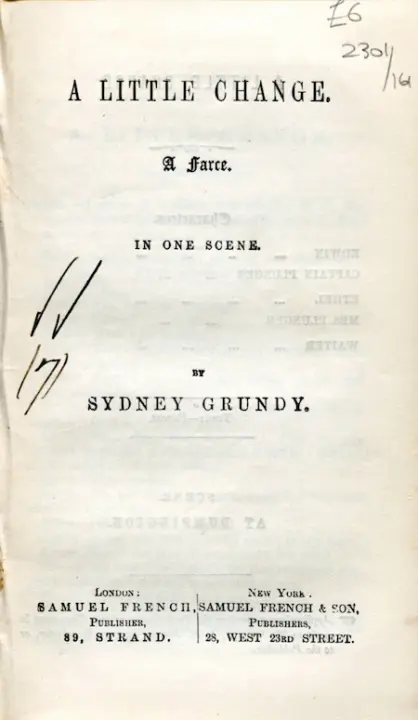
A Little Change: A Farce in One Scene
Sydney Grundy
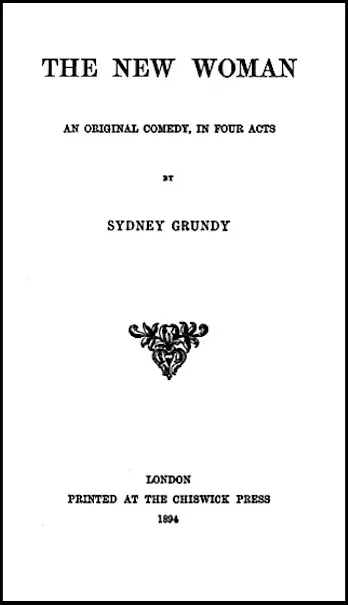
THE CLASSIC COLLECTION · 1894
"The New Woman: An Original Comedy, in Four Acts" by Sydney Grundy is a theatrical play written in the late 19th century. It delves into the social changes and evolving gender roles of the time, particularly through the characters and conversations that reflect contemporary debates about women's rights and identity. The story primarily revolves around Gerald Cazenove and his interactions with various figures in his life, highlighting his relationships with women who embody the ideals and struggles of the New Woman archetype. At the start of the play, we are introduced to Gerald Cazenove and his uncle, Colonel Cazenove, who discuss Gerald’s recent experiences and the influence of women in his life, particularly in the context of education and social expectations. Their dialogue sets the stage for exploring themes of love, societal pressures, and the notion of masculinity, as Gerald reveals that he is in love with a woman named Margery who, while socially beneath him, challenges his previous notions of love and companionship. As guests enter, representing a variety of perspectives on the evolving nature of relationships and feminism, the opening portion establishes a comedic yet critical tone that centers on the complexities of marriage and identity during a time of significant social change.
Introduction adapted from the source catalogue; source summaries may be automatically generated.
Free to read · English · 19,082 words · No account needed
MAKE TIME FOR A GOOD BOOK
On by default. Untick to stop anonymous reading totals. Each page counts after 10 seconds in view. How this works.
Anonymous counting is on unless you have switched it off.
A Fortnight Later.
SCENE.--Drawing-room at LADY WARGRAVE'S. Main entrance C., Conservatory R. Entrance, L., to an inner room. Fireplace, R., up stage, near which is LADY WARGRAVE'S chair, with the cushion of Act I.
The stage is discovered half-filled with Guests, who stand and sit in groups, including COLONEL, CAPTAIN and MRS. SYLVESTER, and GERALD. LADY WARGRAVE is receiving her guests. A buzz of general conversation; and a band is heard playing in the inner room, loudly at first, but softly after the picture is discovered.
SERVANT [at entrance C.].
Miss Vivash and Mr. Pettigrew!
Enter VICTORIA, followed leisurely by PERCY, a very young man who is always smiling to himself, unconsciously.
VICTORIA [going straight to LADY WARGRAVE and grasping her hand].
Good evening, Lady Wargrave, I have taken the liberty of bringing a friend whose name is no doubt known to you--Mr. Percy Pettigrew.
[PERCY bows distantly, smiling.
Pettigrew, did you say?
Percy Bysshe Pettigrew.
[Smiling.
Of course! two of your names are quite well known to me; it is only the surname that is unfamiliar.
PERCY [smiling].
Pettigrew!
[Turns off.
One of my Oxford friends.
LADY WARGRAVE [aside to him].
One of those who are always at Oxford?
His "Supercilia" are quoted everywhere.
His----?
A column Percy does for "The Corset."
A newspaper devoted to our cause.
"The Corset" is Percy's organ.
Ah, his rattle!
Dr. Bevan.
DR. BEVAN [shakes hands with LADY WARGRAVE].
I hope I am not late; but I was detained at the hospital. Most interesting case, unhappily unfit for publication.
Miss Bethune.
[Exit SERVANT.
Enter ENID.
COLONEL [to SYLVESTER].
The best of 'em! [ENID shakes hands with LADY WARGRAVE.] Ah, what a pity, what a pity, Sylvester!
What is a pity, Colonel?
That such a figure should be wasted!
SYLVESTER [in a matter of course voice].
I prefer Mrs. Cazenove's.
[Turns off. COLONEL eyes him curiously. The other Guests should be so arranged that each man is surrounded by a little group of women.
PERCY [the centre of one group, lolling lazily, always smiling with self-complacency, suddenly sits up and shivers].
No, no! don't mention it. It bores me so.
[Shivers.
And me!
[All shiver.
The stage has ever been Woman's greatest foe.
For centuries it has shirked the sexual problem.
SYLVESTER [who has strolled up].
But doesn't it show signs of repentance?
The theatre is dying.
Death-bed repentance, then. That's the one problem it discusses.
It is the one problem in life.
The theatre is dying! Dixi!
[Leans back again.
Your reading position is saved on this browser. Take it to another device with a library code. Reading pages adapt to text, rather than matching a printed edition.
Sydney Grundy
Sydney Grundy
Sydney Grundy
Sydney Grundy
BEHIND THE BOOK
This eBook is for the use of anyone anywhere in the United States and most other parts of the world at no cost and with almost no restrictions whatsoever. You may copy it, give it away or re-use it under the terms of the Project Gutenberg License included with this eBook or online at www.gutenberg.org. If you are not located in the United States, you will have to check the laws of the country where you are located before using this eBook. Read the source licence.
The original source file, including credits and licence, is retained by this library. Request an original-format copy at no charge. Please include the book title and Project Gutenberg identifier #40839.
KEEP YOUR CURIOSITY GOING
Maurice Baring
W. B. (William Butler) Yeats
Edward Martyn

John Brougham & Charlotte Brontë
Marguerite Merington
Leonid Andreyev