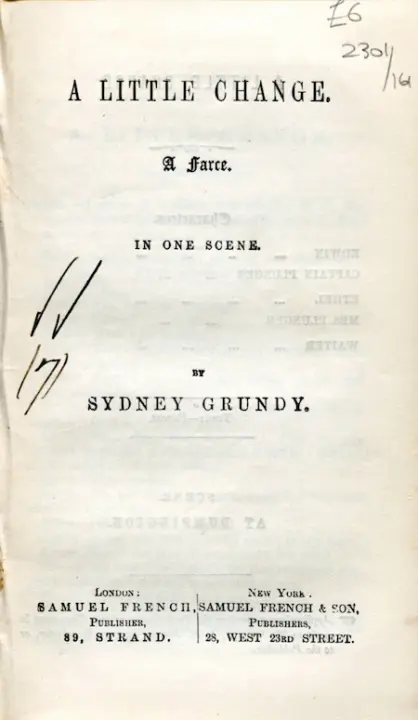
A Little Change: A Farce in One Scene
Sydney Grundy
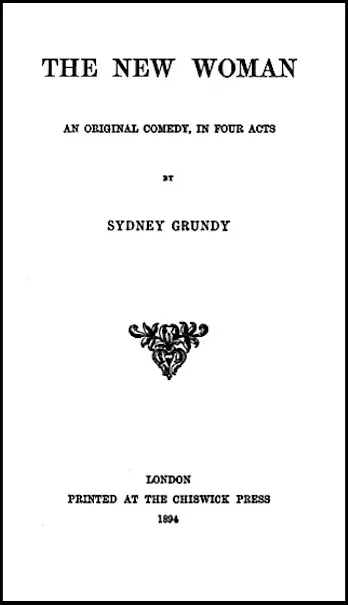
THE CLASSIC COLLECTION · 1894
"The New Woman: An Original Comedy, in Four Acts" by Sydney Grundy is a theatrical play written in the late 19th century. It delves into the social changes and evolving gender roles of the time, particularly through the characters and conversations that reflect contemporary debates about women's rights and identity. The story primarily revolves around Gerald Cazenove and his interactions with various figures in his life, highlighting his relationships with women who embody the ideals and struggles of the New Woman archetype. At the start of the play, we are introduced to Gerald Cazenove and his uncle, Colonel Cazenove, who discuss Gerald’s recent experiences and the influence of women in his life, particularly in the context of education and social expectations. Their dialogue sets the stage for exploring themes of love, societal pressures, and the notion of masculinity, as Gerald reveals that he is in love with a woman named Margery who, while socially beneath him, challenges his previous notions of love and companionship. As guests enter, representing a variety of perspectives on the evolving nature of relationships and feminism, the opening portion establishes a comedic yet critical tone that centers on the complexities of marriage and identity during a time of significant social change.
Introduction adapted from the source catalogue; source summaries may be automatically generated.
Free to read · English · 19,082 words · No account needed
MAKE TIME FOR A GOOD BOOK
On by default. Untick to stop anonymous reading totals. Each page counts after 10 seconds in view. How this works.
Anonymous counting is on unless you have switched it off.
Twelve months have elapsed.
SCENE.--Study at GERALD'S opening upon a little boudoir, through curtains which are drawn across part of the stage at back. Doors, R., and L.U.E. Mantelpiece, between doors, R.
GERALD discovered, seated at a writing table, with his back to the curtains, writing busily. MARGERY'S head appears through the curtains, which she holds closely round it, so that only her face is visible. She watches GERALD for a few moments, with a broad smile on her face.
Bo!
[Withdraws her head.
GERALD [starts and looks round].
Margery, of course!
[Resumes his writing. A peal of laughter behind the curtains, and MARGERY'S head reappears, laughing. GERALD throws down his pen.
MARGERY [running in].
Did I startle you?
Not much; I'm getting used to it.
Well, don't be cross!
I'm not cross, dear; but these repeated interludes make composition
rather difficult.
Oh, bother! you've been all the morning at that stupid book, and I'm so happy, I can't help it. Kiss me, and say that you forgive me!
Of course I forgive you!
Kiss me, then!
My dear----
Gerald! will you kiss me?
GERALD [kisses her].
How many times does that make?
Only three this morning. You used to like kissing me.
Yes, dear, but----
What?
This isn't writing my book.
No, but it's being happy, and that's worth all the books that ever
were written.
Yes--being happy--that's the great thing.
[Sighs.
Why do you sigh?
Did I sigh?
[Smiling.
Yes.
I didn't know I sighed. Writing's hard work.
Then put the book away! [Thrusts the MS. aside.] I've such news for
you!
News?
Such good news. Guess what it is. I'll give you three tries.
GERALD [deprecatingly].
Margery!
You'll never guess!
Then what's the use of trying?
Because I want you to guess wrong.
I shan't do that!
You will! I'm sure you will!
I'm sure I shan't, because I am not going to guess at all.
MARGERY [grimaces].
Cross again! You'd better not be, or you know the penalty!
Come! what is the good news?
That's the good news.
[Gives him a card.
GERALD [with real pleasure].
Margery!
MARGERY [pouting].
You might have guessed!
A card from Lady Wargrave! And addressed to you!
Asking us to a party at her house.
Don't say a party, Margery!
Well, isn't it a party?
Call it an At Home.
Oh, that's another lesson! Never call things by their right names,
it's vulgar!
Your reading position is saved on this browser. Take it to another device with a library code. Reading pages adapt to text, rather than matching a printed edition.
Sydney Grundy
Sydney Grundy
Sydney Grundy
Sydney Grundy
BEHIND THE BOOK
This eBook is for the use of anyone anywhere in the United States and most other parts of the world at no cost and with almost no restrictions whatsoever. You may copy it, give it away or re-use it under the terms of the Project Gutenberg License included with this eBook or online at www.gutenberg.org. If you are not located in the United States, you will have to check the laws of the country where you are located before using this eBook. Read the source licence.
The original source file, including credits and licence, is retained by this library. Request an original-format copy at no charge. Please include the book title and Project Gutenberg identifier #40839.
KEEP YOUR CURIOSITY GOING
Maurice Baring
W. B. (William Butler) Yeats
Edward Martyn

John Brougham & Charlotte Brontë
Marguerite Merington
Leonid Andreyev