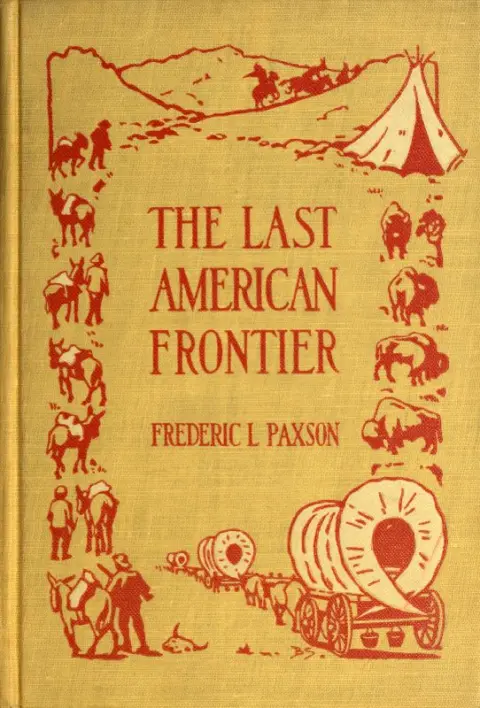
The Last American Frontier
Frederic L. (Frederic Logan) Paxson
THE CLASSIC COLLECTION · 1912
"The New Nation" by Frederic L. Paxson is a historical account written in the early 20th century. The book explores the profound changes that occurred in the United States following the Civil War, addressing the political, economic, and social transformations that shaped the nation during that period. Paxson examines how the nation's identity evolved amidst post-war reconstruction, financial upheaval, and the rise of industrial society, providing insights into the shifting dynamics between state and federal authority. The opening of "The New Nation" discusses the aftermath of the Civil War, emphasizing the complexity of the political landscape and the challenges faced by the United States in maintaining unity and governance. Paxson highlights the rise of the Republican Party and the efforts of leaders like Abraham Lincoln to foster a cohesive national identity while navigating the political turmoil of the time. The text delves into the implications of economic advancements and the changing social fabric, setting the stage for a broader analysis of how these elements defined the American experience in the decades that followed.
Introduction adapted from the source catalogue; source summaries may be automatically generated.
Free to read · English · 87,263 words · No account needed
MAKE TIME FOR A GOOD BOOK
On by default. Untick to stop anonymous reading totals. Each page counts after 10 seconds in view. How this works.
Anonymous counting is on unless you have switched it off.
Railroads, development of, 10, 12, 68, 69, 92, 93;
importance of, 16, 69;
land grants to, 22, 24, 148;
continental, 22, 25, 26, 143, 144, 145;
hostility of the Grange, 68, 70;
rate laws, 71, 72;
agree upon standard time, 148;
encourage immigration and colonization, 148, 149;
regarded as quasi-public, 157, 159;
national control of, 158;
bargaining in rates, 165;
and the Sherman Anti-Trust Law, 173;
promote new settlements, 179;
in the South after the Civil War, 204;
controlled by a few men, 294.
Rainfall, importance of, 150, 179, 180, 182, 186.
Randall, Samuel J., 108, 138.
Rebates, railroad, forbidden by Elkins Law, 296.
Reciprocity, favorite scheme of Blaine, 175.
Reclamation of arid lands of the Southwest, 290, 291, 320.
Reconstruction, an inappropriate name for what took place, 39;
no constitutional theory adequate to meet problems of, 44;
must be judged by results, 44, 45;
completion of, in formal sense, 46;
not far advanced by 1870, 49;
dominant type of leaders, 78;
political superseded by constitutional, 85.
Reconstruction Acts of 1867, the, 43, 45, 47.
Reconstruction Governments, evils of, 50, 51, 61.
Reed, Thomas B., 172, 229, 240.
Referendum and initiative, 249, 250, 333, 334.
Regan, John H., 193.
Reid, Whitelaw, 56, 130.
Republican party, the, during the Civil War, 1, 2;
called itself Union, 4, 32;
paid for its disguise, 32;
in the South after 1876, 54;
new men in control, 78, 79;
regains control of the House (1880), 108;
but loses it again (1882), 117;
dissensions in, 128;
defeated in 1884, 133;
elects President and majority in both houses in 1888, 171;
suffers a landslide (1890), 185, 186;
regains control of Senate and House, (1894), 229;
platform in 1896, 234;
dominates every branch of National Government for fourteen years, 244;
the party of organized business, 252;
approves the Spanish War, 279;
elects Taft President (1908), 324, 325;
revises tariff, 326, 327;
dissatisfaction in, 327, 328;
loses the House (1910), 329;
renominates Taft (1912), 336.
Revels, Hiram R., negro Senator from Mississippi, 47.
River and Harbor Bill, 117.
Rockefeller, John D., gains chief control of petroleum traffic, 165, 166;
aids cause of education in South, 201;
methods of, 310, 321.
Roosevelt, Theodore, 128;
steps out of Blaine campaign, 130;
Assistant Secretary of the Navy, 265, 277;
raises a regiment for Spanish War, 266;
in Cuba, 270;
early public career of, 276;
Governor of New York, 277;
a reformer of a new type, 277;
Vice-President with McKinley, 280;
succeeds to Presidency, 282;
and the Hague Court, 283, 284;
activity in securing Panama Canal, 286, 288;
questionable course toward Colombia, 286, 288;
attitude toward negroes, 289, 290;
widely popular, 291;
disliked by professional politicians, 291;
dissolves Northern Securities Company, 296, 299;
settles coal strike, 300;
alienates party leaders, 302;
wants nomination on his own account, 303;
tries to modify Dingley Tariff, 304;
nominated for President, 305;
and elected, 306;
declares he will not accept another nomination, 307;
goes outside of United States territory, 316-17;
receives the Nobel prize, 317;
promotes second Hague Conference, 318;
sends navy round the world, 319;
holds conference of state governors at White House, 320;
called "Theodore the Meddler," 322;
his policies those of the people, 323;
secures nomination of Taft for Presidency, 324, 325;
goes to Africa, 329;
formulates New Nationalism, 333;
defeated in Republican convention, 336;
nominated by Progressives, 337.
Root, Elihu, becomes Secretary of War, 274, 281;
Secretary of State, 318;
mentioned for Presidency, 324;
presides over Chicago convention, 336.
Rough Riders, the, 266, 270, 277.
"Rum, Romanism, and rebellion," 133.
Rusk, Jeremiah M., 136, 157.
Russia, at war with Japan, 317.
Sackville-West, Sir Lionel, 170.
Salary grab, in Congress, 62.
Salisbury, Lord, in Venezuela case, 230, 231.
Sampson, Capt. William T., in blockade of Cuba, 265, 268, 269, 270, 272.
Your reading position is saved on this browser. Take it to another device with a library code. Reading pages adapt to text, rather than matching a printed edition.
Frederic L. (Frederic Logan) Paxson
BEHIND THE BOOK
This eBook is for the use of anyone anywhere in the United States and most other parts of the world at no cost and with almost no restrictions whatsoever. You may copy it, give it away or re-use it under the terms of the Project Gutenberg License included with this eBook or online at www.gutenberg.org. If you are not located in the United States, you will have to check the laws of the country where you are located before using this eBook. Read the source licence.
The original source file, including credits and licence, is retained by this library. Request an original-format copy at no charge. Please include the book title and Project Gutenberg identifier #27953.
KEEP YOUR CURIOSITY GOING
Cécile Tormay

Moritz Busch
John L. Ransom
Frances Wright
Cécile Tormay

Mabel Potter Daggett