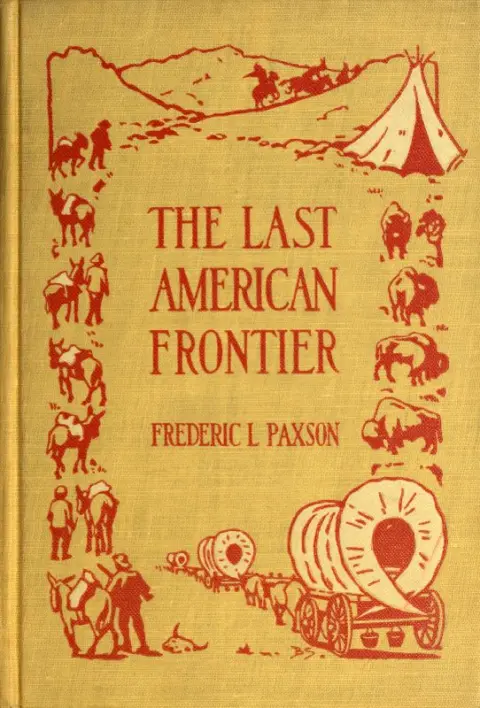
The Last American Frontier
Frederic L. (Frederic Logan) Paxson
THE CLASSIC COLLECTION · 1912
"The New Nation" by Frederic L. Paxson is a historical account written in the early 20th century. The book explores the profound changes that occurred in the United States following the Civil War, addressing the political, economic, and social transformations that shaped the nation during that period. Paxson examines how the nation's identity evolved amidst post-war reconstruction, financial upheaval, and the rise of industrial society, providing insights into the shifting dynamics between state and federal authority. The opening of "The New Nation" discusses the aftermath of the Civil War, emphasizing the complexity of the political landscape and the challenges faced by the United States in maintaining unity and governance. Paxson highlights the rise of the Republican Party and the efforts of leaders like Abraham Lincoln to foster a cohesive national identity while navigating the political turmoil of the time. The text delves into the implications of economic advancements and the changing social fabric, setting the stage for a broader analysis of how these elements defined the American experience in the decades that followed.
Introduction adapted from the source catalogue; source summaries may be automatically generated.
Free to read · English · 87,263 words · No account needed
MAKE TIME FOR A GOOD BOOK
On by default. Untick to stop anonymous reading totals. Each page counts after 10 seconds in view. How this works.
Anonymous counting is on unless you have switched it off.
Schenck, Robert C., 55, 61.
Schley, Commodore Winfield Scott, in blockade of Cuba, 265, 268, 269, 272.
Schurz, Carl, leader of the Liberal Republicans, 56;
introduces merit system, 86;
reorganizes the Indian service, 86, 87;
supports civil service reform, 112, 113;
an anti-imperialist, 278.
Seal fisheries, 212.
Sewall, Arthur, 237.
Seymour, Horatio, 4;
nominated for Presidency, 31;
loyalty above question, 79.
Shafter, Gen. William R., 269, 270.
Sherman, James S., nominated for Vice-Presidency, 325, 336.
Sherman, John, Senator from Ohio, 66;
Secretary of the Treasury, 89;
proposed for the Presidency, 98, 99, 128;
Secretary of State, 253.
Sherman, Gen. William T., 5.
Sherman Anti-Trust Law, the, enacted, 172, 173, 293;
enforced under Roosevelt, 320, 321.
Sherman Silver Purchase Bill, 174, 218, 219, 220.
Silver, fall in value of, 88, 228;
free coinage demanded, 181, 182;
mines, output of, 181;
coinage of, 217;
demonetization of, called a crime, 225.
Sinclair, Upton, 311.
Slater, John F., creates fund for education of negro, 201.
Social Democratic party, 301.
Socialist Labor party, 301, 338.
South, the, before the war, 11, 12;
price of its attempt at independence, 39;
stubbornness of, 40;
decrease in size of farms, 40, 41;
government of, by army, 42;
divided into five military districts, 43;
new constitutions of its States, 46;
readmission to Union, 47, 49;
repudiation of debts, 51;
normal politics Democratic, 52, 54, 79.
See also New South.
South Dakota, admitted to Union, 152;
first State to adopt initiative and referendum, 250.
Southern Pacific Railroad, 145, 148;
passes into control of Union Pacific, 294, 295;
merger dissolved, 330.
Spain, sends Gen. Weyler to Cuba, 260;
embittered against United States by filibustering parties, 261;
changes of Ministry in, 262;
declines mediation, but recalls Gen. Weyler, 263;
establishes a sort of autonomy for Cuba, 263;
war with United States begun, 264;
loses fleet at Manila, 267;
and another at Santiago, 272;
army at Santiago surrenders, 272;
loses Cuba, Porto Rico, the Philippine Islands, and Guam, 273.
Squatters, 21, 155.
Stalwarts, the, support Conkling against Garfield, 103;
claimed as friends by Guiteau, 105;
relations with Arthur, 109, 126.
Standard Oil Company, the, 166, 167;
suit against, brought by Ohio, 168;
history of, 310;
charges of extorting rebates, 311, 312;
dissolved, 330, 331.
Standard time, adopted by American railroads, 148.
Stanford, Leland, 25.
Stanton, Edwin M., 3, 35.
Star route frauds, 103, 104, 105, 113.
Steel industry, the, 16, 297, 298.
Steffens, Lincoln, 310.
Stevens, Thaddeus, 30, 34.
Stevenson, Adlai E., Vice-President with Cleveland, 215;
nominated with Bryan, 279.
Strathcona, Lord, interested in Canadian railways, 148.
Strikes, 121; Pullman, 222;
at Cripple Creek, 222, 301;
at Homestead, 299;
in Pennsylvania coal fields, 299, 300.
Sumner, Charles, 34, 55.
Surplus, embarrassing, 93, 173;
an incentive to extravagance, 116, 136, 138;
easily relieved, 174;
nearly exhausted, 216.
Taft, William II., decision as Circuit Judge against an industrial
combination, 299;
recalled from Philippines to be Secretary of War, 317;
Roosevelt's choice for Presidency, 324;
nominated and elected (1908), 325;
urges tariff revision, 326, 327;
alienates some of the Republican lenders, 327, 328;
in the Pinchot-Ballinger dispute, 328, 329;
pushes anti-trust suits, 330, 331;
extends civil service, 331;
negotiates arbitration treaties with Great Britain and France, 331, 332;
renominated (1912), 336;
badly defeated, 338.
Tanner, James ("Corporal"), 172.
Tarbell, Ida M., writes history of Standard Oil Company, 309, 310.
Your reading position is saved on this browser. Take it to another device with a library code. Reading pages adapt to text, rather than matching a printed edition.
Frederic L. (Frederic Logan) Paxson
BEHIND THE BOOK
This eBook is for the use of anyone anywhere in the United States and most other parts of the world at no cost and with almost no restrictions whatsoever. You may copy it, give it away or re-use it under the terms of the Project Gutenberg License included with this eBook or online at www.gutenberg.org. If you are not located in the United States, you will have to check the laws of the country where you are located before using this eBook. Read the source licence.
The original source file, including credits and licence, is retained by this library. Request an original-format copy at no charge. Please include the book title and Project Gutenberg identifier #27953.
KEEP YOUR CURIOSITY GOING
Cécile Tormay

Moritz Busch
John L. Ransom
Frances Wright
Cécile Tormay

Mabel Potter Daggett