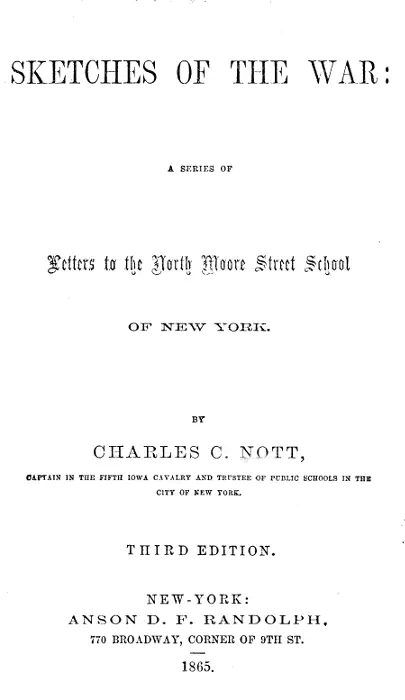
Sketches of the War A Series of Letters to the North Moore Street School of New York
Charles C. Nott
THE CLASSIC COLLECTION · 1908
"The Mystery of the Pinckney Draught" by Charles C. Nott is a historical account written in the early 20th century. The book explores the enigmatic contribution of Charles Pinckney, a lesser-known figure in the creation of the U.S. Constitution, focusing on his draught presented at the Constitutional Convention. It delves into the controversies surrounding the authenticity of the draught and its influence on the final Constitution, raising questions about authorship and credit in the founding documents of the United States. At the start of the narrative, the author introduces the central topic by recounting the historical context of Pinckney's draught, which he presented during the Convention but received little acknowledgment from contemporary observers. Nott discusses how the original records were sealed upon the Convention's conclusion, leading to a mysterious absence of the draught for decades. Eventually, intrigue surrounding the document emerges when John Quincy Adams seeks it nearly thirty years later. The initial chapters examine documents from the time and outline the key players, including James Madison, whose views and criticisms of Pinckney's work provide a nuanced perspective on the value and legacy of the draught in the broader historical narrative of American governance.
Introduction adapted from the source catalogue; source summaries may be automatically generated.
Free to read · English · 60,558 words · No account needed
MAKE TIME FOR A GOOD BOOK
On by default. Untick to stop anonymous reading totals. Each page counts after 10 seconds in view. How this works.
Anonymous counting is on unless you have switched it off.
New York, the Constitution of,
Furnishes the veto power, p. 47, 48
Furnishes other provisions, p. 83, 84, 216, 218, 250
New York and Massachusetts alone pay in full their quota, p. 249
Notes and Memoranda
Of Pinckney and Madison, p. 11
"Note" of Madison to plan of Pinckney, p. 58
Editorial footnote to same, p. 62, 63
Observations, The Pamphlet.
Cited by Madison, p. 33, 34, 43, 46, 50, 62
Cited by Pinckney, p. 90
When written, p. 93, 130
Description of, p. 105
Madison interest in, p. 107
Extracts from, p. 111
The Observations, a speech never made, p. 122, 126, 139
Madison and Yates evidence, p. 122
Contradictions in it, p. 126
Significant error in date, p. 127
Considered as a speech, p. 131
Considered as evidence, p. 132
Confirm Articles III, V, VIII, p. 132, 135
Explanation of Pinckney's publication, p. 135
Why speech was not delivered, p. 137
Why published, p. 138
Why Observations were not cited in Madison's "Note," p. 140
The Observations fateful, p. 141
They sustain the copy in the State department, p. 139
Articles in the draught described in the Observations cannot be
questioned, p. 182, 189, 198, 253, 269, 270
Article 11 referred to by Randolph described in the Observations, p. 198
Patents. See Copyright.
Paulding, James Kirke.
Memorandum for, p. 34, 42, 107
Letters to, p. 43, 108
Friend of Madison, p. 44, 45
Phenomenon, The, of Madison, p. 46, 53, 80
Pinckney, Charles.
His official life, p. 23
His age, p. 88
Why he presented the Observations, p. 135
His strategic purpose, p. 137
Why he published the Observations, p. 138, 142
Desired the supremacy of the national government, p. 181, 279
He alone formulated a constitution before the convention met, p. 189
His misplacement of the veto power, p. 183
The style of the Constitution, p. 243, 245
His draught the only one, p. 249
His method of construction, p. 250
His composite work, p. 250, 251, 252
His generality of treatment and expression, p. 253
A condemned and misrepresented man, p. 254
His training and preparation, p. 261, 264
What he did and failed to o, p. 261
His co-operation with Madison, p. 264, 265, 267
His family, position, etc., p. 278
His speech of June 25, p. 278
The extremist federalist in the convention, p. 279
Pierce's description and estimate of him, p. 281, 284
The destruction of everything which Pinckney possessed, p. 285
Pinckney, Charles Cotesworth,
Opposes election by the people, p. 88
Proposes that no salary be allowed to Senators, p. 176
Living in 1818, p. 24
The most esteemed citizen in S. C., p. 88
Pinckney's Letters
To Secretary of State, p. 8, 12, 26, 27
Contemporary declaration, p. 10
Letter to Madison, p. 62
Pierce, William.
His narrative of a lost paper in the convention, p. 230
His description of Randolph, King, Hamilton and Pinckney, p. 281
Preamble of the Constitution.
Suggested by the Articles of Confederation, p. 169.
Derived from Constitution of Massachusetts, p. 169
Randolph attempted draught of preamble, p. 162
Wilson attempted draught of preamble, p. 166
The preamble in the committee's draught, p. 168
It declared the source and supremacy of authority, p. 213
Ignored State governments, p. 213
The preamble unquestioned in the convention, p. 215
President, The.
See Election of.
Your reading position is saved on this browser. Take it to another device with a library code. Reading pages adapt to text, rather than matching a printed edition.
BEHIND THE BOOK
This eBook is for the use of anyone anywhere in the United States and most other parts of the world at no cost and with almost no restrictions whatsoever. You may copy it, give it away or re-use it under the terms of the Project Gutenberg License included with this eBook or online at www.gutenberg.org. If you are not located in the United States, you will have to check the laws of the country where you are located before using this eBook. Read the source licence.
The original source file, including credits and licence, is retained by this library. Request an original-format copy at no charge. Please include the book title and Project Gutenberg identifier #40904.
KEEP YOUR CURIOSITY GOING
Cécile Tormay

Moritz Busch
John L. Ransom
Frances Wright
Cécile Tormay

Mabel Potter Daggett