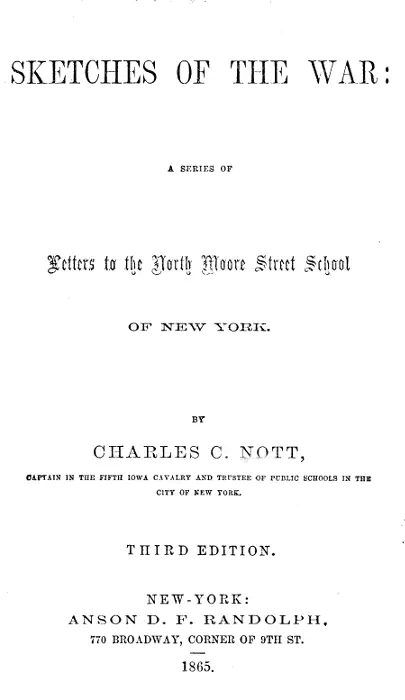
Sketches of the War A Series of Letters to the North Moore Street School of New York
Charles C. Nott
THE CLASSIC COLLECTION · 1908
"The Mystery of the Pinckney Draught" by Charles C. Nott is a historical account written in the early 20th century. The book explores the enigmatic contribution of Charles Pinckney, a lesser-known figure in the creation of the U.S. Constitution, focusing on his draught presented at the Constitutional Convention. It delves into the controversies surrounding the authenticity of the draught and its influence on the final Constitution, raising questions about authorship and credit in the founding documents of the United States. At the start of the narrative, the author introduces the central topic by recounting the historical context of Pinckney's draught, which he presented during the Convention but received little acknowledgment from contemporary observers. Nott discusses how the original records were sealed upon the Convention's conclusion, leading to a mysterious absence of the draught for decades. Eventually, intrigue surrounding the document emerges when John Quincy Adams seeks it nearly thirty years later. The initial chapters examine documents from the time and outline the key players, including James Madison, whose views and criticisms of Pinckney's work provide a nuanced perspective on the value and legacy of the draught in the broader historical narrative of American governance.
Introduction adapted from the source catalogue; source summaries may be automatically generated.
Free to read · English · 60,558 words · No account needed
MAKE TIME FOR A GOOD BOOK
On by default. Untick to stop anonymous reading totals. Each page counts after 10 seconds in view. How this works.
Anonymous counting is on unless you have switched it off.
Printers--Copy.
Pinckney draught used as printers' copy. p. 188, 208, 237
Randolph, Edmund.
The Virginia resolutions cited as his, p. 68
Opens the main business of the convention, p. 130, 136
His draught of the Constitution, p. 158, 161
Read, George.
Letter to Dickinson on Pinckney's draught, p. 89
Ritchie, Thomas.
Madison's letter to, p. 63
Rutledge, John.
Present in the convention, May 29, p. 135
Seconds Pinckney motion to strike out the word people and
insert Legislatures, p. 95
Chairman of the Committee of Detail, p. 75
"Delivers in" the report of the committee, p. 70
His annotations on the other draughts, p. 162, 164, 182
He co-operates with Wilson and Randolph, p. 164
Used Pinckney draught when annotating, p. 182
His ruthless slashing of Wilson's, p. 161
His 43 amendments, p. 161, 204
Strongest man in the State, p. 88
Secrecy. The resolution of the convention, p. 228 Secrecy to continue after the dissolution of the convention, p. 228 Silence of members from May 29 to September 17, p. 229 Washington recognition of the obligation, p. 229 The obligation required that the draught be not lost, p. 232 Pinckney draught used as printers' copy and scrupulously destroyed, p. 237 Legal presumption that it was destroyed, p. 237 Secrecy of Committee of Detail, p. 75, 200, 237
Senate.
Pinckney's Senate, p. 91, 217
To appoint ambassadors and judges, p. 102
South Carolina.
The State postpones action in the convention, p. 175
South Carolina Gazette.
Draught republished in, p. 274
Sparks, Jared.
Writes to Madison, p. 42, 43, 144, 146, 147, 149
Madison to Sparks, p. 35, 42, 43, 110
His opinion of the draught, 148, 152
His correct analysis, p. 152
His most delicate test, p. 153
Story, Mr. Justice.
Ignores the Draught, p. 6, 8, 12
"Supreme Law of the Land."
History of the term. p. 179.
The case of Trevatt v. Weeden gives judicial significance to it, p. 182
Derived from resolution of Congress, p. 251
Thomson, Doctor William H.
Definition of mystery, p. 2
Time.
The second condition imposed on the committee, p. 232
Two of these days were Sundays, p. 233
Three days required for printing, p. 234
200 constitutional provisions framed and printed within
the limited time, p. 234
Treason.
The punishment of treason, p. 185
How defined, etc., in the three draughts, p. 186
Caution of Rutledge and Pinckney, p. 186
Their provisions combined in the Constitution, p. 187
The Treaty Making Power.
Lodged in the Senate exclusively, p. 210
Not authorized by the convention, p. 211
Committee of detail followed Pinckney erroneously, p. 211
Veto Power, The.
Taken from the constitution of New York, p. 47
Misplaced by Pinckney and by the committee, p. 183, 220
Correctly placed by Wilson, p. 183
Your reading position is saved on this browser. Take it to another device with a library code. Reading pages adapt to text, rather than matching a printed edition.
BEHIND THE BOOK
This eBook is for the use of anyone anywhere in the United States and most other parts of the world at no cost and with almost no restrictions whatsoever. You may copy it, give it away or re-use it under the terms of the Project Gutenberg License included with this eBook or online at www.gutenberg.org. If you are not located in the United States, you will have to check the laws of the country where you are located before using this eBook. Read the source licence.
The original source file, including credits and licence, is retained by this library. Request an original-format copy at no charge. Please include the book title and Project Gutenberg identifier #40904.
KEEP YOUR CURIOSITY GOING
Cécile Tormay

Moritz Busch
John L. Ransom
Frances Wright
Cécile Tormay

Mabel Potter Daggett