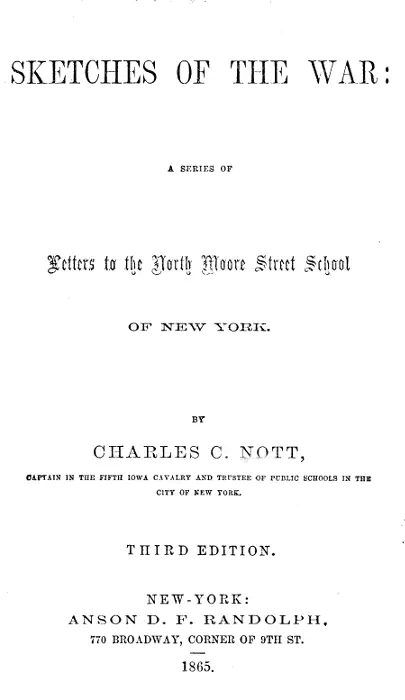
Sketches of the War A Series of Letters to the North Moore Street School of New York
Charles C. Nott
THE CLASSIC COLLECTION · 1908
"The Mystery of the Pinckney Draught" by Charles C. Nott is a historical account written in the early 20th century. The book explores the enigmatic contribution of Charles Pinckney, a lesser-known figure in the creation of the U.S. Constitution, focusing on his draught presented at the Constitutional Convention. It delves into the controversies surrounding the authenticity of the draught and its influence on the final Constitution, raising questions about authorship and credit in the founding documents of the United States. At the start of the narrative, the author introduces the central topic by recounting the historical context of Pinckney's draught, which he presented during the Convention but received little acknowledgment from contemporary observers. Nott discusses how the original records were sealed upon the Convention's conclusion, leading to a mysterious absence of the draught for decades. Eventually, intrigue surrounding the document emerges when John Quincy Adams seeks it nearly thirty years later. The initial chapters examine documents from the time and outline the key players, including James Madison, whose views and criticisms of Pinckney's work provide a nuanced perspective on the value and legacy of the draught in the broader historical narrative of American governance.
Introduction adapted from the source catalogue; source summaries may be automatically generated.
Free to read · English · 60,558 words · No account needed
MAKE TIME FOR A GOOD BOOK
On by default. Untick to stop anonymous reading totals. Each page counts after 10 seconds in view. How this works.
Anonymous counting is on unless you have switched it off.
Journal, The, of Madison.
Its completeness, p. 40
Omission of Pinckney's draught, p. 40
Publication of, p. 52, 63
His best appreciated work, p. 40
To be edited by Mrs. Madison, p. 63
Edited by Henry D. Gilpin, p. 5, 29
Madison method of writing, p. 122
Is the journal evidence against Pinckney, p. 275
It must be received as history, p. 277
King, Rufus.
Mr. Adams' conversation with King, p. 145
King considered as a witness, p. 146
Pierce's description of King, p. 282
Knox, General Henry.
Washington's letter to him, p. 128
Law of the Land.
See Supreme Law of the Land.
Library company of Philadelphia.
Order to the librarian directing him to "furnish the gentlemen" of the
convention with books, p. 240
McLaughlin, Professor,
Discovers a draught of Wilson, p. 158
Discovers report in confederated congress, August, 1786, "written in
Pinckney's own hand," p. 260
Madison, President.
His troubled life, p. 54
His failing memory, p. 52, 54, 81
His only alternative, p. 38
His age, p. 53, 54
His failure to testify, p. 38
His ignorance of the draught, p. 30, 38, 40, 53
His "Note" to the "Plan," p. 58
His "editorial footnote" to the "Note," p. 62, 63
His charges against the draught, p. 63
His objections to Pinckney's draught, p. 5, 6, 7, 43, 45, 46
His poor opinion of Pinckney, p. 32, 53
Most diligent member of convention, p. 80
His letters, p. 33, 34, 35, 36, 42, 43, 45, 54, 63, 107, 108, 109, 110,
129, 214
His comparison of the draught with the Constitution, p. 143, 156, 157
His silence on the primary issue, p. 156
His adroit management, p. 43, 157
Madison on the "object of the Union," p. 214
His and Pinckney's the constructive minds of the convention, p. 264
They agreed as to State legislation, p. 265, 267
They did not attempt to frame a compromise, p. 266
The work of one agrees with the work of the other, p. 267
Their names should be closely associated, p. 268
Madison's Journal. See Journal.
Mrs. Madison
Her rescue of Washington's portrait, p. 56
Intended editor of the Journal, p. 63
Marshall, Chief Justice.
Moulded the Constitution, p. 27
His majestic judicial reign, p. 37
Martin Luther.
His resolution relating to the "Supreme law of the respective States," p. 179
His language a compromise, p. 181
Massachusetts
Constitution furnishes provisions for Pinckney's draught, p. 83, 84, 250
Massachusetts and New York alone paid in full their quota, p. 249 Preamble of the Constitution derived from constitution of Massachusetts, p. 169 The word "posterity" unrestricted, p. 170
Meigs, William M.
His "Growth of the Constitution," p. 161
Reproduces the Randolph draught in facsimile, p. 161
Growth of the Constitution
cited and quoted, p. 189, 192
Militia, The.
Pinckney's draught a radical departure, p. 188
Not authorized by the convention, p. 188
Pinckney's draught followed by Wilson rejected by the committee, p. 189
Money Bills.
Madison refers to them, p. 99
Pinckney's position regarding them, p. 100
Morris, Gouverneur.
His correction of the language of the Constitution, p. 78
Mystery.
The name, p. 1
Its definition, p. 2
Your reading position is saved on this browser. Take it to another device with a library code. Reading pages adapt to text, rather than matching a printed edition.
BEHIND THE BOOK
This eBook is for the use of anyone anywhere in the United States and most other parts of the world at no cost and with almost no restrictions whatsoever. You may copy it, give it away or re-use it under the terms of the Project Gutenberg License included with this eBook or online at www.gutenberg.org. If you are not located in the United States, you will have to check the laws of the country where you are located before using this eBook. Read the source licence.
The original source file, including credits and licence, is retained by this library. Request an original-format copy at no charge. Please include the book title and Project Gutenberg identifier #40904.
KEEP YOUR CURIOSITY GOING
Cécile Tormay

Moritz Busch
John L. Ransom
Frances Wright
Cécile Tormay

Mabel Potter Daggett