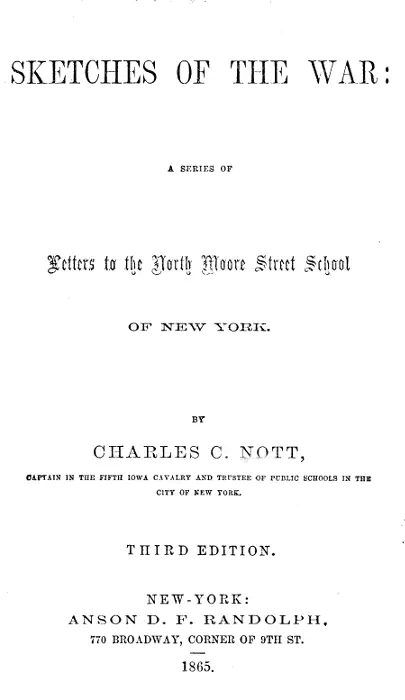
Sketches of the War A Series of Letters to the North Moore Street School of New York
Charles C. Nott
THE CLASSIC COLLECTION · 1908
"The Mystery of the Pinckney Draught" by Charles C. Nott is a historical account written in the early 20th century. The book explores the enigmatic contribution of Charles Pinckney, a lesser-known figure in the creation of the U.S. Constitution, focusing on his draught presented at the Constitutional Convention. It delves into the controversies surrounding the authenticity of the draught and its influence on the final Constitution, raising questions about authorship and credit in the founding documents of the United States. At the start of the narrative, the author introduces the central topic by recounting the historical context of Pinckney's draught, which he presented during the Convention but received little acknowledgment from contemporary observers. Nott discusses how the original records were sealed upon the Convention's conclusion, leading to a mysterious absence of the draught for decades. Eventually, intrigue surrounding the document emerges when John Quincy Adams seeks it nearly thirty years later. The initial chapters examine documents from the time and outline the key players, including James Madison, whose views and criticisms of Pinckney's work provide a nuanced perspective on the value and legacy of the draught in the broader historical narrative of American governance.
Introduction adapted from the source catalogue; source summaries may be automatically generated.
Free to read · English · 60,558 words · No account needed
MAKE TIME FOR A GOOD BOOK
On by default. Untick to stop anonymous reading totals. Each page counts after 10 seconds in view. How this works.
Anonymous counting is on unless you have switched it off.
Draught, rough.
What it is, p. 20
Pinckney's not a rough draught, p. 10, 11
Wilson's rough draught, p. 166
Duer, William A.
Madison's letter to, p. 36, 45
His position in New York, p. 45
Election of Representatives
By the people, p. 9, 85, 91, 93, 94, 95, 97
Pinckney's change of mind, p. 85, 87, 94, 96
Agreement of Articles III and V with Observations, p. 90, 93
Vote of convention, p. 95
Election of the President.
Madison's strictures on the draught, p. 60
Article VIII does not provide a method, p. 97
The omission not remarkable, p. 98
Choosing by the electoral colleges, p. 77, 133
Observations sustain Article VIII, p. 134
Eligibility of Representatives, etc.
Pinckney on the question, p. 101, 103
Elliott, W. S.
A grandnephew of Pinckney, p. 288
His sketch of Pinckney's life and home; of his library, picture gallery
and garden, p. 288
Ellsworth, Oliver
Did not draught a constitution, p. 165
Contributed nothing to draught of the committee, p. 165
Estoppel.
Characterized by Coke, p. 132
Does not extend to historical students, p. 132
Federalists.
Hamilton and Pinckney were, p. 279
Pinckney the most extreme federalist in the convention, p. 279
Ford, Worthington C.
Publishes Pinckney's letter, p. 5
Framers of the Constitution.
Two of the youngest and their work, p. 264
Franklin, Doctor.
His farewell words to the convention, p. 70
Fraud and Plagiarism.
The question of inexorable, p. 21
Detection probable, p. 24
Temptation small, p. 25
The absence of motive, p. 27, 28
Specifications of plagiarisms, p. 78
Failure of specified charges, p. 79
Not sustained by evidence, p. 275
The charge reduced to an absurdity, p. 195
Gerry of Massachusetts
Opposes election by the people, p. 87
Gilpin, Henry D.
Edits Madison's Journal, p. 5, 29
Gorham of Massachusetts.
A member of the committee of detail, p. 75
Did not attempt to draught a constitution, p. 165
Grimke, Thomas S.
Madison's letter to, p. 35
Habeas Corpus.
The writ of, not to be suspended is in the draught, p. 269
Why the committee did not adopt, p. 270
Hamilton, Alexander.
"Those who pay are the masters," p. 174
His not the style of the Constitution, p. 243
Pierce's description of Hamilton, p. 283
Historical Questions.
Concerning the draught in the State Department, p. 12
Historical Society of N. Y.
Possesses Pinckney's Observations, p. 105
Referred to by Madison, p. 110
Hunt, Gaillard.
Description of the draught, p. 18
Immigration.
Expected and relied upon, p. 170
Massachusetts constitution encourages, p. 169
Impeachment.
In Pinckney draught, p. 211
In the committee draught, p. 211
Jackson, Major Wm.
Elected secretary of the convention, p. 129
His notes on draught, p. 74, 75
His letter to Washington, p. 239
Delivers papers of the convention to Washington, p. 239, 241
Jameson, Professor, J. Franklin.
He discovers two of the Wilson draughts, p. 159, 160
Jay, Chief Justice.
His hand appears in the constitution of New York, p. 243
Jefferson, President.
Madison's letter to, p. 33, 129
Jews.
"The people called Jews" address the convention, p. 241
Your reading position is saved on this browser. Take it to another device with a library code. Reading pages adapt to text, rather than matching a printed edition.
BEHIND THE BOOK
This eBook is for the use of anyone anywhere in the United States and most other parts of the world at no cost and with almost no restrictions whatsoever. You may copy it, give it away or re-use it under the terms of the Project Gutenberg License included with this eBook or online at www.gutenberg.org. If you are not located in the United States, you will have to check the laws of the country where you are located before using this eBook. Read the source licence.
The original source file, including credits and licence, is retained by this library. Request an original-format copy at no charge. Please include the book title and Project Gutenberg identifier #40904.
KEEP YOUR CURIOSITY GOING
Cécile Tormay

Moritz Busch
John L. Ransom
Frances Wright
Cécile Tormay

Mabel Potter Daggett