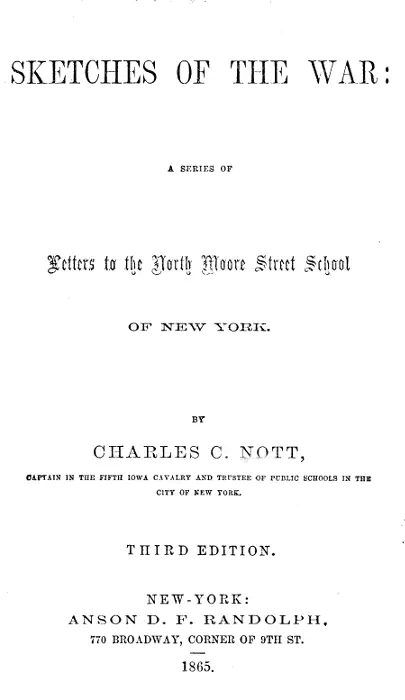
Sketches of the War A Series of Letters to the North Moore Street School of New York
Charles C. Nott
THE CLASSIC COLLECTION · 1908
"The Mystery of the Pinckney Draught" by Charles C. Nott is a historical account written in the early 20th century. The book explores the enigmatic contribution of Charles Pinckney, a lesser-known figure in the creation of the U.S. Constitution, focusing on his draught presented at the Constitutional Convention. It delves into the controversies surrounding the authenticity of the draught and its influence on the final Constitution, raising questions about authorship and credit in the founding documents of the United States. At the start of the narrative, the author introduces the central topic by recounting the historical context of Pinckney's draught, which he presented during the Convention but received little acknowledgment from contemporary observers. Nott discusses how the original records were sealed upon the Convention's conclusion, leading to a mysterious absence of the draught for decades. Eventually, intrigue surrounding the document emerges when John Quincy Adams seeks it nearly thirty years later. The initial chapters examine documents from the time and outline the key players, including James Madison, whose views and criticisms of Pinckney's work provide a nuanced perspective on the value and legacy of the draught in the broader historical narrative of American governance.
Introduction adapted from the source catalogue; source summaries may be automatically generated.
Free to read · English · 60,558 words · No account needed
MAKE TIME FOR A GOOD BOOK
On by default. Untick to stop anonymous reading totals. Each page counts after 10 seconds in view. How this works.
Anonymous counting is on unless you have switched it off.
Constitution, The.
Its four germinal stages, p. 66
Methods for consideration of, p. 67, 68
Birth of, p. 71
References to Committees, p. 69, 70, 78
The work of the Committee of Style, p. 78
Estimate of in 1818, p. 25, 27
Convention, The.
Surviving members of, p. 24, 202
Philosophical methods of, p. 67
First days of the, p. 128, 129, 130
The first business day, p. 135
The secrecy of the convention, p. 227, 229, 232, 237
A lost paper, p. 230
Its careful preservation of papers, p. 287
Copyright and Patents.
Not in the Department copy of the draught, p. 271
But Pinckney the author of those constitutional provisions, p. 271
Copyright cases, p. 206
Council of Revision.
Considered, p. 46, 47, 50, 51
Pinckney's action regarding it, p. 50
Delicate.
The word as used by Madison, p. 36
Draught of Committee of Detail.
Reported by committee, p. 70
Description of, p. 71, 72, 234
Washington's copy of, p. 74
The notes by Major Jackson, p. 74
Agreement with Pinckney's draught, p. 79, 81, 255, 273
The "divide" in the march of the framers, p. 76
The compromises subsequent to the draught, p. 77
Sparks' analysis of it, p. 149
Sparks' test, p. 153, 156
Madison's non-reply to Sparks, p. 155, 156
The misplacing of veto power, p. 183, 220
The treason provisions, p. 185, 221
The Supreme Court jurisdiction clause, p. 191
The draught not yet written, p. 203
The preamble taken from Pinckney, p. 214
How the committee followed Pinckney, p. 215
The committee overrule Wilson, p. 222
Limit of time for preparing, p. 232, 235, 248
Engrossed on Pinckney's as copy for printer, p. 236, 241
"Delivered in" figuratively, p. 236
The most important document of the convention, p. 226
Printing of the draught, p. 233
The real authors of the draught, p. 165
Draught of Pinckney
Presented to the convention, p. 429
Lost, p. 4, 224
The Department copy, p. 4
Description of, p. 16
Madison's Note to the, p. 58
When written, p. 86
The term, "The law of the land," p. 179
Provisions described in the Observations, p. 182
The misplacing of the veto power, p. 183, 220
The militia, p. 188
Randolph recognizes and uses, Art 11, p. 196
Article 11 described in the Observations, p. 198
Publicity attending Pinckney's draught, p. 201, 274
Used as printers' copy and destroyed, p. 236
Never discussed in convention, p. 257
Exaggerated value set upon it, p. 258
Provisions not adopted by the committee, p. 268
Provisions not in the Department case, p. 271
Provisions rejected, p. 263
Its inferiority in detail to the committee's, p. 153
Draught of Randolph.
Description of, p. 161
The annotations of Rutledge, p. 164
Compensation of Senators, p. 163
The joint work of Randolph and Rutledge, p. 165
A disheveled draught, p. 190
Jurisdiction of the Supreme Court in, p. 191
Recognizes and uses Pinckney's Art. 11, p. 196
Draughts of Wilson.
His three draughts, p. 160
Description of his 3d, p. 161
The annotations of Rutledge, p. 161
Wilson's preamble, p. 166,
Charges against Pinckney, p. 168
The word "our," p. 169, 171
Articles which are not Wilson's, p. 182
The proper placing of the veto power, p. 183, 220
The treason provisions, p. 185, 221
The militia provisions, p. 188
Your reading position is saved on this browser. Take it to another device with a library code. Reading pages adapt to text, rather than matching a printed edition.
BEHIND THE BOOK
This eBook is for the use of anyone anywhere in the United States and most other parts of the world at no cost and with almost no restrictions whatsoever. You may copy it, give it away or re-use it under the terms of the Project Gutenberg License included with this eBook or online at www.gutenberg.org. If you are not located in the United States, you will have to check the laws of the country where you are located before using this eBook. Read the source licence.
The original source file, including credits and licence, is retained by this library. Request an original-format copy at no charge. Please include the book title and Project Gutenberg identifier #40904.
KEEP YOUR CURIOSITY GOING
Cécile Tormay

Moritz Busch
John L. Ransom
Frances Wright
Cécile Tormay

Mabel Potter Daggett