Mississippi Outlaws and the Detectives Don Pedro and the Detectives; Poisoner and the Detectives
Allan Pinkerton
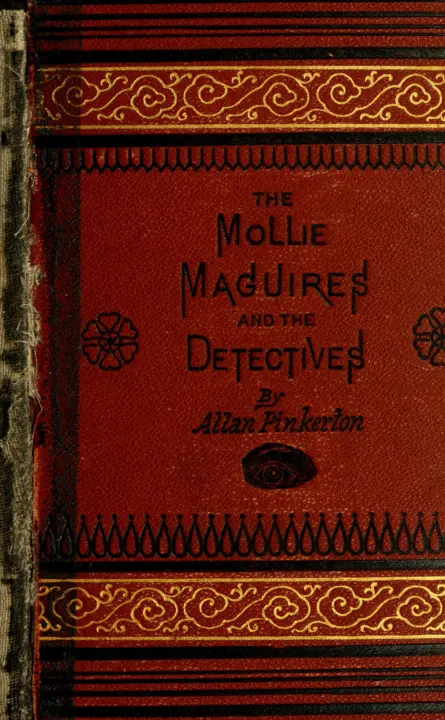
THE CLASSIC COLLECTION · 1877
"The Molly Maguires and the detectives" by Allan Pinkerton is a nonfiction investigative account written in the late 19th century. It chronicles Pinkerton’s covert campaign against the secretive Molly Maguires in Pennsylvania’s anthracite coal region, undertaken at the request of railroad executive Franklin B. Gowen, and follows undercover operative James McParlan (alias James McKenna) as he works to infiltrate the organization amid labor strife, violence, and political intrigue. The opening of the book sets Pinkerton’s pledge to tell a factual, unvarnished story of the coal fields and a violent secret society that, he argues, has evaded justice. Gowen solicits Pinkerton to penetrate the Mollies, whose alibis, intimidation, and sway over local politics have thwarted prosecutions, and Pinkerton accepts with strict conditions of secrecy and a plan to embed an Irish Catholic operative. Pinkerton then selects James McParlan, sketches his background and disguise, and launches him under the alias “James McKenna.” McKenna begins by tramping through towns like Port Clinton, Schuylkillhaven, Tremont, Tower City, and Minersville, posing as a job-seeking laborer while building contacts: he’s refused lodging by a drunken landlord, sheltered by an Irish family (with a comic drunk blocking a door), and quietly probes opinions by discussing scathing newspaper pieces on the Mollies with men like the switchman Fitzgibbons. He cultivates leads through saloon talk (including a former member’s hints that Mahanoy City is fertile ground), descends into a working mine to learn the setting, endures a snowbound stage ride and shabby lodging, and finally settles into a modest boarding house, using evenings in bars and card rooms to deepen his cover and map the society’s haunts.
Introduction adapted from the source catalogue; source summaries may be automatically generated.
Free to read · English · 181,288 words · No account needed
MAKE TIME FOR A GOOD BOOK
On by default. Untick to stop anonymous reading totals. Each page counts after 10 seconds in view. How this works.
Anonymous counting is on unless you have switched it off.
Now the Mollies having Gomer James dead and buried and out of their way, it was believed by some bloodshed would cease. But the attentive reader will have arrived at the conclusion that the end was not yet. For my own part, I must confess to having experienced occasional periods of disappointment. Here had I been, using my best efforts, seconded by the most effective help the Company could furnish, and notwithstanding our united action, despite the fact that we daily knew much of the order, assassinations were not being entirely prevented. This midnight society, to guard against surprise or capture, had its committees within committees, or, in other words, its secret affairs were seldom given to the general members, but were kept in charge of the leading officers and prominent personages. Hence, very few of the Mollies in Shenandoah were officially aware of the fact that Gomer James was to be put out of the way. McAndrew, Hurley, Morris, Munley, Monaghan, McKenna, and a few more knew it, and kept it to themselves—excepting the detective who reported it—as those in Tamaqua and Summit Hill retained among a few leading spirits the facts connected with the murder of Yost and the preparations for cutting off John P. Jones. But Jones was notified by Mr. Franklin, a guard of men put in his house, and the boss instructed to seek some other route, by which to reach his work, than the pipe-line. For a while he maintained a measure of caution, but not during many weeks; it became an old story. Danger, as he thought, had been overestimated. Carelessness and the resumption of his former habits quickly followed this conclusion.
The convention, appointed for the twenty-fifth of August, occurred at Carroll’s house, the members occupying three chambers in the upper part of the building. Among those convened on this interesting occasion were Jack Kehoe, County Delegate; Wm. Gavin, County Secretary; Christopher Donnelly, County Treasurer; Jerry Kane, of Mt. Laffee; Francis Keenan, of Forestville; Frank O’Neill, of St Clair; James Roarty, of Coaldale; John Donahue—“Yellow Jack”—of Tuscarora, and Michael O’Brien, of Mahanoy City. Tom Hurley and John Morris, of Shenandoah, were in one of the rooms for a few minutes. Many outsiders seemed to be in the city and in the building, but the parties mentioned transacted all the business of the meeting. Pat Butler was on hand, but not as a legal part of the convention’s committee—only as a sort of witness. During the session of the lesser body, which was devoted principally to hearing grievances, expelling and readmitting members, Tom Hurley came forward and made known that to him, and to no one else, was the society indebted for the killing of Gomer James. Modesty, it appears, was far from a prominent point in Hurley’s character. At least, on this day, he not only boasted much of his peculiar service, but put before the order, with no circumlocution or evasion, a direct and open claim to a money reward for putting out of the way the murderer of Cosgrove. He thought he was entitled to a large sum for his success. James McKenna, the detective, acting as Secretary of the committee before which Hurley’s demand was made, was obliged to receive it, but Pat Butler, of Loss Creek, presented himself before the same committee with the verbal demand of one McClain, of his division, who asserted that he, and not Hurley, had been the marksman who brought down the young Welshman. When Kehoe heard of the difference, he ordered Pat Butler and James McKenna to act as arbiters and to settle the difference by holding an investigation and reporting a decision, in writing, at a subsequent date, directing to him at his home in Girardville. They accepted the duty and appointed the succeeding Sabbath for the appearance, in Shenandoah, of the two men and their witnesses, when the case should be heard and adjusted according to its real merits. Kehoe would make no movement toward rewarding the man, who, he was free to say, deserved a fair recompense, until this trial had been concluded. Friends of Hurley were satisfied, they urged, that a dozen persons could swear Tom did the shooting. Every confidence was expressed that the blood-money would go to him and to no other person.
Your reading position is saved on this browser. Take it to another device with a library code. Reading pages adapt to text, rather than matching a printed edition.
Allan Pinkerton
Allan Pinkerton
Allan Pinkerton
Allan Pinkerton
BEHIND THE BOOK
This eBook is for the use of anyone anywhere in the United States and most other parts of the world at no cost and with almost no restrictions whatsoever. You may copy it, give it away or re-use it under the terms of the Project Gutenberg License included with this eBook or online at www.gutenberg.org. If you are not located in the United States, you will have to check the laws of the country where you are located before using this eBook. Read the source licence.
The original source file, including credits and licence, is retained by this library. Request an original-format copy at no charge. Please include the book title and Project Gutenberg identifier #76641.
KEEP YOUR CURIOSITY GOING
Cécile Tormay

Moritz Busch
John L. Ransom
Frances Wright
Cécile Tormay

Mabel Potter Daggett