
Mississippi Outlaws and the Detectives Don Pedro and the Detectives; Poisoner and the Detectives
Allan Pinkerton
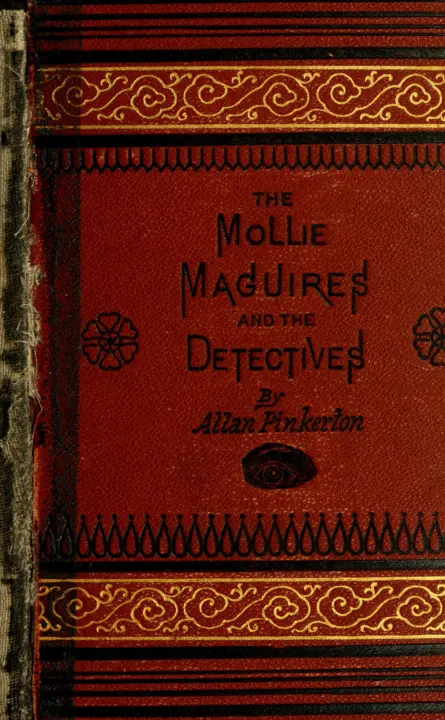
THE CLASSIC COLLECTION · 1877
"The Molly Maguires and the detectives" by Allan Pinkerton is a nonfiction investigative account written in the late 19th century. It chronicles Pinkerton’s covert campaign against the secretive Molly Maguires in Pennsylvania’s anthracite coal region, undertaken at the request of railroad executive Franklin B. Gowen, and follows undercover operative James McParlan (alias James McKenna) as he works to infiltrate the organization amid labor strife, violence, and political intrigue. The opening of the book sets Pinkerton’s pledge to tell a factual, unvarnished story of the coal fields and a violent secret society that, he argues, has evaded justice. Gowen solicits Pinkerton to penetrate the Mollies, whose alibis, intimidation, and sway over local politics have thwarted prosecutions, and Pinkerton accepts with strict conditions of secrecy and a plan to embed an Irish Catholic operative. Pinkerton then selects James McParlan, sketches his background and disguise, and launches him under the alias “James McKenna.” McKenna begins by tramping through towns like Port Clinton, Schuylkillhaven, Tremont, Tower City, and Minersville, posing as a job-seeking laborer while building contacts: he’s refused lodging by a drunken landlord, sheltered by an Irish family (with a comic drunk blocking a door), and quietly probes opinions by discussing scathing newspaper pieces on the Mollies with men like the switchman Fitzgibbons. He cultivates leads through saloon talk (including a former member’s hints that Mahanoy City is fertile ground), descends into a working mine to learn the setting, endures a snowbound stage ride and shabby lodging, and finally settles into a modest boarding house, using evenings in bars and card rooms to deepen his cover and map the society’s haunts.
Introduction adapted from the source catalogue; source summaries may be automatically generated.
Free to read · English · 181,288 words · No account needed
MAKE TIME FOR A GOOD BOOK
On by default. Untick to stop anonymous reading totals. Each page counts after 10 seconds in view. How this works.
Anonymous counting is on unless you have switched it off.
In casting about me for a chief assistant of Mr. Franklin and co-worker with McParlan, in the coal country, I was quick in deciding that the very man, of all others among my large number of operatives, was Robert J. Linden, then of Chicago, a gentleman who had long been connected with the Agency, and in whose courage, judgment, and discretion I could place implicit reliance, and this from the reason that all of these qualities were united in his mind and body, and had received abundant trial during the time he had remained in my service. Capt. Linden was eminently qualified to assume a leading part in such a hazardous undertaking as we were to enter upon in Pennsylvania. A man of attractive personal appearance, captivating address, great energy and perseverance, and with more than ordinary powers of perception, I knew he would make an excellent open operator, when the time might arrive for that kind of business. About forty years of age, tall, powerful in frame and physical organization, with black, close-curling hair, whiskers and mustache of the same texture and color, blue eyes, which were expressive of confidence, and just the kind of orbs to win the confidence of others, Linden was a person who could ably command my coal police. A native of Pennsylvania; at an early day a ship carpenter by trade; possessed of a fair education and many qualities of head and heart to entitle him to esteem and regard, I wished for no better man. He had performed labor for the Philadelphia office previous to 1871, was then detailed to Chicago, and engaged in the responsible position of Lieutenant on my local Preventive Watch. So well did he perform his duty there, that when my son William, several years since, went to Europe on business of the Agency, I appointed Linden to temporarily fill his place in the detective corps. He was yet acting as an Assistant Superintendent, and permanently located, with his estimable family, in Chicago. The only cause of hesitation that I felt in returning him to Pennsylvania, was found in the separation from his wife and children that must necessarily ensue. Still, no other officer that I could spare from the west would fill the position so well, and he was therefore directed to report in Philadelphia at once. His experience in the navy, during the late war, had given him confidence and coolness under trying circumstances, with capacity for the training and management of bodies of men, and I was certain that there would be no needless delay in making his appearance, ready and willing to perform his task. Nor was I disappointed. Linden soon reached Philadelphia, accompanied by a detail of six stalwart men—partly chosen from the Chicago Preventive Watch, and partly from the Detective Department—and there received his orders and instructions. Without resting a single day, he entered upon his labors, taking the cars for Pottsville, Friday, the sixth of May, 1875. Once in that city, where he arrived a little after noon, he took his men to the Merchant’s Hotel, directing them to remain and await his return, and then hunted out General Pleasants, to whom he delivered his letter of introduction. The General received him cordially and at once sent for Mr. Heisler. A long consultation between the three men ensued, during which plans were exhaustively discussed and arrangements carefully made to cover every conceivable condition of affairs. Then followed the induction of the men I had sent into the Coal and Iron Police, which ceremony transpired at the court-house and consisted in taking the usual oath of office. After this the six officers parted company, according to orders, going in pairs, in different directions, with strict instructions to make their headquarters at a certain place, and then survey carefully their field of operations, gaining, by actual experience, a correct knowledge of the shape and character of the country, the towns, villages, patches, collieries, creeks and rivers, mountains and ravines, so that, in the performance of their work, they might have no trouble in finding their route, without inquiry, from one place to another, even in the darkness of night. Two men were sent to Locust Run, two to Boston Colliery, and two to Tunnel Colliery. Mr. Linden received a commission, showing that he was given full control of these policemen. Among the arrangements was a cipher for communicating with General Pleasants, and badges for the men to wear. Mr. Linden—or Captain Linden, as he was soon to be called—made a visit to Ashland on the eighth, where he tarried for several days gaining such information as might prove of value during the summer. At Ashland, on the fourteenth, he was introduced to his assistants, chosen from the Coal and Iron Police, by Mr. Heisler, and found them of the right class, the majority having served with honor as soldiers during the war.
Your reading position is saved on this browser. Take it to another device with a library code. Reading pages adapt to text, rather than matching a printed edition.
Allan Pinkerton
Allan Pinkerton
Allan Pinkerton
Allan Pinkerton
BEHIND THE BOOK
This eBook is for the use of anyone anywhere in the United States and most other parts of the world at no cost and with almost no restrictions whatsoever. You may copy it, give it away or re-use it under the terms of the Project Gutenberg License included with this eBook or online at www.gutenberg.org. If you are not located in the United States, you will have to check the laws of the country where you are located before using this eBook. Read the source licence.
The original source file, including credits and licence, is retained by this library. Request an original-format copy at no charge. Please include the book title and Project Gutenberg identifier #76641.
KEEP YOUR CURIOSITY GOING
Cécile Tormay

Moritz Busch
John L. Ransom
Frances Wright
Cécile Tormay

Mabel Potter Daggett