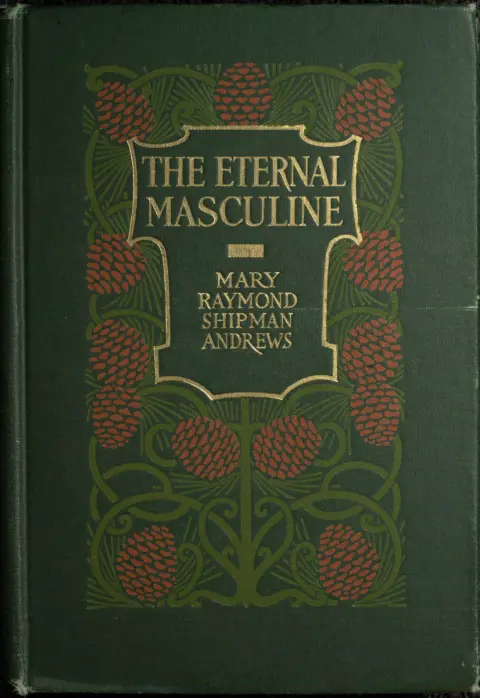
The eternal masculine
Mary Raymond Shipman Andrews
THE CLASSIC COLLECTION · 1907
"The Militants" by Mary Raymond Shipman Andrews is a collection of stories told through the lens of clergymen, soldiers, and other fighters, presumably written in the early 20th century. The work dives into themes of faith, struggle, and the heroism of everyday lives as they intersect during tumultuous times. The opening portion introduces key characters, particularly focusing on a Bishop and a young girl named Eleanor, hinting at their intertwined futures and the impact of their respective journeys. The opening of "The Militants" sets the stage by presenting a quiet July day where the Bishop walks to church and encounters a lively young girl named Eleanor. Their playful exchange reveals her innocence and curiosity, as well as a deeper, reflective side from the Bishop, who finds himself drawn to Eleanor’s resemblance to her deceased mother. The dialogue captures a rich sense of character development and thematic foreshadowing, hinting at loss, kinship, and the trials faced by both characters. In this first interaction, Andrews establishes an emotional bond that will likely influence the unfolding narrative, weaving together themes of spirituality and the trials of love and duty against a backdrop of historical struggles.
Introduction adapted from the source catalogue; source summaries may be automatically generated.
Free to read · English · 68,266 words · No account needed
MAKE TIME FOR A GOOD BOOK
On by default. Untick to stop anonymous reading totals. Each page counts after 10 seconds in view. How this works.
Anonymous counting is on unless you have switched it off.
"Oh, no, Eleanor, you can't force the situation. He has to live out his little grasshopper life the best that he can, before he's good enough to be a butterfly. If you kill him now you might send him backward. He might turn into what he was before--a poor little blind worm perhaps."
"Oh, my Lawd!" said Eleanor.
The Bishop was still a moment, and then repeated, quietly:
Slay not the meanest creature, lest thou slay
Some humble soul upon its upward way.
"Oughtn't to talk to yourself," Eleanor shook her head disapprovingly. "'Tisn't so very polite. Is that true about the grasshopper, Bishop, or is it a whopper?"
The Bishop thought for a moment. "I don't know, Eleanor," he answered,
gently.
"You don't know so very much, do you?" inquired Eleanor, not as despising but as wondering, sympathizing with ignorance.
"Very little," the Bishop agreed. "And I've tried to learn, all my life"--his gaze wandered off reflectively.
"Too bad," said Eleanor. "Maybe you'll learn some time."
"Maybe," said the Bishop and smiled, and suddenly she sprang to her feet, and shook her finger at him.
"I'm afraid," she said, "I'm very much afraid you're a naughty boy."
The Bishop looked up at the small, motherly face, bewildered. "Wh--why?"
he stammered.
"Do you know what you're bein'? You're bein' late to church!"
The Bishop sprang up too, at that, and looked at his watch quickly. "Not late yet, but I'll walk along. Where are you going, waif? Aren't you in charge of anybody?"
"Huh?" inquired Eleanor, her head cocked sideways.
"Whom did you come out with?"
"Madge and Dick, but they're off there," nodding toward the wood behind them. "Madge is cryin'. She wouldn't let me pound Dick for makin' her, so I went away."
"Who is Madge?"
Eleanor, drifting beside him through the sunshine like a rose-leaf on the wind, stopped short. "Why, Bishop, don't you know even Madge? Funny Bishop! Madge is my sister--she's grown up. Dick made her cry, but I think he wasn't much naughty, 'cause she would not let me pound him. She put her arms right around him."
"Oh!" said the Bishop, and there was silence for a moment. "You mustn't tell me any more about Madge and Dick, I think, Eleanor."
"All right, my lamb!" Eleanor assented, cheerfully, and conversation
flagged.
"How old are you, Eleanor Gray?"
"Six, praise de Lawd!"
The Bishop considered deeply for a moment, then his face cleared.
"'Their angels do always behold the face of my Father,'" and he smiled. "I say it too, praise the Lord that she is six."
Your reading position is saved on this browser. Take it to another device with a library code. Reading pages adapt to text, rather than matching a printed edition.
Mary Raymond Shipman Andrews
Mary Raymond Shipman Andrews
Mary Raymond Shipman Andrews
Mary Raymond Shipman Andrews
BEHIND THE BOOK
This eBook is for the use of anyone anywhere in the United States and most other parts of the world at no cost and with almost no restrictions whatsoever. You may copy it, give it away or re-use it under the terms of the Project Gutenberg License included with this eBook or online at www.gutenberg.org. If you are not located in the United States, you will have to check the laws of the country where you are located before using this eBook. Read the source licence.
The original source file, including credits and licence, is retained by this library. Request an original-format copy at no charge. Please include the book title and Project Gutenberg identifier #15496.
KEEP YOUR CURIOSITY GOING
Cécile Tormay

Moritz Busch
Coulson Kernahan
John L. Ransom

Maurice Baring
Frances Wright