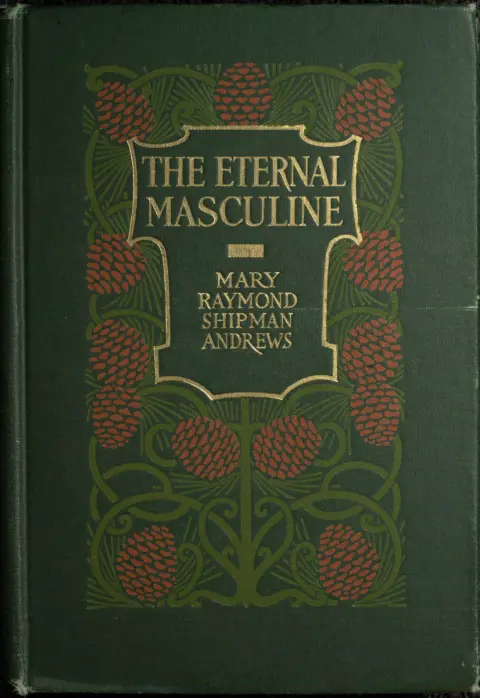
The eternal masculine
Mary Raymond Shipman Andrews
THE CLASSIC COLLECTION · 1918
"Her Country" by Mary Raymond Shipman Andrews is a novel written during the early 20th century, specifically around the time of World War I. The story revolves around themes of patriotism, ambition, and personal sacrifice as it follows the life of Honor Mannering, a young girl aspiring to become a successful singer while grappling with the realities of her family's financial struggles and the call to serve her country. In the narrative, Honor Mannering is determined to make money through her vocal talents, believing her voice can alleviate her family's financial woes. As the United States enters the war, her perspective gradually shifts from seeking personal success to embracing a sense of duty toward her nation, especially influenced by her brother Eric, who aspires to help the war effort through his speeches. The climax occurs when Honor finds herself on stage to replace a famous singer who cannot perform, and she delivers a resonant rendition of patriotic songs that inspires a crowd to support the Liberty Loan campaign. Ultimately, the book captures Honor's transformation from self-interest to a profound sense of responsibility for her country, blending personal ambition with the collective aspirations of a nation at war.
Introduction adapted from the source catalogue; source summaries may be automatically generated.
Free to read · English · 10,500 words · No account needed
MAKE TIME FOR A GOOD BOOK
On by default. Untick to stop anonymous reading totals. Each page counts after 10 seconds in view. How this works.
Anonymous counting is on unless you have switched it off.
The Eternal Feminine. Illustrated net $1.50 August First net $1.00 The Eternal Masculine. Illustrated net $1.50 The Militants. Illustrated net $1.50 Bob and the Guides. Illustrated net $1.50 Her Country net .50 Old Glory net .50 The Counsel Assigned net .50 The Courage of the Commonplace net .50 The Lifted Bandage net .50 The Perfect Tribute net .50
Mary Raymond Shipman Andrews
Charles Scribner’s Sons
1918
Copyright, 1918, by Charles Scribner’s Sons
Copyright, 1918, by the Butterick Publishing Co.
Published May, 1918
Out on the edge of the city were large places, screened from the road by hedges which had been fifty, a hundred years sometimes, in the growing. Behind one such lay a sunshiny garden, lovely in the June Sunday morning. Down the gravel of a path a girl in a white frock walked, swinging a shallow basket in which scissors rattled from side to side. The girl kept a critical eye, walking, on the wall of Dorothy Perkins roses which, growing over a tall broken lattice, separated the garden from the grounds next door.
“You adorable nobodies, you’re like pink music,” she addressed the million little blooms, and halted, erect and poised, glorying in flowers and sunlight.
Two men watched her. “A colt,” spoke the older, smiling lazily.
“I don’t know. I like long, adolescent lines. You don’t see them after eighteen. Honor’s seventeen. I like her figure.”
“Figure! As much figure as a string.” The older man leaned back in his wicker chair and gazed through half-closed lids at the girl, much like a tall, thin angel of Botticelli, shimmering white against shimmering pink.
With that she turned and came lightly towards them across the grass. “What do you think? Is there anything here fit to send McIvor?”
“Why it’s all lovely, Honor--our rose-garden,” the boy said, looking at her in surprise. “Fit to send him! Why, the Mannering rose-garden’s famous. Has been for a hundred years--isn’t it a hundred years, father?”
“Near enough.” Eric Mannering, the fifth, knocked the ashes from his cigar and considered the end of it with absorption. “What’s the matter with the roses, Honor?” He was half amused, half bored. “Why aren’t they good enough for--McIvor, the singer?”
“Nothing’s good enough for McIvor, the singer,” the girl shot at him, quoting the half-contemptuous tone as well as the words. “The roses used to be wonderful, of course. You say they were a show when you were a youngster. But--why, you know better than I do, dad, that roses are an expensive accomplishment. The fine ones are run out; it’s only the hardy ordinary ones that live through neglect. They’re sweet and adorable, but they’re--well, commonplace.”
Your reading position is saved on this browser. Take it to another device with a library code. Reading pages adapt to text, rather than matching a printed edition.
Mary Raymond Shipman Andrews
Mary Raymond Shipman Andrews
Mary Raymond Shipman Andrews
Mary Raymond Shipman Andrews
BEHIND THE BOOK
This eBook is for the use of anyone anywhere in the United States and most other parts of the world at no cost and with almost no restrictions whatsoever. You may copy it, give it away or re-use it under the terms of the Project Gutenberg License included with this eBook or online at www.gutenberg.org. If you are not located in the United States, you will have to check the laws of the country where you are located before using this eBook. Read the source licence.
The original source file, including credits and licence, is retained by this library. Request an original-format copy at no charge. Please include the book title and Project Gutenberg identifier #71078.
KEEP YOUR CURIOSITY GOING
Coulson Kernahan

Maurice Baring
Frances Wright
Cécile Tormay

Frederic Jesup Stimson

W. H. P. (William Henry Pope) Jarvis