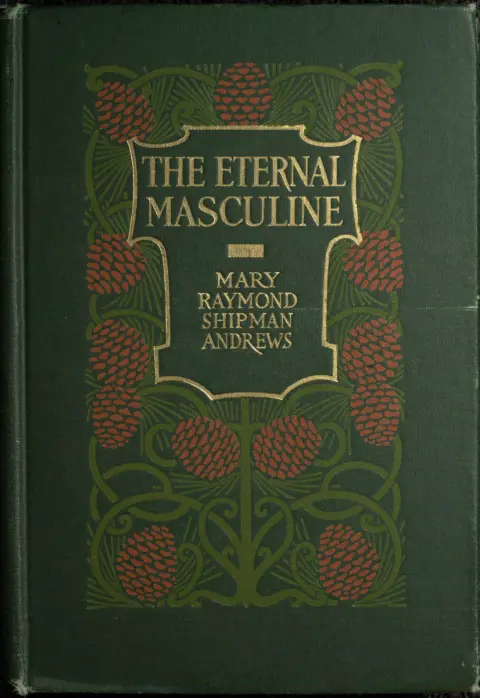
The eternal masculine
Mary Raymond Shipman Andrews
THE CLASSIC COLLECTION · 1907
"The Militants" by Mary Raymond Shipman Andrews is a collection of stories told through the lens of clergymen, soldiers, and other fighters, presumably written in the early 20th century. The work dives into themes of faith, struggle, and the heroism of everyday lives as they intersect during tumultuous times. The opening portion introduces key characters, particularly focusing on a Bishop and a young girl named Eleanor, hinting at their intertwined futures and the impact of their respective journeys. The opening of "The Militants" sets the stage by presenting a quiet July day where the Bishop walks to church and encounters a lively young girl named Eleanor. Their playful exchange reveals her innocence and curiosity, as well as a deeper, reflective side from the Bishop, who finds himself drawn to Eleanor’s resemblance to her deceased mother. The dialogue captures a rich sense of character development and thematic foreshadowing, hinting at loss, kinship, and the trials faced by both characters. In this first interaction, Andrews establishes an emotional bond that will likely influence the unfolding narrative, weaving together themes of spirituality and the trials of love and duty against a backdrop of historical struggles.
Introduction adapted from the source catalogue; source summaries may be automatically generated.
Free to read · English · 68,266 words · No account needed
MAKE TIME FOR A GOOD BOOK
On by default. Untick to stop anonymous reading totals. Each page counts after 10 seconds in view. How this works.
Anonymous counting is on unless you have switched it off.
"Thank you," said the Bishop, sobering at once, but laughter still in
his eyes. "Will you be kind enough to tell me then, Eleanor, who is
Dick?"
Eleanor looked astonished, "You don't know anybody much, do you?" and there was gentle pity in her voice. "Why, Dick, he's--why, he's--why, you see, he's my friend. I don't know his uvver names, but Mr. Fielding, he's Dick's favver."
"Oh!" said the Bishop with comprehension. "Dick Fielding. Then Dick is my friend, too. And people that are friends to the same people should be friends to each other--that's geometry, Eleanor, though it's possibly not life."
"Huh?" Eleanor stared, puzzled.
"Will you be friends with me, Eleanor Gray? I knew your mother a long time ago, when she was Eleanor Gray." Eleanor yawned frankly. That might be true, but it did not appear to her remarkable or interesting. The deep voice went on, with a moment's interval. "Where is your mother? Is she here?"
Eleanor laughed. "Oh, no," she said. "Don't you know? What a funny man you are--you know such a few things. My muvver's up in heaven. She went when I was a baby, long, long ago. I reckon she must have flewed," she added, reflectively, raising clear eyes to the pale, heat-worn sky that gleamed through the branches.
The Bishop's big hands went up to his face suddenly, and the strong fingers clasped tensely above his forehead. Between his wrists one could see that his mouth was set in a hard line. "Dead!" he said. "And I never knew it."
Eleanor dug a small russet heel unconcernedly into the ground. "Naughty, naughty, naughty little grasshopper," she began to chant, addressing an unconscious insect near the heel. "Don't you go and crawl up on the Bishop. No, just don't you. 'Cause if you do, oh, naughty grasshopper, I'll scrunch you!" with a vicious snap on the "scrunch."
The Bishop lowered his hands and looked at her. "I'm not being very
interesting, Eleanor, am I?"
"Not very," Eleanor admitted. "Couldn't you be some more int'rstin'?"
"I'll try," said the Bishop. "But be careful not to hurt the poor grasshopper. Because, you know, some people say that if he is a good grasshopper for a long time, then when he dies his little soul will go into a better body--perhaps a butterfly's body next time."
Eleanor caught the thought instantly. "And if he's a good butterfly, then what'll he be? A hummin'-bird? Let's kill him quick, and see him turn into a butterfly."
Your reading position is saved on this browser. Take it to another device with a library code. Reading pages adapt to text, rather than matching a printed edition.
Mary Raymond Shipman Andrews
Mary Raymond Shipman Andrews
Mary Raymond Shipman Andrews
Mary Raymond Shipman Andrews
BEHIND THE BOOK
This eBook is for the use of anyone anywhere in the United States and most other parts of the world at no cost and with almost no restrictions whatsoever. You may copy it, give it away or re-use it under the terms of the Project Gutenberg License included with this eBook or online at www.gutenberg.org. If you are not located in the United States, you will have to check the laws of the country where you are located before using this eBook. Read the source licence.
The original source file, including credits and licence, is retained by this library. Request an original-format copy at no charge. Please include the book title and Project Gutenberg identifier #15496.
KEEP YOUR CURIOSITY GOING
Cécile Tormay

Moritz Busch
Coulson Kernahan
John L. Ransom

Maurice Baring
Frances Wright