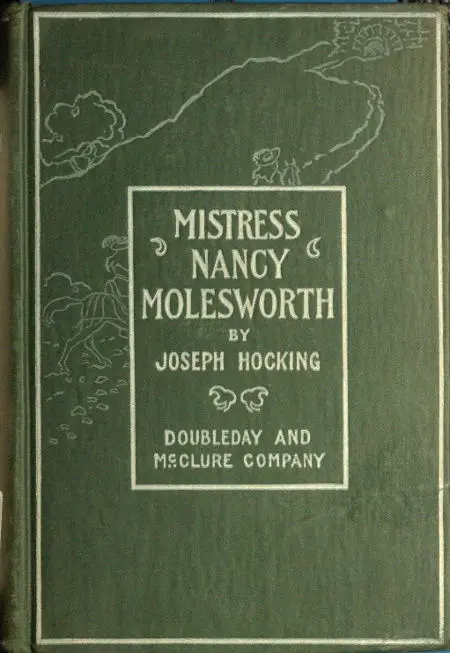
Mistress Nancy Molesworth: A Tale of Adventure
Joseph Hocking
THE CLASSIC COLLECTION · 1906
"The Man Who Rose Again" by Joseph Hocking is a novel written in the early 20th century. The story revolves around Radford Leicester, a cynical, heavy-drinking young politician who, after a night of introspection and conversation with friends in a London club, accepts a wager to prove that a virtuous woman would overlook his moral failings if he offers her a chance at social prominence. His challenge raises ethical questions about the intentions behind relationships and the value of personal integrity versus ambition. The opening of the story introduces a dialogue among four young men in a smoking-room discussing politics and personal matters late into the night. Leicester, characterized by his striking presence, is engaged in a bitter challenge about his worthiness to court the most sought-after heiress in London, Olive Castlemaine, despite his acknowledged flaws. Amidst conversations laden with sarcasm and a sense of foreboding, Leicester expresses a desperate determination to prove his theory—that women are primarily motivated by social standing—by courting Olive, ostensibly for a wager. This sets the stage for a psychological exploration of his character and the complexities of human relationships.
Introduction adapted from the source catalogue; source summaries may be automatically generated.
Free to read · English · 112,956 words · No account needed
MAKE TIME FOR A GOOD BOOK
On by default. Untick to stop anonymous reading totals. Each page counts after 10 seconds in view. How this works.
Anonymous counting is on unless you have switched it off.
"And what did you tell him?" asked Leicester.
"I towld 'im that he must seek the Lord, and fight the devil. Ther's no
other way fer et, sur."
"And did he, do you think?"
"I'm feard not, sur. For afterwards it comed to me who he was. I d' believe he was the gen'leman who tried to git into Parliament for Taviton. I s'pose 'ee wos a awful character. He decaived 'is young laady, he was a ter'ble drunkard, and then afterwards, he thrawed hisself in the revver up to London. 'Twa'sn' he that ded conquer the devil, but the devil conquered he. Ah well, the poor thing es ded now ef 'twas 'ee; 'tes a sad pity."
"And do you believe if he'd sought the Lord, as you call it, that he would have conquered the devil?"
"I doan't believe, sur, I'm sure."
Again Leicester became interested in the country-woman's simple talk. There was such a ring of sincerity in her voice, that he could not but be respectful.
"Mrs. Pethick," he said, "I've been in many countries, and known many religions, but I don't find that the devil is easily killed."
"The Lord Jesus can do et, sur."
"How do you know?"
"Knaw, sur! I do knaw the difference in my heart before I was converted, and after. Besides, there was Aaron Goudge; you doan't know Aaron Goudge, I s'poase?"
"No, I don't know him."
"Well, ef you do look out of the winder you can zee his 'ouse. Aaron was a ter'ble character, 'ee was. He killed his wife, 'ee ded. Ah, poor critter, she ded live a life! Not as you may say oal to wance he ded'n kill her, but little by little. She jist faaded away, she ded. Aaron was a poacher too, and used to stail things. He was allays a-gittin' drunk and fightin'. He was a terror to the parish, he was. Aw, many es the time I've talked to un, bit 'twas oal no use. Grace ded'n tich his heart, so to spaik. Then after his poor wife died, his maid got into trouble, and ef there wos wawn thing in life Aaron cared 'bout, 'twas this maid, and the man that ruined her was Bill Liddicoat, Squire Hendy's gamekeeper. Nothin' could be proved 'gin un, and then, to maake matters wuss, Bill Liddicoat catched Aaron poachin', and he wos put to gaol. When Aaron comed out ov gaol, I spoke to un, and tried to do un good. 'Mrs. Pethick,' ses 'ee, 'I've sould myself to the devil to do fer Bill Liddicoat. I've offered un my soul, ef 'ee'll 'elp me, and 'ee've promised to. And I tell 'ee what, I'll never rest till I've paid out Bill Liddicoat, ef I've got to swing fer it, and ef I've got to go to hell for it, I'll be square with un.' 'But what good'll that do 'ee?' ses I. ''Tes oal I've got to live fer now,' ses 'ee, 'and I b'leeve I cud be 'appy ef I cud pay en out. And I will too, by God, I will!' I tried to raison weth un, but 'twas no use. You cud zee murder in 'is eyes, as he walked the roads. Then wawn mornin', we 'eard 'ow Bill Liddicoat was vound up in Ternouth woods in a pool of blood. He wad'n dead, but the doctors ded'n give much 'ope ov his life. Aaron was tooked up, and tried, but nothin' could be proved agin him. He proved wot is called a allyby--that es, he made out that he was zum plaace else that very night."
Your reading position is saved on this browser. Take it to another device with a library code. Reading pages adapt to text, rather than matching a printed edition.
Joseph Hocking
Joseph Hocking
Joseph Hocking
Joseph Hocking
BEHIND THE BOOK
This eBook is for the use of anyone anywhere in the United States and most other parts of the world at no cost and with almost no restrictions whatsoever. You may copy it, give it away or re-use it under the terms of the Project Gutenberg License included with this eBook or online at www.gutenberg.org. If you are not located in the United States, you will have to check the laws of the country where you are located before using this eBook. Read the source licence.
The original source file, including credits and licence, is retained by this library. Request an original-format copy at no charge. Please include the book title and Project Gutenberg identifier #33964.
KEEP YOUR CURIOSITY GOING
Coulson Kernahan

Maurice Baring
Frances Wright
Cécile Tormay

Frederic Jesup Stimson

W. H. P. (William Henry Pope) Jarvis