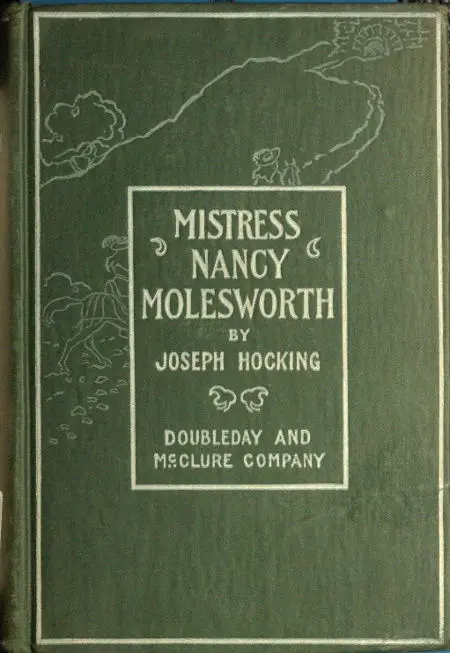
Mistress Nancy Molesworth: A Tale of Adventure
Joseph Hocking
THE CLASSIC COLLECTION · 1906
"The Man Who Rose Again" by Joseph Hocking is a novel written in the early 20th century. The story revolves around Radford Leicester, a cynical, heavy-drinking young politician who, after a night of introspection and conversation with friends in a London club, accepts a wager to prove that a virtuous woman would overlook his moral failings if he offers her a chance at social prominence. His challenge raises ethical questions about the intentions behind relationships and the value of personal integrity versus ambition. The opening of the story introduces a dialogue among four young men in a smoking-room discussing politics and personal matters late into the night. Leicester, characterized by his striking presence, is engaged in a bitter challenge about his worthiness to court the most sought-after heiress in London, Olive Castlemaine, despite his acknowledged flaws. Amidst conversations laden with sarcasm and a sense of foreboding, Leicester expresses a desperate determination to prove his theory—that women are primarily motivated by social standing—by courting Olive, ostensibly for a wager. This sets the stage for a psychological exploration of his character and the complexities of human relationships.
Introduction adapted from the source catalogue; source summaries may be automatically generated.
Free to read · English · 112,956 words · No account needed
MAKE TIME FOR A GOOD BOOK
On by default. Untick to stop anonymous reading totals. Each page counts after 10 seconds in view. How this works.
Anonymous counting is on unless you have switched it off.
"I'm glad you like 'et, but I'd allays call et Cornish craim. I've lived 'ere now better'n twenty 'ear, but I can never make out that I bean't in Cornwall. I caan't fer sure. I was raired there, you zee. 'Ave 'ee ever bin to Cornwall then, zur, maakin' so bowld?"
"Never."
"Then you shud, zur. Some people do like Devonshire best, but I've never seed nothin' in Devonshire so purty as Truro revver. Besides, I do miss the Cornish revivals, I do."
"Revivals?"
"Iss; I was converted at a revival, I was. Not but wot we do 'ave good meetin's over to the Brianite Chapel, but ted'n like Cornwall. Be you a perfessor yerself then, sur?"
"A professor?--what of?"
"Of religion, zur. Be 'ee a perfessin' Christian?"
"I'm afraid not," he replied.
"Ah," she said, "I thot I ded'n see the joy of the Lord in yer eyes."
Try as he would, he could not help laughing. But there was nothing derisive in his laughter. The woman was too sincere.
"I am afraid I've seen too much of the devil to have the joy of the
Lord," he replied.
"Aw, my deear," she said, dropping into the Cornish vernacular, "you do mind me of a gen'l'man wot called 'ere years and years agone, afore my 'usband and my pore dear boy died."
"Oh," said Leicester, "what gentleman?"
"Not that you be anything like en," assured Mrs. Pethick. "Aw, my deear, 'ee was as pale as a ghost, and as thin as a coot, 'ee was. Not but wot 'ee was a fine 'an'some gen'leman, for oal that. 'Twas, lev me zee, six years agone this last spring. Aw, 'ee ded talk funny, he ded. He zed 'ee loved the devil, 'ee ded, and towld me 'ow the devil tempted un to go to Crazzick pool, and sink, and sink, and sink, and thus find paice."
"And what did you say to him?"
"I towld un that 'ee'd never find no paice that way. Ther's no paice
'cept in the dear Lord. I'm sorry you be'ant a perfessin' Christian,
sur."
It did not seem strange to Leicester that she should talk in this way. It seemed natural to her. Besides, in the rural parts of Cornwall and Devonshire, religion is the main topic of conversation among those who love the little roadside chapels.
"Well, as I was a-sayin'," she went on, "this gen'l'man ded zay funny things. He zed 'ee'd nuther father, nor mawther, nor wife, nor sweetheart, and that he ded'n care nothin' 'bout livin'. And then all ov a sudden he axed me wot I wud do ef I wos in his plaace."
Your reading position is saved on this browser. Take it to another device with a library code. Reading pages adapt to text, rather than matching a printed edition.
Joseph Hocking
Joseph Hocking
Joseph Hocking
Joseph Hocking
BEHIND THE BOOK
This eBook is for the use of anyone anywhere in the United States and most other parts of the world at no cost and with almost no restrictions whatsoever. You may copy it, give it away or re-use it under the terms of the Project Gutenberg License included with this eBook or online at www.gutenberg.org. If you are not located in the United States, you will have to check the laws of the country where you are located before using this eBook. Read the source licence.
The original source file, including credits and licence, is retained by this library. Request an original-format copy at no charge. Please include the book title and Project Gutenberg identifier #33964.
KEEP YOUR CURIOSITY GOING
Coulson Kernahan

Maurice Baring
Frances Wright
Cécile Tormay

Frederic Jesup Stimson

W. H. P. (William Henry Pope) Jarvis