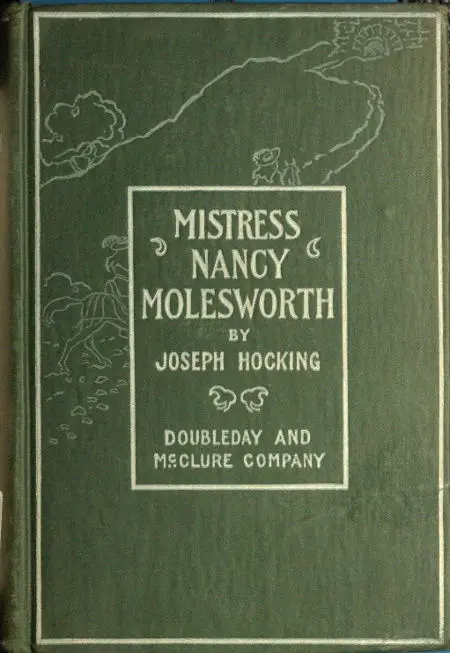
Mistress Nancy Molesworth: A Tale of Adventure
Joseph Hocking
THE CLASSIC COLLECTION · 1906
"The Man Who Rose Again" by Joseph Hocking is a novel written in the early 20th century. The story revolves around Radford Leicester, a cynical, heavy-drinking young politician who, after a night of introspection and conversation with friends in a London club, accepts a wager to prove that a virtuous woman would overlook his moral failings if he offers her a chance at social prominence. His challenge raises ethical questions about the intentions behind relationships and the value of personal integrity versus ambition. The opening of the story introduces a dialogue among four young men in a smoking-room discussing politics and personal matters late into the night. Leicester, characterized by his striking presence, is engaged in a bitter challenge about his worthiness to court the most sought-after heiress in London, Olive Castlemaine, despite his acknowledged flaws. Amidst conversations laden with sarcasm and a sense of foreboding, Leicester expresses a desperate determination to prove his theory—that women are primarily motivated by social standing—by courting Olive, ostensibly for a wager. This sets the stage for a psychological exploration of his character and the complexities of human relationships.
Introduction adapted from the source catalogue; source summaries may be automatically generated.
Free to read · English · 112,956 words · No account needed
MAKE TIME FOR A GOOD BOOK
On by default. Untick to stop anonymous reading totals. Each page counts after 10 seconds in view. How this works.
Anonymous counting is on unless you have switched it off.
"I hope you don't mind, Mr. Leicester, but I was obliged to make arrangements. As soon as I got the telegram saying that Parliament had dissolved, I thought I had better take the bull by the horns, and----"
"It's all right, Smith, all right. I don't feel like election speeches, but they've got to be made, and we'll fight this affair for all it's worth."
"Thank you, Mr. Leicester, you relieve my mind very much. Of course I saw that paragraph in the newspaper yesterday, and I knew that you must be greatly upset. I sincerely hope it's nothing serious, and that Miss Castlemaine will soon be well."
"We'll drop Miss Castlemaine, please."
Smith was Leicester's election agent, and seemed anxious to make certain
explanations.
"Certainly, sir. I only thought----"
"All right, but there are certain subjects I wish avoided--that's one."
The man knew nothing but what had appeared in the papers; but Leicester had a feeling that he knew everything and spoke accordingly. Besides, he had scarcely slept through the night, and he was a prey to dark fancies.
Smith looked at him wonderingly. He had many doubts about telegraphing Leicester, and had feared that he would not come to Taviton at all. There had been a great deal of gossip in the town about the postponed wedding, and already the opposition party had been seeking to make capital out of it.
"Forgive me, Mr. Leicester," he said, "but my own opinion is that, properly worked, this should bring us a good many votes. Of course we had hoped that when the election took place Mrs. Leicester would appear on the platform with you, and be a kind of leader among the ladies. I have only had the pleasure of meeting her once, but from an electioneering standpoint, I should say she was just perfect, sir, just perfect. Well, if a judicious statement were made at the meeting to-night--I repeat the word judicious, sir--and delicately put, to the effect that, that is--well, sir, she is very ill, but is greatly grieved that she is not able to be with you, and that the doctors hope that in a few months, perhaps less, sir, the wedding will come off, I believe it would work wonders. Of course I don't press it, sir, but if she could send a message to be read at one of the public meetings, it would----"
But Leicester did not let him finish the sentence. At first he had listened in a dazed sort of way, scarcely realising what he was saying, but as the man continued he lost his self-control.
"Curse it, Smith," he said, "haven't I told you to drop that question."
Your reading position is saved on this browser. Take it to another device with a library code. Reading pages adapt to text, rather than matching a printed edition.
Joseph Hocking
Joseph Hocking
Joseph Hocking
Joseph Hocking
BEHIND THE BOOK
This eBook is for the use of anyone anywhere in the United States and most other parts of the world at no cost and with almost no restrictions whatsoever. You may copy it, give it away or re-use it under the terms of the Project Gutenberg License included with this eBook or online at www.gutenberg.org. If you are not located in the United States, you will have to check the laws of the country where you are located before using this eBook. Read the source licence.
The original source file, including credits and licence, is retained by this library. Request an original-format copy at no charge. Please include the book title and Project Gutenberg identifier #33964.
KEEP YOUR CURIOSITY GOING
Coulson Kernahan

Maurice Baring
Frances Wright
Cécile Tormay

Frederic Jesup Stimson

W. H. P. (William Henry Pope) Jarvis