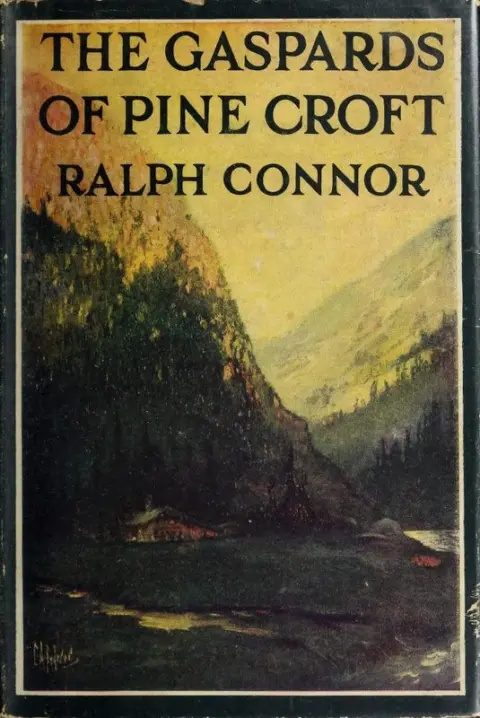
The Gaspards of Pine Croft: A Romance of the Windermere
Ralph Connor
THE CLASSIC COLLECTION · 1917
"The Major" by Ralph Connor is a novel written during the early 20th century. The story centers around Lawrence Gwynne, a young boy grappling with themes of courage, identity, and family honor, especially in light of his mother's Quaker background, which is perceived by some as cowardice. Through childhood adventures and the pressure of social expectations, the narrative explores how Lawrence navigates the challenges of growing up in a close-knit village. At the start of the book, we are introduced to Lawrence, who is captivated by the arrival of spring and the vibrant life around him. The opening scene depicts a typical day in the village, as Lawrence enthusiastically sets off for school, only to be sidetracked by his friends, leading to a day filled with exploration and adventure in nature. However, their escapades take a turn when they skip school and encounter a bully named Mop, who cruelly insults Lawrence, labeling him a coward like his mother, inciting a fierce internal struggle within the boy about his values and identity. This conflict sets the stage for further developments as Lawrence confronts societal norms and personal expectations in his quest for bravery and self-acceptance.
Introduction adapted from the source catalogue; source summaries may be automatically generated.
Free to read · English · 118,349 words · No account needed
MAKE TIME FOR A GOOD BOOK
On by default. Untick to stop anonymous reading totals. Each page counts after 10 seconds in view. How this works.
Anonymous counting is on unless you have switched it off.
June, and the sun flooding with a golden shimmer a land of tawny prairie, billowy hills, wooded valleys and mountain peaks white with eternal snows, touching with silver a stream which, glacier-born, hurled itself down mountain sides in fairy films of mist, rushed through canyons in a mad torrent, hurried between hills in a swollen flood, meandered along wide valleys in a full-lipped tide, lingered in a placid lake in a bit of lowland banked with poplar bluffs, and so onward past ranch-stead and homestead to the great Saskatchewan and Father Ocean, prairie and hills, valleys and mountains, river and lake, making a wonder world of light and warmth and colour and joyous life.
Two riders on rangey bronchos, followed by two Russian boarhounds, climbed the trail that went winding up among the hills towards a height which broke abruptly into a ridge of bare rock. Upon the ridge they paused.
“There! Can you beat that? If so, where?” The lady swept her gauntletted hand toward the scene below. Mrs. Waring-Gaunt was tall, strongly made, handsome with that comeliness which perfect health and out-of-doors life combine to give, her dark hair, dark flashing eyes, straight nose, wide, full-lipped curving mouth, and a chin whose chiselled firmness was softened but not weakened by a dimple, making a picture good to look upon.
“There!” she cried again, “tell me, can you beat it?”
“Glorious! Sybil, utterly and splendidly glorious!” said her brother, his eyes sweeping the picture below. “And you too, Sybil,” he said, turning his eyes upon her. “This country has done you well. By jove, what a transformation from the white-faced, willowy--”
“Weedy,” said she.
“Well, as it's no longer true, weedy--woman that faded out of London, how many--eight years ago!”
“Ten years, ten long, glorious, splendid years.”
“Ten years! Surely not ten!”
“Yes, ten beautiful years.”
“I wish to God I had come with you then. I might have been--well, I should have been saved some bumps and a ghastly cropper at last.”
“'Cut it out,' Jack, as the boys say here. En avant! We never look back in this land, but ever forward. Oh, now isn't this worth while?” Again she swept her hand toward the scene below her. “Look at that waving line in the east, that broad sweep; and here at our left, those great, majestic things. I love them. I love every scar in their old grey faces. They have been good friends to me. But for them some days might have been hard to live through, but they were always there like friends, watching, understanding. They kept me steady.”
Your reading position is saved on this browser. Take it to another device with a library code. Reading pages adapt to text, rather than matching a printed edition.
Ralph Connor
Ralph Connor
Ralph Connor
Ralph Connor
BEHIND THE BOOK
This eBook is for the use of anyone anywhere in the United States and most other parts of the world at no cost and with almost no restrictions whatsoever. You may copy it, give it away or re-use it under the terms of the Project Gutenberg License included with this eBook or online at www.gutenberg.org. If you are not located in the United States, you will have to check the laws of the country where you are located before using this eBook. Read the source licence.
The original source file, including credits and licence, is retained by this library. Request an original-format copy at no charge. Please include the book title and Project Gutenberg identifier #3249.
KEEP YOUR CURIOSITY GOING
Coulson Kernahan

Maurice Baring
Frances Wright
Cécile Tormay

Frederic Jesup Stimson

W. H. P. (William Henry Pope) Jarvis