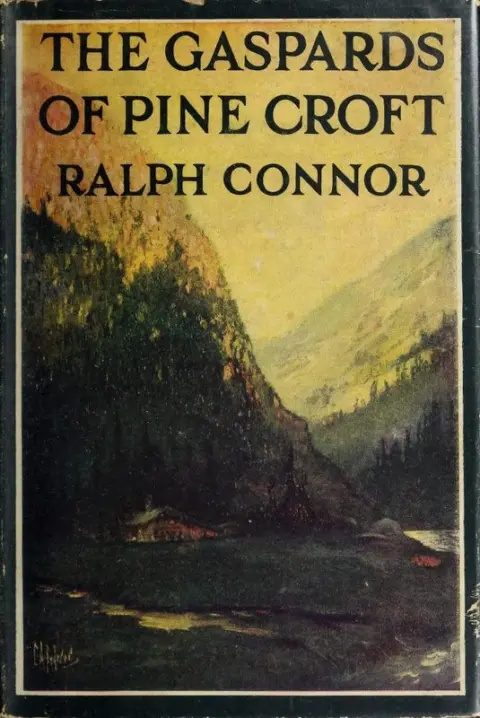
The Gaspards of Pine Croft: A Romance of the Windermere
Ralph Connor
THE CLASSIC COLLECTION · 1917
"The Major" by Ralph Connor is a novel written during the early 20th century. The story centers around Lawrence Gwynne, a young boy grappling with themes of courage, identity, and family honor, especially in light of his mother's Quaker background, which is perceived by some as cowardice. Through childhood adventures and the pressure of social expectations, the narrative explores how Lawrence navigates the challenges of growing up in a close-knit village. At the start of the book, we are introduced to Lawrence, who is captivated by the arrival of spring and the vibrant life around him. The opening scene depicts a typical day in the village, as Lawrence enthusiastically sets off for school, only to be sidetracked by his friends, leading to a day filled with exploration and adventure in nature. However, their escapades take a turn when they skip school and encounter a bully named Mop, who cruelly insults Lawrence, labeling him a coward like his mother, inciting a fierce internal struggle within the boy about his values and identity. This conflict sets the stage for further developments as Lawrence confronts societal norms and personal expectations in his quest for bravery and self-acceptance.
Introduction adapted from the source catalogue; source summaries may be automatically generated.
Free to read · English · 118,349 words · No account needed
MAKE TIME FOR A GOOD BOOK
On by default. Untick to stop anonymous reading totals. Each page counts after 10 seconds in view. How this works.
Anonymous counting is on unless you have switched it off.
The first days of the war were for Larry days of dazed bewilderment and of ever-deepening misery. The thing which he had believed impossible had come. That great people upon whose generous ideals and liberal Christian culture he had grounded a sure hope of permanent peace had flung to the winds all the wisdom, and all justice, and all the humanity which the centuries had garnered for them, and, following the primal instincts of the brute, had hurled forth upon the world ruthless war. Even the great political party of the Social Democrats upon which he had relied to make war impossible had without protest or division proclaimed enthusiastic allegiance to the war programme of the Kaiser. The universities and the churches, with their preachers and professors, had led the people in mad acclaim of war. His whole thinking on the subject had been proved wrong. Passionately he had hoped against hope that Britain would not allow herself to enter the war, but apparently her struggle for peace had been in vain. His first feeling was one of bitter disappointment and of indignation with the great leaders of the British people who had allowed themselves to become involved in a Mid-European quarrel. Sir Edward Grey's calm, moderate--sub-moderate, indeed--exposition of the causes which had forced Britain into war did much to cool his indignation, and Bethmann-Hollweg's cynical explanation of the violation of Belgium's neutrality went far to justify Britain's action consequent upon that outraging of treaty faith. The deliberate initiation of the policy of “frightfulness” which had heaped such unspeakable horrors upon the Belgian people tore the veil from the face of German militarism and revealed in its sheer brutality the ruthlessness and lawlessness of that monstrous system.
From the day of Austria's ultimatum to Servia Larry began to read everything he could find dealing with modern European history, and especially German history. Day and night he studied with feverish intensity the diplomacy and policies of the great powers of Europe till at length he came to a somewhat clear understanding of the modern theory and world policy of the German state which had made war inevitable. But, though his study made it possible for him to relieve his country from the charge of guilt in this war, his anxiety and his misery remained. For one thing, he was oppressed with an overwhelming loneliness. He began to feel that he was dwelling among an alien people. He had made many and close friends during the months of his stay in Chicago. But while they were quick to offer him sympathy in his anxiety and misery, he could not fail to observe on every hand the obvious and necessary indications of the neutral spirit. He could expect nothing else. In this conflict America had decided that she was not immediately concerned and she was resolute to remain unconcerned. A leading representative of the Chicago press urged Americans to be careful not to “rock the boat.” The President of the United States counselled his people “to keep calm” and to observe the strictest neutrality. Larry discovered, too, an unconfessed, almost unconscious desire in the heart of many an American, a relic of Revolutionary days, to see England not destroyed or even seriously disabled, but, say, “well trimmed.” It would do her good. There was, beside, a large element in the city distinctly and definitely pro-German and intensely hostile to Great Britain. On his way to the office one afternoon Larry found himself held up by a long procession of young German reservists singing with the utmost vigour and with an unmistakable note of triumph the German national air, “Die Wacht Am Rhein,” and that newer song which embodied German faith and German ambition, “Deutschland Uber Alles.” When he arrived at the office that afternoon he was surprised to find that he was unable to go on with his work for the trembling of his hands. In the office he was utterly alone, for, however his friends there might take pains to show extra kindness, he was conscious of complete isolation from their life. Unconcerned, indifferent, coolly critical of the great conflict in which his people were pouring out blood like water, they were like spectators at a football match on the side lines willing to cheer good play on either side and ready to acclaim the winner.
Your reading position is saved on this browser. Take it to another device with a library code. Reading pages adapt to text, rather than matching a printed edition.
Ralph Connor
Ralph Connor
Ralph Connor
Ralph Connor
BEHIND THE BOOK
This eBook is for the use of anyone anywhere in the United States and most other parts of the world at no cost and with almost no restrictions whatsoever. You may copy it, give it away or re-use it under the terms of the Project Gutenberg License included with this eBook or online at www.gutenberg.org. If you are not located in the United States, you will have to check the laws of the country where you are located before using this eBook. Read the source licence.
The original source file, including credits and licence, is retained by this library. Request an original-format copy at no charge. Please include the book title and Project Gutenberg identifier #3249.
KEEP YOUR CURIOSITY GOING
Coulson Kernahan

Maurice Baring
Frances Wright
Cécile Tormay

Frederic Jesup Stimson

W. H. P. (William Henry Pope) Jarvis