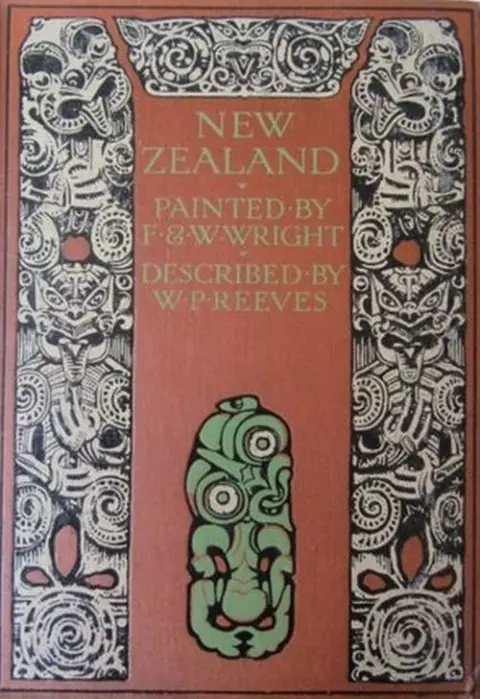
New Zealand
William Pember Reeves
THE CLASSIC COLLECTION · 1898
"The Long White Cloud: 'Ao Tea Roa'" by William Pember Reeves is a historical account written in the late 19th century. It provides an insightful exploration of New Zealand's genesis and development, tracing the island's history from the arrival of its earliest Polynesian settlers, the Maoris, to its status as a British colony. The work highlights the cultural, political, and natural aspects of New Zealand, aiming to shed light on its landscape and the complexities of its colonization. At the start of the book, Reeves establishes the backdrop of New Zealand's early European encounters. He notes the isolation and distinctiveness of the islands, contrasting their features with those of Britain and Australia. The opening portion delves into the arrival of the Maoris, their efforts in navigating the ocean to find New Zealand, and the rich, yet challenging landscape they encountered. Reeves also addresses the inadvertent impact of European settlers on the indigenous population and environment, setting the stage for a nuanced exploration of New Zealand's evolution through its unique struggles and successes.
Introduction adapted from the source catalogue; source summaries may be automatically generated.
Free to read · English · 102,986 words · No account needed
MAKE TIME FOR A GOOD BOOK
On by default. Untick to stop anonymous reading totals. Each page counts after 10 seconds in view. How this works.
Anonymous counting is on unless you have switched it off.
They were not, however, the only representatives of law and order in New Zealand. The British authorities in New South Wales had all along, perforce, been keeping their eye on this troublesome archipelago in the south-east. In 1813 Governor Macquarie made Sydney shipmasters sailing for the country give bonds for a thousand pounds not to kidnap Maori men, take the women on board their vessels, or meddle with burying grounds. In 1814 he appointed the chiefs Hongi and Koro Koro, and the missionary Kendall, to act as magistrates in the Bay of Islands. Possibly the two first-named magistrates were thus honoured to induce them not to eat the third. No other advantage was gained by the step. A statute was passed in England in 1817 authorizing the trial and punishment of persons guilty of murder and other crimes in certain savage and disturbed countries, amongst which were specified New Zealand, Otaheite, and Honduras. Two others, in 1823 and 1828, gave the Australian courts jurisdiction over Whites in New Zealand. One White ruffian was actually arrested in New Zealand, taken back to Sydney, and executed. But this act of vigour did not come till the end of 1837. Then the crime punished was not one of the atrocities which for thirty years had made New Zealand a by-word. The criminal, Edward Doyle, paid the extreme penalty of the law for stealing in a dwelling in the Bay of Islands and "putting John Wright in bodily fear." Governor Bourke issued a special proclamation expressing hope that Doyle's punishment would be a warning to evil-doers in New Zealand. Governor Darling, as already mentioned, prohibited the inhuman traffic in preserved and tattooed heads by attaching thereto a penalty of £40, coupled with exposure of the trader's name.
In England more than one influential believer in colonies had long been watching New Zealand. As early as 1825, a company was formed to purchase land and settle colonists in the North Island. This company's agent, Captain Herd, went so far as to buy land on the Hokianga Estuary, and conduct thither a party of settlers. One of the first experiences of the new-comers was, however, the sight of a native war-dance, the terrifying effects of which, added to more practical difficulties, caused most of them to fold their tents and depart to Australia. Thus for the first time did an English company lose £20,000 in a New Zealand venture. The statesmen of the period were against any such schemes. A deputation of the Friends of Colonization waited upon the Duke of Wellington to urge that New Zealand should be acquired and settled. The Duke, under the advice of the Church Missionary Society, flatly refused to think of such a thing. It was then that he made the historically noteworthy observation that, even supposing New Zealand were as valuable as the deputation made out, Great Britain had already colonies enough. When one reflects what the British Colonial Empire was then, and what it has since become, the remark is a memorable example of the absence of the imaginative quality in statesmen. But the Duke of Wellington was not by any means alone in a reluctance to annex New Zealand. In 1831 thirteen Maori chiefs, advised by missionaries, had petitioned for British protection, which had not been granted. The truth is, not only that the Empire seemed large enough to others besides the Duke, but that the missionaries stood in the way. As representing the most respectable and the only self-sacrificing element amongst those interested in the islands, they were listened to. It would have been strange had it been otherwise. Nevertheless, the growing trade and the increasing number of unauthorized white settlers made it necessary that something should be done. Consequently, in 1832, Lord Goderich sent to the Bay of Islands Mr. James Busby to reside there as British resident. He was paid a salary, and provided with £200 a year to distribute in presents to the native chiefs. He entered on his duties in 1833. He had no authority, and was not backed by any force. He was aptly nicknamed "a man-of-war without guns." He presented the local chiefs with a national flag. Stars and stripes appeared in the design which the chiefs selected, thanks, says tradition, to the sinister suggestion of a Yankee whaling-skipper. H.M.S. Alligator signalised the hoisting of the ensign with a salute of twenty-one guns. After this impressive solemnity, Mr. Busby lived at the bay for six years. His career was a prolonged burlesque--a farce without laughter, played by a dull actor in serious earnest. Personally he went through as strange an experience as has often fallen to the lot of a British official. A man of genius might possibly have managed the inhabitants of his Alsatia. But governments have no right to expect genius in unsupported officials--even when they pay them £300 a year. Mr. Busby was a well-meaning, small-minded person, anxious to justify his appointment. His Alsatians did not like him, and complained that his manners were exclusive and his wit caustic. Probably this meant nothing more than that he declined to join in their drinking-bouts. His life, however, had its own excitements. A chief whom he had offended tried to shoot him. Crouching one night in the verandah of the resident's cottage, he fired at the shadow of Mr. Busby's head as it appeared on the window-blind. As he merely hit the shadow, not the substance, the would-be assassin was not punished, but the better disposed Maoris gave a piece of land as compensation--not to the injured Busby, but to his Government.
Your reading position is saved on this browser. Take it to another device with a library code. Reading pages adapt to text, rather than matching a printed edition.
William Pember Reeves
BEHIND THE BOOK
This eBook is for the use of anyone anywhere in the United States and most other parts of the world at no cost and with almost no restrictions whatsoever. You may copy it, give it away or re-use it under the terms of the Project Gutenberg License included with this eBook or online at www.gutenberg.org. If you are not located in the United States, you will have to check the laws of the country where you are located before using this eBook. Read the source licence.
The original source file, including credits and licence, is retained by this library. Request an original-format copy at no charge. Please include the book title and Project Gutenberg identifier #12411.
KEEP YOUR CURIOSITY GOING
Cécile Tormay

Moritz Busch
John L. Ransom
Frances Wright
Cécile Tormay

Mabel Potter Daggett