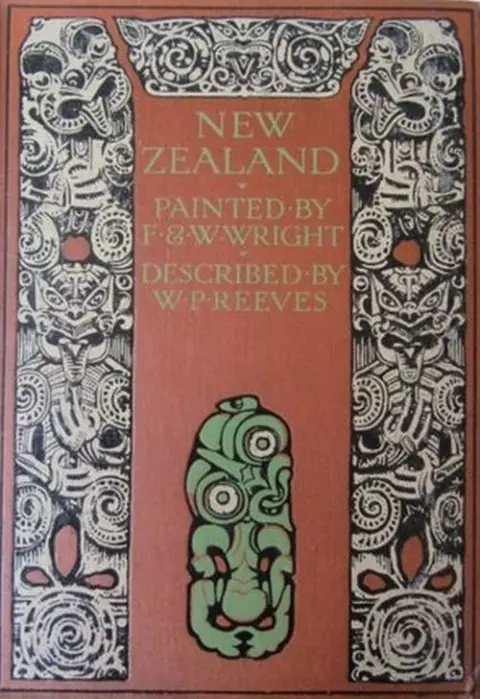
New Zealand
William Pember Reeves
THE CLASSIC COLLECTION · 1898
"The Long White Cloud: 'Ao Tea Roa'" by William Pember Reeves is a historical account written in the late 19th century. It provides an insightful exploration of New Zealand's genesis and development, tracing the island's history from the arrival of its earliest Polynesian settlers, the Maoris, to its status as a British colony. The work highlights the cultural, political, and natural aspects of New Zealand, aiming to shed light on its landscape and the complexities of its colonization. At the start of the book, Reeves establishes the backdrop of New Zealand's early European encounters. He notes the isolation and distinctiveness of the islands, contrasting their features with those of Britain and Australia. The opening portion delves into the arrival of the Maoris, their efforts in navigating the ocean to find New Zealand, and the rich, yet challenging landscape they encountered. Reeves also addresses the inadvertent impact of European settlers on the indigenous population and environment, setting the stage for a nuanced exploration of New Zealand's evolution through its unique struggles and successes.
Introduction adapted from the source catalogue; source summaries may be automatically generated.
Free to read · English · 102,986 words · No account needed
MAKE TIME FOR A GOOD BOOK
On by default. Untick to stop anonymous reading totals. Each page counts after 10 seconds in view. How this works.
Anonymous counting is on unless you have switched it off.
The intellectual average is good. Thanks in great part to Gibbon Wakefield's much-abused Company, New Zealand was fortunate in the mental calibre of her pioneer settlers, and in their determined efforts to save their children from degenerating into loutish, half-educated provincials. Looking around in the Colony at the sons of these pioneers, one finds them on all sides doing useful and honourable work. They make upright civil servants, conscientious clergymen, schoolmasters, lawyers, and journalists, pushing agents, resourceful engineers, steady-going and often prosperous farmers, and strong, quick, intelligent labourers. Of the "self-reverence, self-knowledge, self-control" needful to make a sound race they have an encouraging share. Of artistic, poetic, or scientific talent, of wit, originality, or inventiveness, there is yet but little sign. In writing they show facility often, distinction never; in speech fluency and force of argument, and even, sometimes, lucidity, but not a flash of the loftier eloquence. Nor has the time yet arrived for Young New Zealand to secure the chief prizes of its own community--such posts and distinctions as go commonly to men fairly advanced in years. No native of the country has yet been its Prime Minister or sat amongst its supreme court judges or bishops. A few colonial-born have held subordinate Cabinet positions, but the dozen leading Members of Parliament are just now all British-born. So are the leading doctors, engineers, university professors, and preachers; the leading barrister is a Shetlander. Two or three, and two or three only, of the first-class positions in the civil service are filled by natives. On the whole, Young New Zealand is, as yet, better known by collective usefulness than by individual distinction.
The grazing of sheep and cattle, dairying, agriculture, and mining for coal and gold, are the chief occupations. 47,000 holdings are under cultivation. The manufactures grow steadily, and already employ 40,000 hands. A few figures will give some notion of the industrial and commercial position. The number of the sheep is a little under 20,000,000; of cattle, 1,150,000; of horses, 250,000. The output of the factories and workshops is between £10,000,000 and £11,000,000 sterling a year; the output of gold, about £1,000,000; that of coal, about 900,000 tons. The export of wool is valued at £4,250,000. Among the exports for 1897 were: 2,700,000 frozen sheep and lambs; 66,000 cwt. cheese, and 71,000 cwt butter; £433,000 worth of kauri gum; £427,000 worth of grain. The exports and imports of the Colony for the year 1897 were a little over £10,000,000 and £8,000,000 sterling respectively. It would appear that, taking a series of years, about three-quarters of the Colony's trade has been with the mother-country, and nearly all the remainder with other parts of the Empire. The public debt is about £44,000,000; the revenue, £5,000,000. The State owns 2,061 miles of railway.
Your reading position is saved on this browser. Take it to another device with a library code. Reading pages adapt to text, rather than matching a printed edition.
William Pember Reeves
BEHIND THE BOOK
This eBook is for the use of anyone anywhere in the United States and most other parts of the world at no cost and with almost no restrictions whatsoever. You may copy it, give it away or re-use it under the terms of the Project Gutenberg License included with this eBook or online at www.gutenberg.org. If you are not located in the United States, you will have to check the laws of the country where you are located before using this eBook. Read the source licence.
The original source file, including credits and licence, is retained by this library. Request an original-format copy at no charge. Please include the book title and Project Gutenberg identifier #12411.
KEEP YOUR CURIOSITY GOING
Cécile Tormay

Moritz Busch
John L. Ransom
Frances Wright
Cécile Tormay

Mabel Potter Daggett