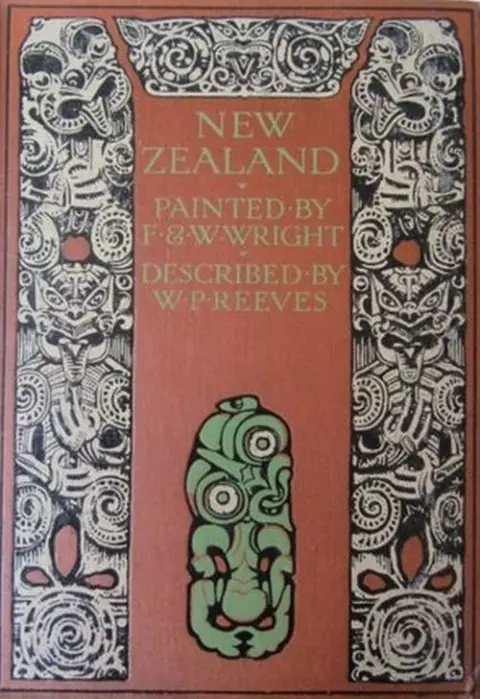
New Zealand
William Pember Reeves
THE CLASSIC COLLECTION · 1898
"The Long White Cloud: 'Ao Tea Roa'" by William Pember Reeves is a historical account written in the late 19th century. It provides an insightful exploration of New Zealand's genesis and development, tracing the island's history from the arrival of its earliest Polynesian settlers, the Maoris, to its status as a British colony. The work highlights the cultural, political, and natural aspects of New Zealand, aiming to shed light on its landscape and the complexities of its colonization. At the start of the book, Reeves establishes the backdrop of New Zealand's early European encounters. He notes the isolation and distinctiveness of the islands, contrasting their features with those of Britain and Australia. The opening portion delves into the arrival of the Maoris, their efforts in navigating the ocean to find New Zealand, and the rich, yet challenging landscape they encountered. Reeves also addresses the inadvertent impact of European settlers on the indigenous population and environment, setting the stage for a nuanced exploration of New Zealand's evolution through its unique struggles and successes.
Introduction adapted from the source catalogue; source summaries may be automatically generated.
Free to read · English · 102,986 words · No account needed
MAKE TIME FOR A GOOD BOOK
On by default. Untick to stop anonymous reading totals. Each page counts after 10 seconds in view. How this works.
Anonymous counting is on unless you have switched it off.
Within his cabinet, he had the staunchest of lieutenants in Mr. John McKenzie aforesaid, whose burly strength combined with that of Mr. Seddon, now Premier, to supply the physical fighting force lacking in their chief. Mr. Cadman, another colleague, was an administrator of exceptional assiduity. But none of these had held office before, and outside his cabinet Ballance had to consolidate a party made up largely of raw material. Amongst it was a novel and hardly calculable element, the Labour Members. At the elections, however, no attempt had been made to reserve the Labour vote for candidates belonging exclusively to Trades Unions, or who were workmen. Of some score of Members who owed their return chiefly to the Labour vote, and who had accepted the chief points of the Labour policy, six only were working mechanics. Moreover, though the six were new to Parliament, several of their closest allies had been there before, and were old members of the Ballance Party. Not only, therefore, was a distinct Labour Party not formed, but there was no attempt to form one. For the rest, any feeling of nervous curiosity with which the artisan parliamentarians were at first regarded soon wore off. They were without exception men of character, intelligence, and common-sense. They behaved as though their only ambition was to be sensible Members of Parliament. As such, they were soon classed, and lookers-on were only occasionally reminded that they held a special brief.
Anything like a detailed history of the struggles which followed would be out of place here. Nor is it possible yet to sum up the results of changes, none of which are eight years old. A mere enumeration of them would take some space: a succinct description would require a fairly thick pamphlet. Some were carried after hot debate; some after very little. Some were resolutely contested in the popular chamber, and were assented to rather easily in the Upper House; others went through the Lower House without much difficulty, but failed again and again to run the gauntlet of the nominated chamber. The voting of some was on strict party lines: in other instances leading Opposition Members like Captain Russell frankly accepted the principle of measures. Some were closely canvassed in the newspapers and country; others were hardly examined outside Parliament. But, roughly speaking, the chief experiments of the last eight years not already dealt with many be divided into three sections. These relate to (1) Finance; (2) Constitutional Reform; (3) Labour. One of the first and--to a New Zealander's eyes--boldest strokes delivered was against the Property Tax. This, the chief direct tax of the Colony, was an annual impost of 1d. in the £ on the capital value of every citizen's possessions, less his debts and an exemption of £500. Its friends claimed for this tax that it was no respecter of persons, but was simple, even-handed, and efficient. The last it certainly was, bringing as it did into the Treasury annually about as many thousands as there are days in the year. But inasmuch as different kinds of property are by no means equally profitable, and therefore the ability of owners to pay is by no means equal, the simplicity of the Property Tax was not by many thought equity. The shopkeeper, taxed on unsaleable stock, the manufacturer paying on plant and buildings as much in good years as in bad, bethought them that under an Income Tax they would at any rate escape in bad seasons when their income might be less or nothing. The comfortable professional man or well-paid business manager paid nothing on their substantial and regular incomes. The working-farmer settling in the desert felt that for every pound's worth of improvements made by muscle and money he would have to account to the tax-collector at the next assessment. Nevertheless the Conservative politicians rallied round the doomed tax. It was a good machine for raising indispensable revenue. Moreover, it did not select any class of property-owners or any description of property for special burdens. This suited the landowners, who dreaded a Land Tax, for might not a Land Tax contain the germ of that nightmare of the larger colonial landowner--the Single Tax? It suited also the wealthy, who feared graduated taxation, and the lawyers, doctors, agents, and managing directors, whose incomes it did not touch. So when in the autumn the rumour went round that the Ballance Ministry meant to abolish the Property Tax and bring forward Bills embodying a Progressive Land Tax, and Progressive Income Tax, the proposal was thought to represent the audacity of impudence or desperation. When the rumour proved true, it was predicted that the farmers throughout the length and breath of the country would rise in wrath and terror, scared by the very name of Land Tax. Nevertheless Parliament passed the Bills, with the addition of a light Absentee Tax. The smaller farmers, at any rate, took the appeals of the Property Taxers with apathy, suspecting that under a tax on bare land values they would pay less than under a Property Tax which fell on land, improvements, and live stock as well. Since 1891, therefore, progression or graduation has been in New Zealand a cardinal principle of direct taxation.
Your reading position is saved on this browser. Take it to another device with a library code. Reading pages adapt to text, rather than matching a printed edition.
William Pember Reeves
BEHIND THE BOOK
This eBook is for the use of anyone anywhere in the United States and most other parts of the world at no cost and with almost no restrictions whatsoever. You may copy it, give it away or re-use it under the terms of the Project Gutenberg License included with this eBook or online at www.gutenberg.org. If you are not located in the United States, you will have to check the laws of the country where you are located before using this eBook. Read the source licence.
The original source file, including credits and licence, is retained by this library. Request an original-format copy at no charge. Please include the book title and Project Gutenberg identifier #12411.
KEEP YOUR CURIOSITY GOING
Cécile Tormay

Moritz Busch
John L. Ransom
Frances Wright
Cécile Tormay

Mabel Potter Daggett