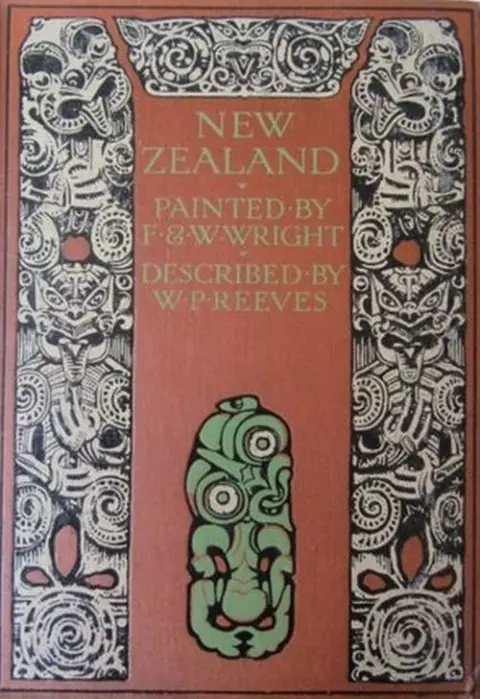
New Zealand
William Pember Reeves
THE CLASSIC COLLECTION · 1898
"The Long White Cloud: 'Ao Tea Roa'" by William Pember Reeves is a historical account written in the late 19th century. It provides an insightful exploration of New Zealand's genesis and development, tracing the island's history from the arrival of its earliest Polynesian settlers, the Maoris, to its status as a British colony. The work highlights the cultural, political, and natural aspects of New Zealand, aiming to shed light on its landscape and the complexities of its colonization. At the start of the book, Reeves establishes the backdrop of New Zealand's early European encounters. He notes the isolation and distinctiveness of the islands, contrasting their features with those of Britain and Australia. The opening portion delves into the arrival of the Maoris, their efforts in navigating the ocean to find New Zealand, and the rich, yet challenging landscape they encountered. Reeves also addresses the inadvertent impact of European settlers on the indigenous population and environment, setting the stage for a nuanced exploration of New Zealand's evolution through its unique struggles and successes.
Introduction adapted from the source catalogue; source summaries may be automatically generated.
Free to read · English · 102,986 words · No account needed
MAKE TIME FOR A GOOD BOOK
On by default. Untick to stop anonymous reading totals. Each page counts after 10 seconds in view. How this works.
Anonymous counting is on unless you have switched it off.
For the last five years Liquor has disputed with Land the chief place in the public interest. It has introduced an element of picturesque enthusiasm and, here and there, a passion of hatred rarely seen before in New Zealand politics. It brought division into the Liberal Party in 1893, at the moment when the Progressive movement seemed to have reached its high-water mark, and the feeling it roused was found typified in the curious five years' duel between Mr. Seddon and Sir Robert Stout, which began in 1893 and ended only with Sir Robert's retirement at the beginning of the present year. It has strangely complicated New Zealand politics, is still doing so, and is the key to much political manoeuvring with which it might seem to have nothing whatever to do.
For many years total abstainers in New Zealand have grown in numbers. Though for the last thirty years drinking and drunkenness have been on the decline among all classes of colonists, and though New Zealanders have for a long time consumed much less alcohol per head than Britons do, that has not checked the growth of an agitation for total prohibition, which has absorbed within itself probably the larger, certainly the more active, section of temperance reformers.[1] In 1882 a mild form of local option went on to the statute-book, while the granting of licenses was handed over to boards elected by ratepayers. For the next ten years no marked result roused attention. Then, almost suddenly, the Prohibition movement was seen to be advancing by leaps and bounds. Two clergymen, the Rev. Leonard Isitt and the Rev. Edward Walker, were respectively the voice and the hand of the Prohibitionists. As a speaker Mr. Isitt would perhaps be the better for a less liberal use of the bludgeon, but his remarkable energy and force on the platform, and his bold and thorough sincerity, made him a power in the land. Mr. Walker had much to do with securing tangible results for the force which Mr. Isitt's harangues aroused, and in which the Liberal Party was to a large extent enrolled. In 1893 the temperance leaders thought themselves strong enough to make sweeping demands of Parliament. Ballance, the Liberal Premier, had just died; his party was by many believed to be disorganized. In Sir Robert Stout, the Brougham of New Zealand public life, the Prohibitionists had a spokesman of boundless energy and uncommon hitting power in debate. He tabled a Bill briefly embodying their complete demands, and it was read a second time. Old parliamentary hands knew full well that the introduction of so controversial and absorbing a measure in the last session before a General Election meant the sacrifice for that year, at least, of most of the policy bills on labour, land, and other matters. But, whether it would or would not have been better to postpone Licensing Reform to a Parliament elected to deal with it, as matters came to stand, there was no choice. The Ministry tried to deal with the question on progressive, yet not unreasonable, lines. A Local Option Bill was passed, therefore, and nearly every other important policy measure, except the Female Franchise Bill, went by the board--blocked or killed in one Chamber or the other. The hurried Government licensing measure of 1893 had of course to be expanded and amended in 1895 and 1896. Now, though it has failed to satisfy the more thorough-going Prohibitionists, it embraces a complete and elaborate system of local option. Except under certain extraordinary conditions, the existing number of licenses cannot be increased. The licensing districts are coterminous with the Parliamentary electorates. The triennial licensing poll takes place on the same day as the General Election, thus ensuring a full vote. Every adult male and female resident may vote: (1) to retain all existing licenses; or (2) to reduce the number of licenses, and (3) to abolish all licenses within the district. To carry No. 3 a majority of three to two is requisite. No compensation is granted to any licensed house thus closed. Two local option polls have been held under this law. The first resulted in the closing of some seventy houses and the carrying of a total prohibition of retail liquor sales in the district of Clutha. Limited Prohibition has been the law in Clutha for some four years. The accounts of the results thereof conflict very sharply. In the writer's opinion--given with no great confidence--the consumption of beer and wine there has been greatly reduced, that of spirits not very greatly. There is much less open drunkenness. In certain spots there is sly grog-selling with its concomitants of expense, stealthy drinking, and perjury. The second general Licensing Poll was held in December, 1896. Then for the first time it was taken on the same day as the Parliamentary elections. In consequence the Prohibitionist vote nearly doubled. But the Moderate vote more than trebled, and the attacking abstainers were repulsed all along the line, though they, on their side, defeated an attempt to recapture Clutha.
Your reading position is saved on this browser. Take it to another device with a library code. Reading pages adapt to text, rather than matching a printed edition.
William Pember Reeves
BEHIND THE BOOK
This eBook is for the use of anyone anywhere in the United States and most other parts of the world at no cost and with almost no restrictions whatsoever. You may copy it, give it away or re-use it under the terms of the Project Gutenberg License included with this eBook or online at www.gutenberg.org. If you are not located in the United States, you will have to check the laws of the country where you are located before using this eBook. Read the source licence.
The original source file, including credits and licence, is retained by this library. Request an original-format copy at no charge. Please include the book title and Project Gutenberg identifier #12411.
KEEP YOUR CURIOSITY GOING
Cécile Tormay

Moritz Busch
John L. Ransom
Frances Wright
Cécile Tormay

Mabel Potter Daggett