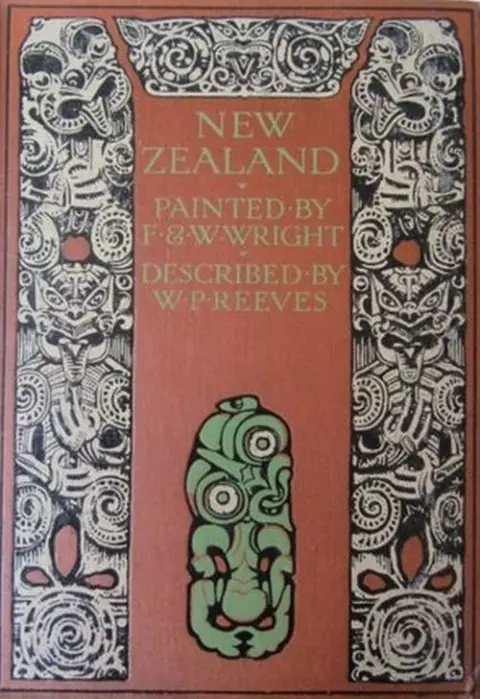
New Zealand
William Pember Reeves
THE CLASSIC COLLECTION · 1898
"The Long White Cloud: 'Ao Tea Roa'" by William Pember Reeves is a historical account written in the late 19th century. It provides an insightful exploration of New Zealand's genesis and development, tracing the island's history from the arrival of its earliest Polynesian settlers, the Maoris, to its status as a British colony. The work highlights the cultural, political, and natural aspects of New Zealand, aiming to shed light on its landscape and the complexities of its colonization. At the start of the book, Reeves establishes the backdrop of New Zealand's early European encounters. He notes the isolation and distinctiveness of the islands, contrasting their features with those of Britain and Australia. The opening portion delves into the arrival of the Maoris, their efforts in navigating the ocean to find New Zealand, and the rich, yet challenging landscape they encountered. Reeves also addresses the inadvertent impact of European settlers on the indigenous population and environment, setting the stage for a nuanced exploration of New Zealand's evolution through its unique struggles and successes.
Introduction adapted from the source catalogue; source summaries may be automatically generated.
Free to read · English · 102,986 words · No account needed
MAKE TIME FOR A GOOD BOOK
On by default. Untick to stop anonymous reading totals. Each page counts after 10 seconds in view. How this works.
Anonymous counting is on unless you have switched it off.
Other districts were less fortunate. By the early part of 1865 the Hau-Hau craze was at work on the east as well as the west coast. It was in the country round the Wanganui River to the west, and in the part of the east coast, between Tauranga on the Bay of Plenty and Hawkes Bay, that the new mischief gave the most trouble. The task of coping with it devolved on the New Zealand Militia, and the warriors of certain friendly tribes, headed by the chiefs called by the Europeans Ropata and Kemp. In this loose and desultory but exceedingly arduous warfare, the irregulars and friendlies undoubtedly proved far more efficient than the regular troops had usually been permitted to be. They did not think it useless to follow the enemy into the bush; far from it. They went there to seek him out. They could march many miles in a day, and were not fastidious as to commissariat. More than once they gained food and quarters for the night by taking them from their opponents. In a multitude of skirmishes in 1865 and 1866, they were almost uniformly victorious. Of the laurels gained in New Zealand warfare, a large share belongs to Ropata, to Kemp, and to Militia officers like Tuke, McDonnell and Fraser. Later in the war, when energetic officers tried to get equally good results out of inexperienced volunteers, and when, too--in some cases--militia discipline had slackened, the consequences were by no means so satisfactory. It did not follow that brave men ready to plunge into the bush were good irregulars merely because they were not regulars. Nor were all friendly natives by any means as effective as the Wanganui and Ngatiporou, or all chiefs as serviceable as Ropata and Kemp.
The east coast troubles began in March, 1865, with the murder at Opotiki, on the Bay of Plenty, of Mr. Volckner, a missionary and the most kindly and inoffensive of mankind. At the bidding of Kereopa, a Hau-Hau emissary, the missionary's people suddenly turned on him, hung him, hacked his body to pieces, and smeared themselves with his blood. At another spot in the same Bay a trading schooner was seized just afterwards by order of another Hau-Hau fanatic, and all on board killed save two half-caste boys. A force of militia soon dealt out condign punishment for these misdeeds, but meanwhile Kereopa and his fellow fire-brands had passed down the coast and kindled a flame which gradually crept southward even to Hawkes Bay. In village after village the fire blazed up, and a rising equal to that in the Waikato seemed imminent. It was, indeed, fortunate that much the ablest warrior on that side of the island at once declared against the craze. This was Ropata Te Wahawaha, then and afterwards the most valuable Maori ally the Government had, and one of the very few captains on either side who went through the wars without anything that could be called a defeat. Without fear or pity, he was a warrior of the older Maori type, who with equal enjoyment could plan a campaign, join in a hand-to-hand tussle, doom a captive to death, or shoot a deserter with his own rifle. As he would not join the Hau-Haus, they and their converts made the mistake of attacking him. After beating them off he was joined by Major Biggs and a company of militia. Together they advanced against the stronghold of the insurgents, perched on a cliff among the Waiapu hills. By scaling a precipice with twenty picked men, Ropata and Biggs gained a crest above the pa, whence they could fire down into the midst of their astonished adversaries, over 400 of whom surrendered in terror to the daring handful. But the mischief had run down the coast. Spreading from point to point, dying down and then starting up, it was as hard to put out as fire abroad in the fern. The amiable Kereopa visited Poverty Bay, three days' journey south of the Waiapu, and tried hard to persuade the natives to murder Bishop Williams, the translator of the Scriptures into Maori. Though they shrank from this, the Bishop had to fly, and his flock took up arms, stood a siege in one of their pas, and lost over a hundred men before they would surrender to the militia. Further south still the next rising flared up on the northern frontier of the Hawkes Bay province. Once more Ropata stamped it under, and the generalship with which he repaired the mistakes made by others, and routed a body of 500 insurgents was not more remarkable than the cold-blooded promptitude with which after the fight he shot four prisoners of note with his own hand. It took ten months for the spluttering fire to flame up again. Then it was yet another stage further south, within a few miles of Napier, amid pastoral plains, where, if anywhere, peace, it would seem, should have an abiding-place. The rising there was but a short one-act play. To Colonel Whitmore belonged the credit of dealing it a first and final blow at Omaranui, where, with a hastily raised force of volunteers, and some rather useless friendlies, he went straight at the insurgents, caught them in the open, and quickly killed, wounded, or captured over ninety per cent. of their number.
Your reading position is saved on this browser. Take it to another device with a library code. Reading pages adapt to text, rather than matching a printed edition.
William Pember Reeves
BEHIND THE BOOK
This eBook is for the use of anyone anywhere in the United States and most other parts of the world at no cost and with almost no restrictions whatsoever. You may copy it, give it away or re-use it under the terms of the Project Gutenberg License included with this eBook or online at www.gutenberg.org. If you are not located in the United States, you will have to check the laws of the country where you are located before using this eBook. Read the source licence.
The original source file, including credits and licence, is retained by this library. Request an original-format copy at no charge. Please include the book title and Project Gutenberg identifier #12411.
KEEP YOUR CURIOSITY GOING
Cécile Tormay

Moritz Busch
John L. Ransom
Frances Wright
Cécile Tormay

Mabel Potter Daggett