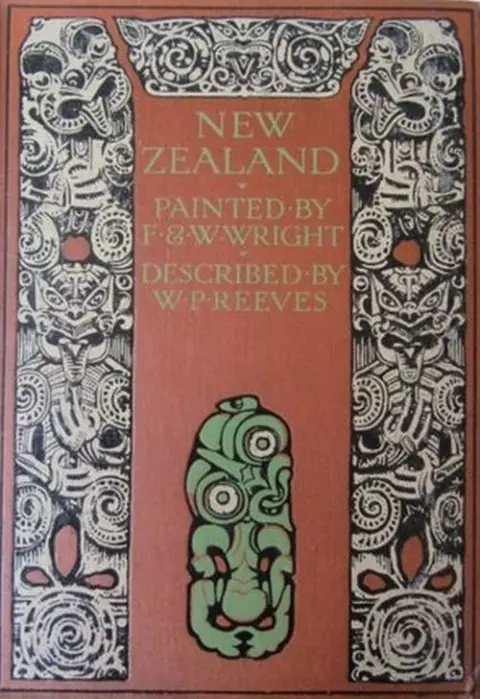
New Zealand
William Pember Reeves
THE CLASSIC COLLECTION · 1898
"The Long White Cloud: 'Ao Tea Roa'" by William Pember Reeves is a historical account written in the late 19th century. It provides an insightful exploration of New Zealand's genesis and development, tracing the island's history from the arrival of its earliest Polynesian settlers, the Maoris, to its status as a British colony. The work highlights the cultural, political, and natural aspects of New Zealand, aiming to shed light on its landscape and the complexities of its colonization. At the start of the book, Reeves establishes the backdrop of New Zealand's early European encounters. He notes the isolation and distinctiveness of the islands, contrasting their features with those of Britain and Australia. The opening portion delves into the arrival of the Maoris, their efforts in navigating the ocean to find New Zealand, and the rich, yet challenging landscape they encountered. Reeves also addresses the inadvertent impact of European settlers on the indigenous population and environment, setting the stage for a nuanced exploration of New Zealand's evolution through its unique struggles and successes.
Introduction adapted from the source catalogue; source summaries may be automatically generated.
Free to read · English · 102,986 words · No account needed
MAKE TIME FOR A GOOD BOOK
On by default. Untick to stop anonymous reading totals. Each page counts after 10 seconds in view. How this works.
Anonymous counting is on unless you have switched it off.
It is true that travellers may come to the Islands and leave them with no notion of a New Zealand river, except a raging mountain torrent, hostile to man and beast. Or they may be jolted over this same torrent when, shrunk and dwindled in summer heat to a mere glittering thread, it meanders lost and bewildered about a glaring bed of hot stones. But then railways and ordinary lines of communication are chiefly along the coasts. The unadventurous or hurried traveller sticks pretty closely to these. It happens that the rivers, almost without exception, show plainer features as they near the sea.
He who wishes to see their best must go inland and find them as they are still to be found in the North Island, winding through untouched valleys, under softly-draped cliffs, or shadowed by forests not yet marred by man. Or, in the South Island, they should be watched in the Alps as, milky or green-tinted, their ice-cold currents race through the gorges.
Of forest rivers, the Wanganui is the longest and most famous, perhaps the most beautiful. Near the sea it is simply a broad river, traversed by boats and small steamers, and with grassy banks dotted with weeping willows or clothed with flax and the palm-lily. But as you ascend it the hills close in. Their sides become tall cliffs, whose feet the water washes. From the tops of these precipices the forest, growing denser and richer at every turn, rises on the flanks of the hills. In places the cliffs are so steep and impracticable that the Maoris use ladders for descending on their villages above to their canoes in the rivers below. Lovely indeed are these cliffs; first, because of the profusion of fern frond, leaf, and moss, growing from everything that can climb to, lay hold of, or root itself in crack, crevice, or ledge, and droop, glistening with spray-drops, or wave whispering in the wind; next, because of the striking form and colour of the cliffs themselves. They are formed of what is called "Papa." This is a blue, calcareous clay often found with limestone, which it somewhat resembles. The Maori word "papa" is applied to any broad, smooth, flattish surface, as a door, or to a slab of rock. The smooth, slab-like, papa cliffs are often curiously marked--tongued and grooved, as with a gouge, channelled and fluted. Sometimes horizontal lines seem to divide them into strata. Again, the lines may be winding and spiral, so that on looking at certain cliffs it might be thought possible that the Maoris had got from them some of their curious tattoo patterns. Though pale and delicate, the tints of the rock are not their least beauty. Grey, yellow, brown, fawn, terra-cotta, even pale orange are to be noted. No photograph can give the charm of the drapery that clothes these cliffs. Photographs give no light or colour, and New Zealand scenery without light and colour is Hamlet with Hamlet left out. How could a photograph even hint at the dark, glossy green of the glistening karaka leaves, the feathery, waving foliage of the lace bark, or the white and purple bloom of the koromiko? How could black-and-white suggest the play of shade and shine when, between flying clouds, the glint of sunlight falls upon the sword-bayonet blades of the flax, and the golden, tossing plumes of the toe-toe, the New Zealand cousin of the Pampas grass? Add to this, that more often than the passenger can count as he goes along the river, either some little rill comes dripping over the cliff, scattering the sparkling drops on moss and foliage, or the cliffs are cleft and, as from a rent in the earth, some tributary stream gushes out of a dark, leafy tunnel of branches. Sometimes, too, the cliffs are not cleft, but the stream rushes from their summit, a white waterfall veiling the mossy rocks. Then there are the birds. In mid-air is to be seen the little fan-tail, aptly named, zig-zagging to and fro. The dark blue tui, called parson bird, from certain throat-feathers like white bands, will sing with a note that out-rivals any blackbird. The kuku, or wild pigeon, will show his purple, copper-coloured, white and green plumage as he sails slowly by, with that easy, confiding flight that makes him the cheap victim of the tyro sportsman. The grey duck, less easy to approach, rises noisily before boat or canoe comes within gunshot. The olive and brown, hoarse-voiced ka-ka, a large, wild parrot, and green, crimson-headed parakeets, may swell the list. Such is a "papa" river! and there are many such.
Your reading position is saved on this browser. Take it to another device with a library code. Reading pages adapt to text, rather than matching a printed edition.
William Pember Reeves
BEHIND THE BOOK
This eBook is for the use of anyone anywhere in the United States and most other parts of the world at no cost and with almost no restrictions whatsoever. You may copy it, give it away or re-use it under the terms of the Project Gutenberg License included with this eBook or online at www.gutenberg.org. If you are not located in the United States, you will have to check the laws of the country where you are located before using this eBook. Read the source licence.
The original source file, including credits and licence, is retained by this library. Request an original-format copy at no charge. Please include the book title and Project Gutenberg identifier #12411.
KEEP YOUR CURIOSITY GOING
Cécile Tormay

Moritz Busch
John L. Ransom
Frances Wright
Cécile Tormay

Mabel Potter Daggett