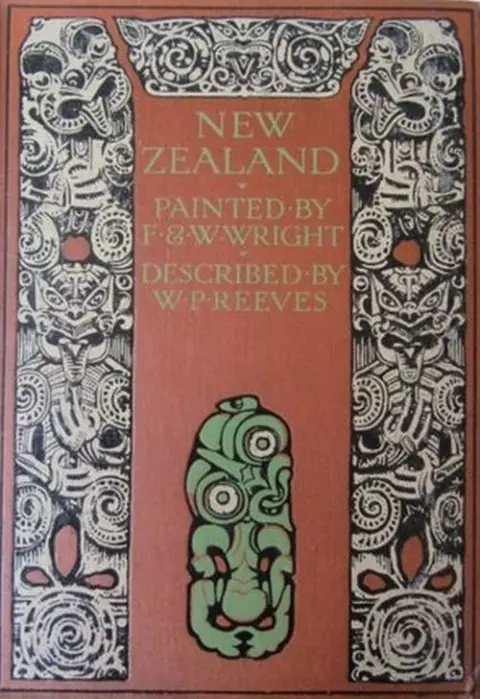
New Zealand
William Pember Reeves
THE CLASSIC COLLECTION · 1898
"The Long White Cloud: 'Ao Tea Roa'" by William Pember Reeves is a historical account written in the late 19th century. It provides an insightful exploration of New Zealand's genesis and development, tracing the island's history from the arrival of its earliest Polynesian settlers, the Maoris, to its status as a British colony. The work highlights the cultural, political, and natural aspects of New Zealand, aiming to shed light on its landscape and the complexities of its colonization. At the start of the book, Reeves establishes the backdrop of New Zealand's early European encounters. He notes the isolation and distinctiveness of the islands, contrasting their features with those of Britain and Australia. The opening portion delves into the arrival of the Maoris, their efforts in navigating the ocean to find New Zealand, and the rich, yet challenging landscape they encountered. Reeves also addresses the inadvertent impact of European settlers on the indigenous population and environment, setting the stage for a nuanced exploration of New Zealand's evolution through its unique struggles and successes.
Introduction adapted from the source catalogue; source summaries may be automatically generated.
Free to read · English · 102,986 words · No account needed
MAKE TIME FOR A GOOD BOOK
On by default. Untick to stop anonymous reading totals. Each page counts after 10 seconds in view. How this works.
Anonymous counting is on unless you have switched it off.
In 1853, the year of the land regulations, the Governor was entrusted with the task of proclaiming the constitution. He took the rather curious course of bringing the Provincial Councils into existence, and leaving the summoning of the central Parliament to his successor. He left the Colony in December of the same year, praised and regretted by the Maoris, regarded by the settlers with mixed feelings. Nevertheless, it would not be easy now to find any one who would refuse a very high meed of praise to Governor Grey's first administration. It was not merely that he found the Colony on the brink of ruin, and left it in a state of prosperity and progress. Able subalterns, a rise in prices, the development of some new industry, might have brought about the improvement. Such causes have often made reputation for colonial rulers and statesmen. But in Grey's case no impartial student can fail to see that to a considerable extent the change for the better was due to him. Moreover, he not only grappled with the difficulties of his time, but with both foresight and power of imagination built for the future, and--with one marked exception--laid foundations deep and well.
If the Colonial Office did not see its way to retain Grey in the Colony until his constitution had been put into full working order, it should, at least, have seen that he was replaced by a capable official. This was not done. His successor did not arrive for two years, and meanwhile the Vice-regal office devolved upon Colonel Wynyard, a good-natured soldier, unfitted for the position. The first Parliament of New Zealand was summoned, and met at Auckland on the Queen's birthday in 1854. Many, perhaps most, of its members were well-educated men of character and capacity. The presence of Gibbon Wakefield, now himself become a colonist, added to the interest of the scene. At last, those who had been agitating so long for self-government had the boon apparently within their grasp. In their eyes it was a great occasion--the true commencement of national life in the Colony. The irony of fate, or the perversity of man, turned it into a curious anticlimax. The Parliament, indeed, duly assembled. But it dispersed after weeks of ineffectual wrangling and intrigue, amid scenes which were discreditable and are still ridiculous. Those who had drawn up the constitution had forgotten that Government, through responsible Ministers forming a Cabinet and possessing the confidence of the elective Chamber, must be a necessary part of their system. Not only was no provision made for it in the written constitution, but the Colonial Office had sent the Governor no instructions on the subject. The Viceroy was surrounded by Patent Officers, some of whom had been administering since the first days of the Colony. No place of refuge had been prepared for them, and, naturally, they were not going to surrender their posts without a struggle. Colonel Wynyard was wax in the hands of the cleverest of these--Mr. Attorney-General Swainson. When the Parliament met, he asked three members to join with his old advisers in forming a Cabinet. They agreed to do so, and one of them, Mr. James Edward Fitzgerald, a Canterbury settler of brilliant abilities, figured as the Colony's first Premier. An Irish gentleman, an orator and a wit, he was about as fitted to cope with the peculiar and delicate imbroglio before him as Murat would have been to conceive and direct one of Napoleon's campaigns. In a few weeks he and his Parliamentary colleagues came to loggerheads with the old officials in the Cabinet, and threw up the game. Then came prorogation for a fortnight and another hybrid ministry, known to New Zealand history as the "Clean-Shirt Ministry," because its leader ingenuously informed Parliament that when asked by the Governor to form an administration, he had gone upstairs to put on a clean shirt before presenting himself at Government House. The Clean-Shirt Ministry lived for just two days. It was born and died amid open recrimination and secret wire-pulling, throughout which Mr. Attorney Swainson, who had got himself made Speaker of the Upper House while retaining his post as the Governor's legal adviser, and Mr. Gibbon Wakefield, who was ostensibly nothing but a private member of the Lower House, pulled the strings behind the scenes. Wakefield began by putting himself at the head of the agitation for responsible Ministers. When later, after negotiating with the Governor's entourage, he tried compromise, the majority of the House turned angrily upon him. At last a compromise was arrived at. Colonel Wynyard was to go on with his Patent Officers until a Bill could be passed and assented to in England establishing responsible government; then the old officials were to be pensioned off and shelved. At one stage in this singular session, the Governor sent a message to the House written on sheets of paper, one of the leaves of which the clerk found to be missing. Gibbon Wakefield thereupon coolly pulled the missing portion out of his pocket and proposed to hand it in--a piece of effrontery which the House could not stomach. On another occasion the door of the House had to be locked to prevent the minority running away to force on a count-out, and one honourable member assaulted another with his fists. Australia laughed at the scene, which, it may here be said, has never been repeated in the New Zealand Legislature. The greatest man in the Parliament was the greatest failure of the session. Gibbon Wakefield left Auckland unpopular and distrusted. Soon afterwards his health broke down, and the rest of his life was passed in strict retirement in the Colony which he had founded and in which he died.
Your reading position is saved on this browser. Take it to another device with a library code. Reading pages adapt to text, rather than matching a printed edition.
William Pember Reeves
BEHIND THE BOOK
This eBook is for the use of anyone anywhere in the United States and most other parts of the world at no cost and with almost no restrictions whatsoever. You may copy it, give it away or re-use it under the terms of the Project Gutenberg License included with this eBook or online at www.gutenberg.org. If you are not located in the United States, you will have to check the laws of the country where you are located before using this eBook. Read the source licence.
The original source file, including credits and licence, is retained by this library. Request an original-format copy at no charge. Please include the book title and Project Gutenberg identifier #12411.
KEEP YOUR CURIOSITY GOING
Cécile Tormay

Moritz Busch
John L. Ransom
Frances Wright
Cécile Tormay

Mabel Potter Daggett