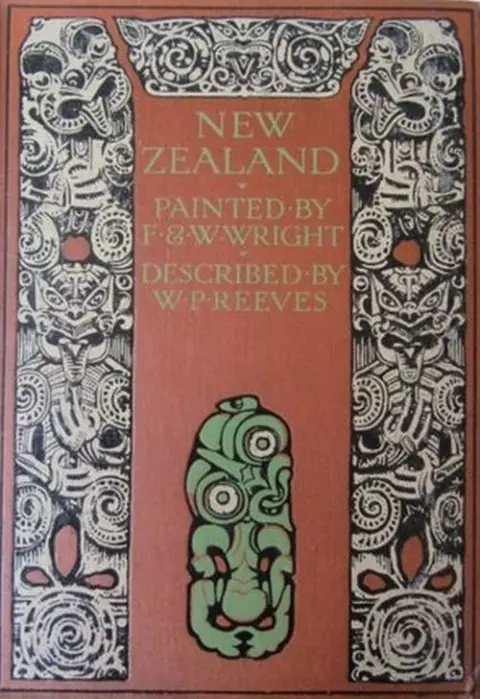
New Zealand
William Pember Reeves
THE CLASSIC COLLECTION · 1898
"The Long White Cloud: 'Ao Tea Roa'" by William Pember Reeves is a historical account written in the late 19th century. It provides an insightful exploration of New Zealand's genesis and development, tracing the island's history from the arrival of its earliest Polynesian settlers, the Maoris, to its status as a British colony. The work highlights the cultural, political, and natural aspects of New Zealand, aiming to shed light on its landscape and the complexities of its colonization. At the start of the book, Reeves establishes the backdrop of New Zealand's early European encounters. He notes the isolation and distinctiveness of the islands, contrasting their features with those of Britain and Australia. The opening portion delves into the arrival of the Maoris, their efforts in navigating the ocean to find New Zealand, and the rich, yet challenging landscape they encountered. Reeves also addresses the inadvertent impact of European settlers on the indigenous population and environment, setting the stage for a nuanced exploration of New Zealand's evolution through its unique struggles and successes.
Introduction adapted from the source catalogue; source summaries may be automatically generated.
Free to read · English · 102,986 words · No account needed
MAKE TIME FOR A GOOD BOOK
On by default. Untick to stop anonymous reading totals. Each page counts after 10 seconds in view. How this works.
Anonymous counting is on unless you have switched it off.
Not only, therefore, have English forms of life been of necessity drawn upon to fill the void spaces, but other countries have furnished their quota. The dark eucalypt of Tasmania, with its heavy-hanging, languid leaves, is the commonest of exotic trees. The artificial stiffness and regularity of the Norfolk Island pine, and the sweet-smelling golden blooms of the Australian wattle, are sights almost as familiar in New Zealand as in their native lands. The sombre pines of California and the macro carpa cypress cover thousands of acres. The merino sheep brought from Spain, viâ Saxony and Australia, is the basis of the flocks. The black swan and magpie represent the birds of New Holland. The Indian minah, after becoming common, is said to be retreating before the English starling. The first red deer came from Germany. And side by side with these strangers and with the trees and plants which colonists call specifically "English"--for the word "British" is almost unknown in the Colony--the native flora is beginning to be cultivated in gardens and grounds. Neglected by the first generation, it is better appreciated by their children--themselves natives of the soil.
In the north and warmer island the traveller also meets sharp contrasts. These, however, except in the provinces of Wellington and Napier, where the Tararua-Ruahiné spine plays to some extent the part taken by the Alps in the South Island, are not so much between east and west as between the coasts and the central plateau. For the most part, all the coasts, except the south-east, are, or have been, forest-clad. Nearly everywhere they are green, hilly and abundantly watered; windy, but not plagued with extremes of cold and heat. Frost touches them but for a short time in mid-winter.
The extreme south and north of the North Island could hardly, by any stretch of imagination, be called rich and fertile. But the island demonstrates the "falsehood of extremes," for between them is found some of the finest and pleasantest land in the southern hemisphere. Nearly all of this, however, lies within fifty miles of one or other coast. When you have left these tracts, and have risen a thousand feet or so, you come to a volcanic plateau, clad for the most part in dark green and rusty bracken or tussocks of faded yellow. Right in the centre rise the great volcanoes, Ruapehu, Tongariro and Tarawera, majestic in their outlines, fascinating because of the restless fires within and the outbreaks which have been and will again take place. Scattered about this plateau are lakes of every shape and size, from Taupo--called Te Moana (the sea) by the Maoris--to the tiniest lakelets and ponds. Here are found pools and springs of every degree of heat. Some are boiling cauldrons into which the unwary fall now and again to meet a death terrible, yet--if the dying words of some of them may be believed--not always agonizing, so completely does the shock of contact with the boiling water kill the nervous system. Many pools are the colour of black broth. Foul with mud and sulphur, they seethe and splutter in their dark pits, sending up clouds of steam and sulphurous fumes. Others are of the clearest green or deepest, purest blue, through which thousands of silver bubbles shoot up to the surface, flash, and vanish. But the main use of the hot springs is found in their combination of certain chemical properties,--sulphur-acid, sulphur-alkaline. Nowhere in the world, probably, are found healing waters at once so powerful and so various in their uses. Generations ago the Maori tribes knew something of their effects. Now invalids come from far and near in hundreds and thousands, and when the distractions and appliances of the sanitary stations equal those of the European spas they will come in tens of thousands, for the plateau is not only a health-resort but a wonderland. Its geysers rank with those of Iceland and the Yellowstone. Seen in the clear sunny air, these columns of water and white foam, mounting, swaying, blown by the wind into silver spray, and with attendant rainbows glittering in the light, are sights which silence even the chattering tourist for a while. Solfataras, mud volcanoes and fumaroles are counted in hundreds in the volcanic zone. If there were not such curiosities, still the beauty of the mountains, lakes, streams and patches of forest would, with the bright invigorating air, make the holiday-maker seek them in numbers. Through the middle of this curious region runs the Waikato, the longest and on the whole most tranquil and useful of that excitable race the rivers of New Zealand. Even the Waikato has its adventures. In one spot it is suddenly compressed to a sixth of its breadth, and, boiling between walls of rock, leaps in one mass of blue water and white foam into a deep, tree-fringed pool below. This is the Huka Waterfall. It is but one of the many striking falls to be met with in the Islands.
Your reading position is saved on this browser. Take it to another device with a library code. Reading pages adapt to text, rather than matching a printed edition.
William Pember Reeves
BEHIND THE BOOK
This eBook is for the use of anyone anywhere in the United States and most other parts of the world at no cost and with almost no restrictions whatsoever. You may copy it, give it away or re-use it under the terms of the Project Gutenberg License included with this eBook or online at www.gutenberg.org. If you are not located in the United States, you will have to check the laws of the country where you are located before using this eBook. Read the source licence.
The original source file, including credits and licence, is retained by this library. Request an original-format copy at no charge. Please include the book title and Project Gutenberg identifier #12411.
KEEP YOUR CURIOSITY GOING
Cécile Tormay

Moritz Busch
John L. Ransom
Frances Wright
Cécile Tormay

Mabel Potter Daggett