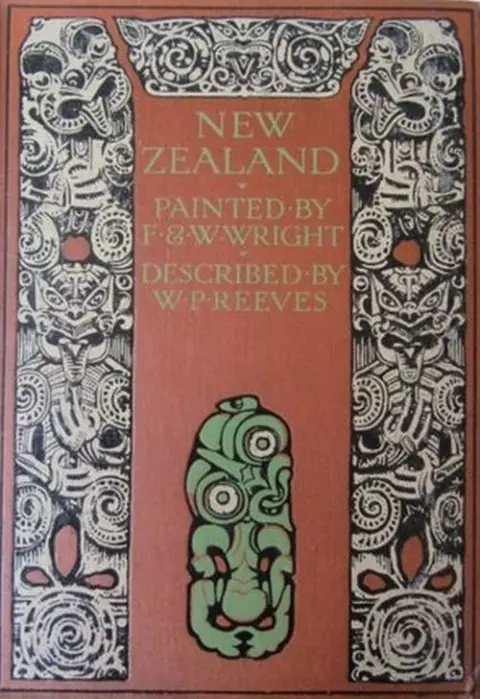
New Zealand
William Pember Reeves
THE CLASSIC COLLECTION · 1898
"The Long White Cloud: 'Ao Tea Roa'" by William Pember Reeves is a historical account written in the late 19th century. It provides an insightful exploration of New Zealand's genesis and development, tracing the island's history from the arrival of its earliest Polynesian settlers, the Maoris, to its status as a British colony. The work highlights the cultural, political, and natural aspects of New Zealand, aiming to shed light on its landscape and the complexities of its colonization. At the start of the book, Reeves establishes the backdrop of New Zealand's early European encounters. He notes the isolation and distinctiveness of the islands, contrasting their features with those of Britain and Australia. The opening portion delves into the arrival of the Maoris, their efforts in navigating the ocean to find New Zealand, and the rich, yet challenging landscape they encountered. Reeves also addresses the inadvertent impact of European settlers on the indigenous population and environment, setting the stage for a nuanced exploration of New Zealand's evolution through its unique struggles and successes.
Introduction adapted from the source catalogue; source summaries may be automatically generated.
Free to read · English · 102,986 words · No account needed
MAKE TIME FOR A GOOD BOOK
On by default. Untick to stop anonymous reading totals. Each page counts after 10 seconds in view. How this works.
Anonymous counting is on unless you have switched it off.
Moreover, for the reasons already sketched, the English in New Zealand formed a house divided against itself. The differences in the north between Maoris' officials, Alsatians of the old school, and settlers of the new, were sufficient to supply the Governor with a daily dish of annoyance. But the main colony of New Zealand was not in the north round Governor Hobson, but in Cook's Straits. There was to be found the large and daily increasing antagonistic element being brought in by the New Zealand Company. With an energy quite unchecked by any knowledge of the real condition of New Zealand, the directors of the Company in London kept on sending out ship-load after ship-load of emigrants to the districts around Cook's Straits. The centre of their operations was Port Nicholson, but bodies of their settlers were planted at Wanganui, at the mouth of the fine river described in the first chapter; at New Plymouth, hard by the Sugar-Loaves, in devastated almost empty Taranaki; and at pleasant but circumscribed Nelson in the South Island. Soon these numbered five times as many Whites as could be mustered in the north. Upon them at the very outset came the thunderbolt of Governor Hobson's proclamation refusing recognition to their land purchases. Of this and of the land clause in the Treaty of Waitangi the natives were made fully aware by the missionaries. Rauparaha, before told of and still the most influential chief near Cook's Straits, was exactly the man to take advantage of the situation. He had taken the muskets and gunpowder of the Company, and was now only too pleased to refuse them the price they thought to receive. It was, as already said, impossible to justify all, or nearly all, of Colonel Wakefield's gigantic purchase. But it was certainly incumbent on the Government to find a modus vivendi with the least possible delay. On the one hand they had thousands of decent, intelligent English colonists newly landed in a savage country, and not in any way responsible for the Company's haste and ignorance. The settlers at any rate had paid ample value for their land. They had given £1 for each acre of it. Angry as the English Government had been with the New Zealand Company for the defiant dispatch of its settlers, Lord John Russell had instructed Hobson's superior, Sir George Gibbs, that the emigrants should be regarded with kindness and consideration. On the other side were the native tribes, who, as the price of land went in those days, had certainly received the equivalent for a considerable territory. There was room for an equitable arrangement just as there was most pressing need for promptitude. Speed was the first thing needful, also the second, and the third. Instead of speed the settlers got a Royal Commission. A Commissioner was appointed, who did not arrive until two years after the Governor, and whose final award was not given for many months more. When he did give it, he cut down the Company's purchase of twenty million acres to two hundred and eighty-three thousand. As for land-claims of private persons, many of them became the subjects of litigation and petition, and some were not settled for twenty years. Why three or four Commissioners were not sent instead of one, and sent sooner, the official mind alone knows. Meantime, the weary months dragged on, and the unfortunate settlers of the Company were either not put in possession of their land at all, or had as little security for their farms as for their lives. They were not allowed to form volunteer corps, though living in face of ferocious and well-armed savages. Yet the Governor who forbade them to take means to defend themselves had not the troops with which to defend them. To show the state of the country it may be noted that the two tribes from whom Colonel Wakefield bought the land round Port Nicholson quarrelled amongst themselves over the sale. The Ngatiraukawa treacherously attacked the Ngatiawa, were soundly beaten, and lost seventy men. At first, it is true, settlers and natives got on excellently well together. The new-comers had money, and were good customers. But as time went on, and the settlers exhausted their funds and hopes, they ceased to be able to buy freely. And when they found the Maoris refusing to admit them to the farms for which they had paid £1 an acre in London, feeling grew more and more acute. The Company's settlement at Port Nicholson was perversely planted just on that place in the inner harbour which is exposed to the force of the ocean. It had to be shifted to a more sheltered spot, and this the natives denied they ever sold. That was but one of a series of disputes which led to murder and petty warfare, and were hardly at an end seven years later. The settlers, though shut out of the back country, did, however, hold the townland on which they had squatted, and which is now the site of Wellington, the capital of New Zealand.
Your reading position is saved on this browser. Take it to another device with a library code. Reading pages adapt to text, rather than matching a printed edition.
William Pember Reeves
BEHIND THE BOOK
This eBook is for the use of anyone anywhere in the United States and most other parts of the world at no cost and with almost no restrictions whatsoever. You may copy it, give it away or re-use it under the terms of the Project Gutenberg License included with this eBook or online at www.gutenberg.org. If you are not located in the United States, you will have to check the laws of the country where you are located before using this eBook. Read the source licence.
The original source file, including credits and licence, is retained by this library. Request an original-format copy at no charge. Please include the book title and Project Gutenberg identifier #12411.
KEEP YOUR CURIOSITY GOING
Cécile Tormay

Moritz Busch
John L. Ransom
Frances Wright
Cécile Tormay

Mabel Potter Daggett