THE CLASSIC COLLECTION✦An outlaw’s diary: the CommuneCLASSIC FREE BOOKS
An outlaw’s diary: the Commune
Cécile Tormay
THE CLASSIC COLLECTION · 1598
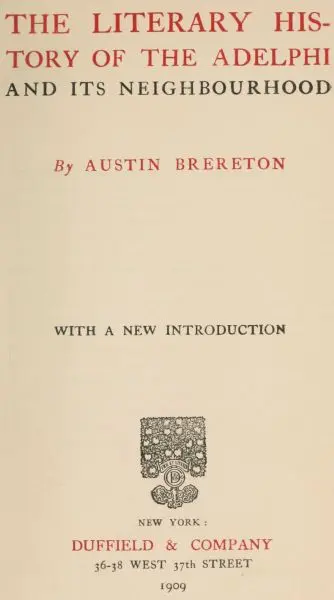
"The Literary History of the Adelphi and Its Neighbourhood" by Austin Brereton is a historical account written in the early 20th century. The work explores the rich literary and cultural history of the Adelphi area of London, detailing its significance through various illustrious figures and events over centuries. The narrative seeks to unveil the storied past of this intriguing locality, shedding light on its transformation and the notable individuals who have left their mark on it. The opening of the book sets the stage by presenting an overview of the Adelphi's historical significance, emphasizing its connections to various notable figures, including kings, queens, literary giants, and other influential personalities throughout history. Brereton mentions various important locations within the Adelphi, such as Durham House, which once served as a residence for many prominent figures and has been a site of significant events. The chapter introduces readers to the colorful history of the neighborhood, highlighting the various stories and anecdotes that define its character, thus engaging those interested in both literary history and the broader context of London's past.
Introduction adapted from the source catalogue; source summaries may be automatically generated.
Free to read · English · 71,958 words · No account needed
MAKE TIME FOR A GOOD BOOK
On by default. Untick to stop anonymous reading totals. Each page counts after 10 seconds in view. How this works.
Anonymous counting is on unless you have switched it off.
The Society of Arts--Its Foundation--Its Removal to the Adelphi in 1774--James Barry and his Famous Paintings--Visited in John Street by Burke and Johnson--The Latter's opinion of his Genius--Description of his Pictures for the Society--The Work of the Society--"Spot" Ward, the Inventor of "Friar's Balsam"--Johnson speaks in the Great Room--Forsaken by his "Flowers of Oratory."
INSEPARABLY connected with the romance of the Adelphi, and very interesting on its own account, is the history of the Society of Arts, with its memories, not only of painters, but of Johnson and other celebrities. The Society owes its origin to William Shipley (1714-1803), a drawing-master of Northampton, and brother of Jonathan Shipley, Bishop of St Asaph, the friend of Benjamin Franklin. It was established at a meeting held on March 22, 1754, at Rawthmell's Coffee-house, in Henrietta Street, Covent Garden. Its first president was Jacob, Lord Viscount Folkestone. Its complete designation is "The Society for the Encouragement of Arts, Manufactures and Commerce." Smollett, in his History of England (1757), says, somewhat grandiloquently: "The Society is so numerous, the contributions so considerable, the plan so judiciously laid, and executed with such discretion and spirit as to promise much more effectual and extensive advantage to the public than ever accrued from all the boasted academies of Christendom." The Society had various homes prior to settling in the Adelphi. Its first meetings were held over a circulating library in Crane's Court, Fleet Street. A move was made westward to Craig's Court, Charing Cross, and from there the Society went to the Strand, in rooms opposite the New Exchange, and, in 1759, to apartments in Beaufort Buildings, Savoy.
In 1771, the brothers Adam entered into an agreement with the Society for the erection of "a proper building in the Adelphi for the use of the Society and the accommodation of its officers." The first stone was laid by Lord Romney, on March 28, 1772, and the building was opened in 1774. The Great Room, in which are the six famous pictures painted by James Barry, R.A. (1741-1806), between the years 1777 and 1783, is 44 feet in width, 60 feet in depth, and 48 feet in height. The painting of these celebrated pictures is one of the most extraordinary episodes in the history of art. In 1774, the Society of Arts suggested to certain members of the Royal Academy--then newly instituted--that they should paint the interior of the Great Room, and that they should be reimbursed by the public exhibition of the completed works. This proposition was rejected by the academicians, at whose head was Sir Joshua Reynolds, and Barry, as a member, refused the offer. Three years later, however, Barry, having but sixteen shillings in his pocket, applied for permission to execute the work, unaided, and without remuneration. The Society's housekeeper told Benjamin Haydon, the historical painter (1786-1846), that she remembered Barry at work on his frescoes. His violence, she said, was dreadful, his oaths were horrid, and his temper was like insanity. In summer, he started painting at five o'clock, worked until dark, and then etched by lamp-light until eleven at night. Burke and Johnson called once. But no artist dared to brave his wrath. He had his tea boiled in a quart pot, dined on porridge, and drank milk for supper. So poor was the painter that he applied, but in vain, to the Society for a little money, and "an insolent secretary even objected to his charge for colours and models." Subsequently, the Society relented and advanced the artist a hundred pounds. The Society "afterwards indulged him with two exhibitions of his paintings, in 1783 and 1784, which brought him £503, 12s., the Society paying the cost of the exhibitions, which amounted to £174." He was also "rewarded" by the Society with a gold medal. But he had other, and, perhaps, more pleasing recognitions of his talent. That sturdy traveller and philanthropist, Jonas Hanway (1712-1786), came to one of the exhibitions, and the pioneer of the umbrella was so pleased that he insisted upon leaving a guinea instead of the customary shilling. The Prince of Wales gave Barry sittings, and Lord Aldborough declared that the painter had "surpassed Raphael." Lord Romney gave him a hundred guineas for a copy of the heads, and Dr Johnson thought highly of Barry's imaginative powers. "Whatever the hand may have done," he said to Boswell, "the mind has done its part. There is a grasp of mind there which you find nowhere else." Poor, neglected, and half-mad, Barry died at the age of sixty-five. His body lay in state in the Great Room on March 7. He was buried in St Paul's.
Your reading position is saved on this browser. Take it to another device with a library code. Reading pages adapt to text, rather than matching a printed edition.
BEHIND THE BOOK
This eBook is for the use of anyone anywhere in the United States and most other parts of the world at no cost and with almost no restrictions whatsoever. You may copy it, give it away or re-use it under the terms of the Project Gutenberg License included with this eBook or online at www.gutenberg.org. If you are not located in the United States, you will have to check the laws of the country where you are located before using this eBook. Read the source licence.
The original source file, including credits and licence, is retained by this library. Request an original-format copy at no charge. Please include the book title and Project Gutenberg identifier #57372.
KEEP YOUR CURIOSITY GOING
Cécile Tormay

Moritz Busch
John L. Ransom
Frances Wright
Cécile Tormay

Mabel Potter Daggett