THE CLASSIC COLLECTION✦An outlaw’s diary: the CommuneCLASSIC FREE BOOKS
An outlaw’s diary: the Commune
Cécile Tormay
THE CLASSIC COLLECTION · 1598
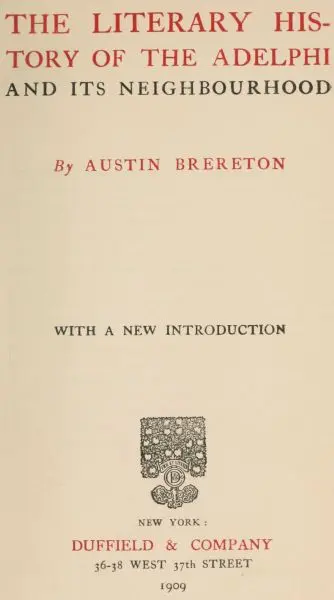
"The Literary History of the Adelphi and Its Neighbourhood" by Austin Brereton is a historical account written in the early 20th century. The work explores the rich literary and cultural history of the Adelphi area of London, detailing its significance through various illustrious figures and events over centuries. The narrative seeks to unveil the storied past of this intriguing locality, shedding light on its transformation and the notable individuals who have left their mark on it. The opening of the book sets the stage by presenting an overview of the Adelphi's historical significance, emphasizing its connections to various notable figures, including kings, queens, literary giants, and other influential personalities throughout history. Brereton mentions various important locations within the Adelphi, such as Durham House, which once served as a residence for many prominent figures and has been a site of significant events. The chapter introduces readers to the colorful history of the neighborhood, highlighting the various stories and anecdotes that define its character, thus engaging those interested in both literary history and the broader context of London's past.
Introduction adapted from the source catalogue; source summaries may be automatically generated.
Free to read · English · 71,958 words · No account needed
MAKE TIME FOR A GOOD BOOK
On by default. Untick to stop anonymous reading totals. Each page counts after 10 seconds in view. How this works.
Anonymous counting is on unless you have switched it off.
Some sixty years ago, said a writer towards the middle of the last century, there might have been seen daily passing in a direction between Oxford Street and the Adelphi, for years together, and through all kinds of weather, one whose appearance told, to even the most casual observer, he looked upon a remarkable man. Referring to himself, in one of his letters to a friend, Barry had once said, "Though the body and the soul of a picture will discover themselves on the slightest glance, yet you know it could not be the same with such a pock-fretted, hard-featured little fellow as I am also"; but neither these personal characteristics, nor the mean garb in which he usually appeared, could conceal the earnestness stamped upon his grave, saturnine countenance, or the air of entire absorption in some mental pursuit, having little in common with the bustle of the everyday business of the world around him. He was a man to make or to keep few friends, and to shun all acquaintances; it was not often, therefore, that, in these passages to and fro, he had any companion; but the event was noticeable when he had, from the striking change in his demeanour. He became full of animation, and of a kind of sparkling cheerfulness; his conversation was at once frank, weighty, and elevating, and even the oaths, with which he made somewhat free, could not spoil the delight of the most fastidious censor of words, whilst borne along on the full and free current of the painter's thoughts. No one but himself at such times would have called his countenance "hard-featured"; its smile was inexpressibly sweet, its look of scorn or anger, when roused, such as few men could have met unmoved. But what was the employment that thus determined for so long a period his daily movements? The answer will require a brief review of his past career. Whilst a young student at Rome, Barry, annoyed by the absurd taunts of foreigners as to the ungenial character of the British soil for the growth of art, was often seduced into answering them in such a manner as suited rather his fiery temper and indomitable will than the cause which he so impatiently espoused. But a better result was his own quiet determination to devote his life to the disproof of the theory. He began admirably, by a strict analysis of his own powers, and by inquiring how they were best to be developed. Here is the result: "If I should chance to have genius, or anything else," he observes, in a letter to a friend, "it is so much the better; but my hopes are grounded upon an unwearied, intense application, of which I am not sparing. At present I have little to show that I value; my work is all underground digging and laying foundations, which, with God's assistance, I may hereafter find the use of. I every day centre more and more upon the art; I give myself totally to it; and except honour and conscience, am determined to renounce everything else." But the writer was without a shilling in the world to call his own; and although he had friends, the best of friends, as they were--one of them at least, Burke, the best of men--he had already received from them the entire means of subsistence while he had been studying so long at Rome, and was determined, therefore, to be no longer a burden to them or to others; but how should he, renouncing all ordinary blandishments of a young painter's career, the "face-painting" and other methods by which genius condescends to become fashionable, or, in other words, to lay down its immortality for the pleasure of being acknowledged immortal--how was he to subsist? It was whilst this question remained, we may suppose, not decisively answered, that the painter thus wrote to another friend:--"O, I could be happy, in my going home, to find some corner where I could sit down in the middle of my studies, books, and casts after the antique, to paint this work and others, where I might have models of nature, when necessary, bread and soup, and a coat to cover me! I should care not what became of my work when it was done; but I reflect with horror upon such a fellow as I am, and with such a kind of art in London, with house-rent to pay, duns to follow me, and employers to look for. Had I studied art in a manner more accommodated to the nation, there would be no dread of this." But from this state of despondency and dissatisfaction he was soon to rise triumphant. Again and again he asked himself how he was to subsist while the great things he meditated should be accomplished, and the answer came: the conclusion was anything but attractive or cheering, but he saw it was the conclusion: no cross, no crown; and he accepted it ungrudgingly. It was not long before he could say, "I have taken great pains to fashion myself to this kind of Quixotism; to this end I have contracted and simplified my cravings and wants, and brought them into a very narrow compass." There are few, we think, of those who may have smiled with pity or contempt at the painter's mean garb, who would not have honoured it while they reverenced him, had they known this. The first apparent opportunity of achieving the object indicated was in connection with the proposed decoration of St Paul's.[28] But this fell through, and it was not until the Society of Arts accepted his offer that he was able to bring himself into line with his own convictions.
Your reading position is saved on this browser. Take it to another device with a library code. Reading pages adapt to text, rather than matching a printed edition.
BEHIND THE BOOK
This eBook is for the use of anyone anywhere in the United States and most other parts of the world at no cost and with almost no restrictions whatsoever. You may copy it, give it away or re-use it under the terms of the Project Gutenberg License included with this eBook or online at www.gutenberg.org. If you are not located in the United States, you will have to check the laws of the country where you are located before using this eBook. Read the source licence.
The original source file, including credits and licence, is retained by this library. Request an original-format copy at no charge. Please include the book title and Project Gutenberg identifier #57372.
KEEP YOUR CURIOSITY GOING
Cécile Tormay

Moritz Busch
John L. Ransom
Frances Wright
Cécile Tormay

Mabel Potter Daggett