THE CLASSIC COLLECTION✦An outlaw’s diary: the CommuneCLASSIC FREE BOOKS
An outlaw’s diary: the Commune
Cécile Tormay
THE CLASSIC COLLECTION · 1598
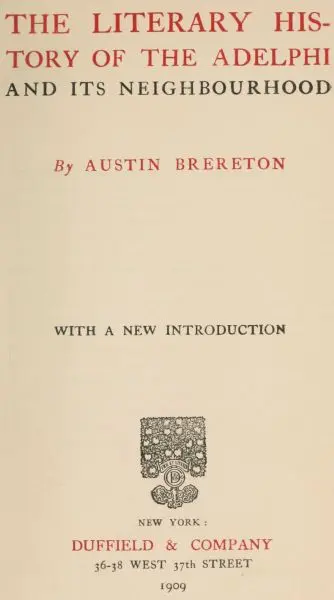
"The Literary History of the Adelphi and Its Neighbourhood" by Austin Brereton is a historical account written in the early 20th century. The work explores the rich literary and cultural history of the Adelphi area of London, detailing its significance through various illustrious figures and events over centuries. The narrative seeks to unveil the storied past of this intriguing locality, shedding light on its transformation and the notable individuals who have left their mark on it. The opening of the book sets the stage by presenting an overview of the Adelphi's historical significance, emphasizing its connections to various notable figures, including kings, queens, literary giants, and other influential personalities throughout history. Brereton mentions various important locations within the Adelphi, such as Durham House, which once served as a residence for many prominent figures and has been a site of significant events. The chapter introduces readers to the colorful history of the neighborhood, highlighting the various stories and anecdotes that define its character, thus engaging those interested in both literary history and the broader context of London's past.
Introduction adapted from the source catalogue; source summaries may be automatically generated.
Free to read · English · 71,958 words · No account needed
MAKE TIME FOR A GOOD BOOK
On by default. Untick to stop anonymous reading totals. Each page counts after 10 seconds in view. How this works.
Anonymous counting is on unless you have switched it off.
"In Craven Street, Strand, ten attorneys find place, And ten dark coal-barges are moor'd at its base; Fly, Honesty, fly! seek some safer retreat, For there's craft in the river, and craft in the street."[70]
This satire led to a retort by Sir George Rose, the judge and well-known legal writer, in extemporaneous lines written at a dinner:
"Why should Honesty fly to some safer retreat,
From attorneys and barges?--'od rot 'em!--
For the lawyers are just at the top of the street,
And the barges are just at the bottom."
Lawyers still have their offices in Craven Street, but the coal-barges vanished in 1876. A few doors from James Smith's, in the house on the left-hand side from the Strand, there lodged, in 1885, the celebrated American comedian, John Sleeper Clarke (1834-1899). His rooms overlooked the back of what was then the Avenue Theatre. This house, opened on March 11, 1882, was rebuilt by Mr Cyril Maude, and, on the eve of its re-opening, December 5, 1905, it was destroyed by the fall of the roof of Charing Cross Station. Again rebuilt by Mr Maude, it was opened, on January 28, 1907, as the Playhouse. The theatrical associations of this part of London are, indeed, like Mr Weller's knowledge of London, "extensive and peculiar."
[Footnote 64: The Court of England under the Stuarts, Jesse, vol.
iii., pp. 356-7.]
[Footnote 65: Forster's Goldsmith.]
[Footnote 66: Old and New London, vol. iii., p. 140.]
[Footnote 67: London in the Reign of Victoria, G. Laurence Gomme, pp.
156-7.]
[Footnote 68: Memoirs of James Smith, vol. i., p. 32.]
[Footnote 69: Haunted London, pp. 140-141.]
[Footnote 70: Gothic Miscellanies, James Smith, vol. ii., p. 186.]
Appendix
January 31, 1668.--Up, and by coach, with W. Griffin with me, and our Contract-books, to Durham Yard to the Commissioners for Accounts. [See page 37.]
May 10, 1668.--From church home with my Lady Pen; and after being there an hour or so talking, I took her ... and old Mrs Whistler, her mother-in-law, by water ... as far as Chelsy, and so back to Spring Garden ... and so to water again, and set down the old woman at home at Durham Yard.
April 26, 1669.--I am told by Betty, who was all undressed, of a great fire happened in Durham Yard last night, burning the house of one Lady Hungerford. [See page 38.]
February 11, 1660.--My wife and I ... went out again to show her the fires, and after walking as far as the Exchange, we returned and to bed.
March 12, 1660.--My wife and I to the Exchange, where we bought a
great many things.
July 7, 1660.--Thence to the 'Change, where I bought two fine prints
of Ragotti from Rubens.
Your reading position is saved on this browser. Take it to another device with a library code. Reading pages adapt to text, rather than matching a printed edition.
BEHIND THE BOOK
This eBook is for the use of anyone anywhere in the United States and most other parts of the world at no cost and with almost no restrictions whatsoever. You may copy it, give it away or re-use it under the terms of the Project Gutenberg License included with this eBook or online at www.gutenberg.org. If you are not located in the United States, you will have to check the laws of the country where you are located before using this eBook. Read the source licence.
The original source file, including credits and licence, is retained by this library. Request an original-format copy at no charge. Please include the book title and Project Gutenberg identifier #57372.
KEEP YOUR CURIOSITY GOING
Cécile Tormay

Moritz Busch
John L. Ransom
Frances Wright
Cécile Tormay

Mabel Potter Daggett