THE CLASSIC COLLECTION✦An outlaw’s diary: the CommuneCLASSIC FREE BOOKS
An outlaw’s diary: the Commune
Cécile Tormay
THE CLASSIC COLLECTION · 1598
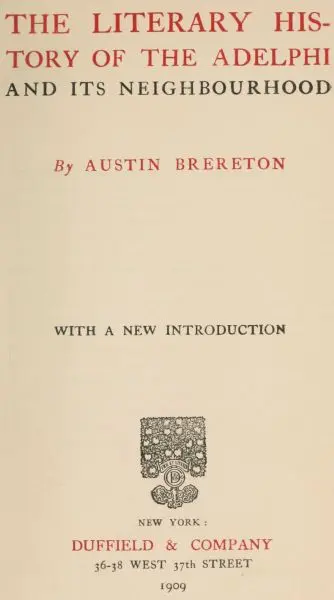
"The Literary History of the Adelphi and Its Neighbourhood" by Austin Brereton is a historical account written in the early 20th century. The work explores the rich literary and cultural history of the Adelphi area of London, detailing its significance through various illustrious figures and events over centuries. The narrative seeks to unveil the storied past of this intriguing locality, shedding light on its transformation and the notable individuals who have left their mark on it. The opening of the book sets the stage by presenting an overview of the Adelphi's historical significance, emphasizing its connections to various notable figures, including kings, queens, literary giants, and other influential personalities throughout history. Brereton mentions various important locations within the Adelphi, such as Durham House, which once served as a residence for many prominent figures and has been a site of significant events. The chapter introduces readers to the colorful history of the neighborhood, highlighting the various stories and anecdotes that define its character, thus engaging those interested in both literary history and the broader context of London's past.
Introduction adapted from the source catalogue; source summaries may be automatically generated.
Free to read · English · 71,958 words · No account needed
MAKE TIME FOR A GOOD BOOK
On by default. Untick to stop anonymous reading totals. Each page counts after 10 seconds in view. How this works.
Anonymous counting is on unless you have switched it off.
Craven Street, which still retains much of its old-world air, is chiefly notable for the fact that Benjamin Franklin lived here, at No. 7, at the house of Mrs Margaret Stevenson, during the entire period of his visits to London as agent for the House of Assembly, Philadelphia, and "other provinces." Leigh Hunt, speaking of this circumstance, says: "What a change along the shores of the Thames in a few years (for two centuries are less than two years in the lapse of time), from the residence of a set of haughty nobles, who never dreamt that a tradesman could be anything but a tradesman, to that of a yeoman's son, and a printer, who was one of the founders of a great state!" He was visited here in February, 1755, by William Pitt (the first Earl of Chatham, 1708-1788), and, wrote Franklin, "He stayed with me near two hours, his equipage waiting at the door." The house, which is marked by a tablet, is now a private hotel.
Mark Akenside, the poet and physician, was visited in this street, on January 22, 1761--at which time he was physician to Queen Charlotte--by Sir Joshua Reynolds. Heinrich Heine, during his stay in England, April 23 to August 8, 1827, lodged at No. 32 Craven Street. A notorious resident of this street was James Hackman (1752-1779), incumbent of Wiveton, Norfolk. He fell in love with Martha Ray, who was the mother of nine children, of whom Lord Sandwich was the father. His passion was so great that, as the lady would not marry him, he shot her dead on the night of April 7, 1779, in the piazza of Covent Garden Theatre. He turned the pistol upon himself, but without fatal effect. He was hanged at Tyburn twelve days later.
A more interesting resident was James Smith, one of the authors of the Rejected Addresses, who lived for many years at No. 27, where he died on December 24, 1839. This remarkable literary character, the son of a solicitor to the Ordnance, was born in 1775. At the age of twenty-seven he had made his mark in Fleet Street, and, from 1807 to 1817, the articles to the Monthly Mirror entitled "Horace in London" were written by him. In 1812, with his younger brother, Horatio, he published the Rejected Addresses, in which Wordsworth, Southey, Coleridge, Lord Byron, Sir Walter Scott, and other writers were parodied with admirable felicity. He wrote many of the "Entertainments" for Charles Mathews the Elder, including Country Cousins in 1820, and the Trip to France and the Trip to America in the two succeeding years. For the last two sketches he received a thousand pounds. "A thousand pounds!" he used to exclaim, with a shrug of the shoulders, "and all for nonsense."[68] He was lucky enough to obtain a legacy of £300 for a complimentary epigram on Mr Strachan, the King's printer. Being patted on the head when a boy by Chief-Justice Mansfield, in Highgate churchyard, and once seeing Horace Walpole on his lawn at Twickenham, were the two chief historical events of Mr Smith's quiet life. The four reasons that kept so clever a man employed on mere amateur trifling were these--an indolent disinclination to sustained work, a fear of failure, a dislike to risk a well-earned fame, and a foreboding that literary success might injure his practice as a lawyer. His favourite visits were to Lord Mulgrave's, Mr Croker's, Lord Abinger's, Lady Blessington's, and Lord Harrington's. Pretty Lady Blessington used to say of him, that "James Smith, if he had not been a witty man, must have been a great man. He died in his house in Craven Street, with the calmness of a philosopher, on the 24th of December, 1839, in the sixty-fifth year of his age."[69] It was on his own street that he wrote the well-known epigram:
Your reading position is saved on this browser. Take it to another device with a library code. Reading pages adapt to text, rather than matching a printed edition.
BEHIND THE BOOK
This eBook is for the use of anyone anywhere in the United States and most other parts of the world at no cost and with almost no restrictions whatsoever. You may copy it, give it away or re-use it under the terms of the Project Gutenberg License included with this eBook or online at www.gutenberg.org. If you are not located in the United States, you will have to check the laws of the country where you are located before using this eBook. Read the source licence.
The original source file, including credits and licence, is retained by this library. Request an original-format copy at no charge. Please include the book title and Project Gutenberg identifier #57372.
KEEP YOUR CURIOSITY GOING
Cécile Tormay

Moritz Busch
John L. Ransom
Frances Wright
Cécile Tormay

Mabel Potter Daggett