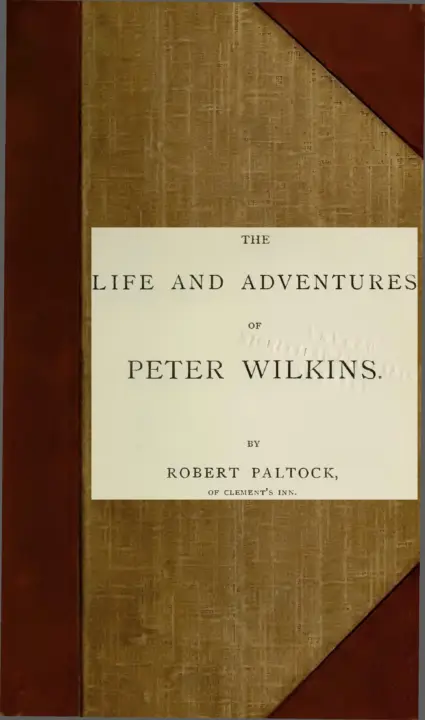
The Life and Adventures of Peter Wilkins, Complete (Volumes 1 and 2)
Robert Paltock
THE CLASSIC COLLECTION · 1751
"The Life and Adventures of Peter Wilkins, Volume 1" by Robert Paltock is a novel written in the early 18th century. The tale revolves around the adventures of Peter Wilkins, a Cornish man who experiences a series of extraordinary events, including a shipwreck and his incredible encounters with a flying woman named Youwarkee in a mystical world. This whimsical narrative combines elements of fantasy, exploration, and romance. The opening of the book introduces Peter Wilkins and hints at his remarkable life story, which he recounts during his journey home from a shipwreck near the South Pole. It begins with the author, Robert Paltock, setting the stage with a preface and introduction that provide context about Peter's past and adventures to come. As Peter recounts his experiences, he reflects on his background, family struggles, and the remarkable circumstances that led him to encounter a flying woman and her unique society. The writing hints at themes of adventure, love, and the exploration of fantastical realms, engaging readers with the promise of a captivating journey ahead.
Introduction adapted from the source catalogue; source summaries may be automatically generated.
Free to read · English · 72,779 words · No account needed
MAKE TIME FOR A GOOD BOOK
On by default. Untick to stop anonymous reading totals. Each page counts after 10 seconds in view. How this works.
Anonymous counting is on unless you have switched it off.
Paltock's fame may be said to be firmly established. An American writer, it is true, in a recent "History of Fiction," says not a word about "Peter Wilkins;" but, we must remember, another American wrote a "History of Caricature" without mentioning Rowlandson. Coleridge admired the book, and is reported to have said: "Peter Wilkins is, to my mind, a work of uncommon beauty.... I believe that 'Robinson Crusoe' and 'Peter Wilkins' could only have been written by islanders. No continentalist could have conceived either tale.... It would require a very peculiar genius to add another tale ejusdem generis to 'Robinson Crusoe' and 'Peter Wilkins.' I once projected such a thing, but the difficulty of the preoccupied ground stopped me. Perhaps La Motte Fouque might effect something; but I should fear that neither he nor any other German could entirely understand what may be called the desert island feeling. I would try the marvellous line of 'Peter Wilkins' if I attempted it rather than the real fiction of 'Robinson Crusoe'" ("Table-Talk," 1851, pp. 331-332). Southey, in a note on a passage of the "Curse of Kehama," went so far as to say that Paltock's winged people "are the most beautiful creatures of imagination that ever were devised," and added that Sir Walter Scott was a warm admirer of the book. With Charles Lamb at Christ's Hospital the story was a favourite. "We had classics of our own," he says, "without being beholden to 'insolent Greece or haughty Rome,' that passed current among us--'Peter Wilkins,' the 'Adventures of the Hon. Captain Robert Boyle,' the 'Fortunate Blue-Coat Boy,' and the like." But nobody loved the old romance with such devotion as Leigh Hunt. He was never tired of discoursing about its beauties, and he wrote with such thorough appreciation of his subject that he left little or nothing for another to add. "It is interesting," he writes in one place, "to fancy R. P., or 'Mr. Robert Paltock of Clement's Inn,' a gentle lover of books, not successful enough, perhaps, as a barrister to lead a public or profitable life, but eking out a little employment or a bit of a patrimony with literature congenial to him, and looking oftener to 'Purchase Pilgrims' on his shelves than to 'Coke on Littleton.' We picture him to ourselves with 'Robinson Crusoe' on one side of him and 'Gaudentio di Lucca' on the other, hearing the pen go over his paper in one of those quiet rooms in Clement's Inn that look out of its old-fashioned buildings into the little garden with the dial in it held by the negro: one of the prettiest corners in London, and extremely fit for a sequestered fancy that cannot get any further. There he sits, the unknown, ingenious, and amiable Mr. Robert Paltock, thinking of an imaginary beauty for want of a better, and creating her for the delight of posterity, though his contemporaries were to know little or nothing of her. We shall never go through the place again without regarding him as its crowning interest.... Now a sweeter creature [than Youwarkee] is not to be found in books; and she does him immortal honour. She is all tenderness and vivacity; all born good taste and blessed companionship. Her pleasure consists but in his; she prevents all his wishes; has neither prudery nor immodesty; sheds not a tear but from right feeling; is the good of his home and the grace of his fancy. It has been well observed that the author has not made his flying women in general light and airy enough... And it may be said, on the other hand, that the kind of wing, the graundee, or elastic drapery which opens and shuts at pleasure, however ingeniously and even beautifully contrived, would necessitate creatures whose modifications of humanity, bodily and mental, though never so good after their kind, might have startled the inventor had he been more of a naturalist; might have developed a being very different from the feminine, sympathising, and lovely Youwarkee. Muscles and nerves not human must have been associated with inhuman wants and feelings; probably have necessitated talons and a beak! At best the woman would have been wilder, more elvish, capricious, and unaccountable. She would have ruffled her whalebones when angry; been horribly intimate, perhaps, with birds' nests and fights with eagles; and frightened Wilkins out of his wits with dashing betwixt rocks and pulling the noses of seals and gulls. ("Book for a Corner," 1868, i. 68, &c.) Could criticism be more delightful? But in the "London Journal," November 5, 1834, the genial essayist's fancy dallied even more daintily with the theme: "A peacock with his plumage displayed, full of 'rainbows and starry eyes,' is a fine object, but think of a lovely woman set in front of an ethereal shell and wafted about like a Venus.... We are to picture to ourselves a nymph in a vest of the finest texture and most delicate carnation. On a sudden this drapery parts in two and flies back, stretched from head to foot like an oval fan or an umbrella; and the lady is in front of it, preparing to sweep blushing away from us and 'winnow the buxom air.'"
Your reading position is saved on this browser. Take it to another device with a library code. Reading pages adapt to text, rather than matching a printed edition.
BEHIND THE BOOK
This eBook is for the use of anyone anywhere in the United States and most other parts of the world at no cost and with almost no restrictions whatsoever. You may copy it, give it away or re-use it under the terms of the Project Gutenberg License included with this eBook or online at www.gutenberg.org. If you are not located in the United States, you will have to check the laws of the country where you are located before using this eBook. Read the source licence.
The original source file, including credits and licence, is retained by this library. Request an original-format copy at no charge. Please include the book title and Project Gutenberg identifier #21513.
KEEP YOUR CURIOSITY GOING
Coulson Kernahan

Maurice Baring
Frances Wright
Cécile Tormay
Francis Greenleaf Allinson & Anne C. E. (Anne Crosby Emery) Allinson

Frederic Jesup Stimson