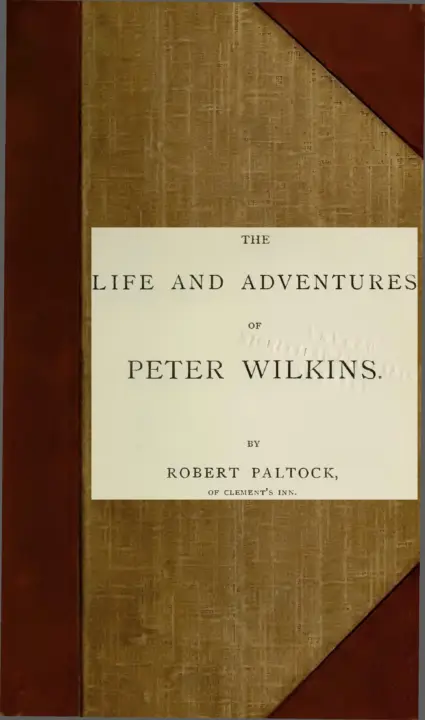
The Life and Adventures of Peter Wilkins, Complete (Volumes 1 and 2)
Robert Paltock
THE CLASSIC COLLECTION · 1751
"The Life and Adventures of Peter Wilkins, Volume 1" by Robert Paltock is a novel written in the early 18th century. The tale revolves around the adventures of Peter Wilkins, a Cornish man who experiences a series of extraordinary events, including a shipwreck and his incredible encounters with a flying woman named Youwarkee in a mystical world. This whimsical narrative combines elements of fantasy, exploration, and romance. The opening of the book introduces Peter Wilkins and hints at his remarkable life story, which he recounts during his journey home from a shipwreck near the South Pole. It begins with the author, Robert Paltock, setting the stage with a preface and introduction that provide context about Peter's past and adventures to come. As Peter recounts his experiences, he reflects on his background, family struggles, and the remarkable circumstances that led him to encounter a flying woman and her unique society. The writing hints at themes of adventure, love, and the exploration of fantastical realms, engaging readers with the promise of a captivating journey ahead.
Introduction adapted from the source catalogue; source summaries may be automatically generated.
Free to read · English · 72,779 words · No account needed
MAKE TIME FOR A GOOD BOOK
On by default. Untick to stop anonymous reading totals. Each page counts after 10 seconds in view. How this works.
Anonymous counting is on unless you have switched it off.
An edition appeared immediately afterwards at Dublin; so the book must have had some sale. The introduction and the dedication to the Countess of Northumberland (to whom it will be remembered Percy dedicated his "Reliques" and Goldsmith the first printed copy of his "Edwin and Angelina") are signed with the initials "R. P.;" and for many years the author's full name was unknown. In 1835, Nicol, the printer, sold by auction a number of books and manuscripts in his possession, which had once belonged to Dodsley, the publisher; and when these were being catalogued, the original agreement * for the sale of the MS. of "Peter Wilkins" was brought to light.
* It is now in the collection, shortly to be dispersed, of the late Mr. James Crossley of Manchester, a gentleman who was esteemed throughout his long life not less for unfailing courtesy than for rare scholarship. Mr. Crossley promised to search for the document and send me a transcript of it; but his kind intention was frustrated by his death. Paltock's name is sometimes written Pultock or Poltock. There is no ground for identifying the author of "Peter Wilkins" with the "R. P., Gent.," who published in 1751 "Memoirs of the Life of Parnese, a Spanish Lady, Translated from the Spanish MS."
From this document it appeared that the author was Robert Paltock of Clement's Inn, and that he received for the copyright 20L., twelve copies of the book, and "the cuts of the first impression"(proof impressions of the illustrations). The writer's name shows him to have been, like his hero, of Cornish origin; but the authors of the admirable and exhaustive "Bibliotheca Cornubiensis" could discover nothing about him beyond the fact that he was not a bencher of Clement's Inn. That Paltock should have chosen Clement's Inn as a place of residence is not surprising. It still keeps something of its pristine repose. The sun-dial is still supported by the negro; the grass has not lost its verdure, and on August evenings the plane-trees' leaves glint golden in the sun. One may still hear the chimes at midnight as Falstaff and Justice Shallow heard them of old. Here, where only a muffled murmur comes from the work-a-day world, a man in the last century might have dreamed away his life, lonely as Peter Wilkins on the island. One can imagine the amiable recluse composing his homely romance amid such surroundings. Perhaps it was the one labour of his life. He may have come to the Inn originally with the aspiration of making fame and money; and then the spirit of cloistered calm turned him from such vulgar paths, and instead of losing his fine feelings and swelling the ranks of the plutocrats, he gave us a charming romance for our fireside. With the literary men of his day he seems to have had no intercourse. Not a single mention of him is to be found among his contemporaries, and we may be sure that he cut no brilliant figure at the club-houses. No chorus of reviewers chimed the praises of "Peter Wilkins." So far as I can discover, the "Monthly Review" was the only journal in which the book was noticed, and such criticism as the following can hardly be termed laudatory:--"Here is a very strange performance indeed. It seems to be the illegitimate offspring of no very natural conjunction, like 'Gulliver's Travels' and 'Robinson Crusoe;' but much inferior to the manner of these two performances as to entertainment or utility. It has all that is impossible in the one or impossible in the other, without the wit and spirit of the first, or the just strokes of nature and useful lessons of morality in the second. However, if the invention of wings for mankind to fly with is sufficient amends for all the dulness and unmeaning extravagance of the author, we are willing to allow that his book has some merit, and that he deserves some encouragement at least as an able mechanic, if not as a good author." But the book was not forgotten. A new edition appeared in 1783, and again in the following year. It was included in Weber's "Popular Romances," 1812, and published separately, with some charming plates by Stothard, in 1816. Within the last fifty years it has been frequently issued, entire or mutilated, in a popular form. A drama founded on the romance was acted at Covent Garden on April 16, 1827; and more than once of late years "Peter Wilkins" has afforded material for pantomimes. In 1763 a French translation (by Philippe Florent de Puisieux) appeared under the title of "Les Hommes Volants, ou les Aventures de Pierre Wilkins," which was included in vols. xxii.-xxiii. of DePerthe's "Voyages Imaginaires" ( 1788-89). A German translation was published in 1767, having for title "Die fliegenden Menschen, oder wunderbare Begebenheiten Peter Wilkins." Whether the author lived to see the translations of this work cannot be ascertained. A Robert Paltock was buried at Ryme Intrinseca Church, Dorset, in 1767, aged seventy (Hutchin's "Dorset," iv. 493-494, third edition), but it is very doubtful whether he was the author of the romance.
Your reading position is saved on this browser. Take it to another device with a library code. Reading pages adapt to text, rather than matching a printed edition.
BEHIND THE BOOK
This eBook is for the use of anyone anywhere in the United States and most other parts of the world at no cost and with almost no restrictions whatsoever. You may copy it, give it away or re-use it under the terms of the Project Gutenberg License included with this eBook or online at www.gutenberg.org. If you are not located in the United States, you will have to check the laws of the country where you are located before using this eBook. Read the source licence.
The original source file, including credits and licence, is retained by this library. Request an original-format copy at no charge. Please include the book title and Project Gutenberg identifier #21513.
KEEP YOUR CURIOSITY GOING
Coulson Kernahan

Maurice Baring
Frances Wright
Cécile Tormay
Francis Greenleaf Allinson & Anne C. E. (Anne Crosby Emery) Allinson

Frederic Jesup Stimson