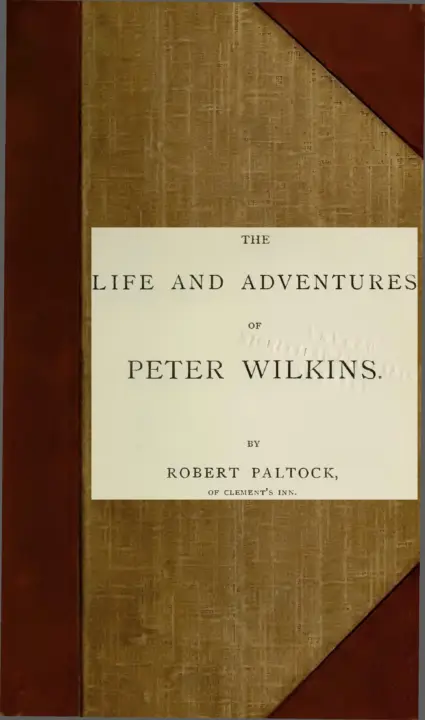
The Life and Adventures of Peter Wilkins, Complete (Volumes 1 and 2)
Robert Paltock
THE CLASSIC COLLECTION · 1751
"The Life and Adventures of Peter Wilkins, Volume 1" by Robert Paltock is a novel written in the early 18th century. The tale revolves around the adventures of Peter Wilkins, a Cornish man who experiences a series of extraordinary events, including a shipwreck and his incredible encounters with a flying woman named Youwarkee in a mystical world. This whimsical narrative combines elements of fantasy, exploration, and romance. The opening of the book introduces Peter Wilkins and hints at his remarkable life story, which he recounts during his journey home from a shipwreck near the South Pole. It begins with the author, Robert Paltock, setting the stage with a preface and introduction that provide context about Peter's past and adventures to come. As Peter recounts his experiences, he reflects on his background, family struggles, and the remarkable circumstances that led him to encounter a flying woman and her unique society. The writing hints at themes of adventure, love, and the exploration of fantastical realms, engaging readers with the promise of a captivating journey ahead.
Introduction adapted from the source catalogue; source summaries may be automatically generated.
Free to read · English · 72,779 words · No account needed
MAKE TIME FOR A GOOD BOOK
On by default. Untick to stop anonymous reading totals. Each page counts after 10 seconds in view. How this works.
Anonymous counting is on unless you have switched it off.
The Author observes her flight--A description of a glumm in the graundee--She finds out the gulf not far from the ship--Brings home more goods--Makes her a gown by her husband's instruction
I had ever since our marriage been desirous of seeing Youwarkee fly; but this was the first opportunity I had of it; and indeed the sight was worthy of all the attention I paid it; for I desired her slowly to put herself in proper order for it, that I might make my observation the more accurately; and shall now give you an account of the whole apparatus, though several parts of the description were taken from subsequent views; for it would have been impossible to have made just remarks of everything at that once, especially as I only viewed her back parts then.
I told you before, I had seen her graundee open, and quite extended as low as her middle; but that being in the grotto by lamplight, I could not take so just a survey as now, when the sort of light we ever had was at the brightest.
She first threw up two long branches or ribs of the whalebone, as I called it before (and indeed for several of its properties, as toughness, elasticity, and pliableness, nothing I have ever seen can so justly be compared to it), which were jointed behind to the upper bone of the spine, and which, when not extended, lie bent over the shoulders on each side of the neck forwards, from whence, by nearer and nearer approaches, they just meet at the lower rim of the belly in a sort of point; but when extended, they stand their whole length above the shoulders, not perpendicularly, but spreading outwards, with a web of the softest and most pliable and springy membrane that can be imagined, in the interstice between them, reaching from their root or joint on the back up above the hinder part of the head, and near half-way their own length; but when closed, the membrane falls down in the middle upon the neck, like a handkerchief. There are also two other ribs rising as it were from the same root, which, when open, run horizontally, but not so long as the others. These are filled up in the interstice between them and the upper ones with the same membrane; and on the lower side of this is also a deep flap of the membrane, so that the arms can be either above or below it in flight, and are always above it when closed. This last rib, when shut, flaps under the upper one, and also falls down with it before to the waist, but is not joined to the ribs below. Along the whole spine-bone runs a strong, flat, broad, grisly cartilage, to which are joined several other of these ribs; all which open horizontally, and are filled in the interstices with the above membrane, and are jointed to the ribs of the person just where the plane of the back begins to turn towards the breast and belly; and, when shut, wrap the body round to the joints on the contrary side, folding neatly one side over the other. At the lower spine are two more ribs, extended horizontally when open, jointed again to the hips, and long enough to meet the joint on the contrary side cross the belly; and from the hip-joint, which is on the outermost edge of the hip-bone, runs a pliable cartilage quite down the outside of the thigh and leg to the ankle; from which there branch out divers other ribs horizontally also when open, but when closed, they encompass the whole thigh and leg, rolling inwards cross the back of the leg and thigh till they reach and just cover the cartilage. The interstices of these are also filled up with the same membrane. From the two ribs which join to the lower spine-bone, there hangs down a sort of short apron, very full of plaits, from hip-joint to hip-joint, and reaches below the buttocks, half-way or more to the hams. This has also several small limber ribs in it. Just upon the lower spine-joint, and above the apron, as I call it, there are two other long branches, which, when close, extend upon the back from the point they join at below to the shoulders, where each rib has a clasper, which reaching over the shoulders, just under the fold of the uppermost branch or ribs, hold up the two ribs flat to the back like a V, the interstices of which are also filled up with the aforesaid membrane. This last piece, in flight, falls down almost to the ankles, where the two claspers lapping under each leg within-side, hold it very fast; and then also the short apron is drawn up by-the strength of the ribs in it, between the thighs forward, and covers the pudenda and groin as far as the rim of the belly. The whole arms are covered also from the shoulders to the wrist with the same delicate membrane, fastened to ribs of proportionable dimensions, and jointed to a cartilage on the outside in the same manner as on the legs.
Your reading position is saved on this browser. Take it to another device with a library code. Reading pages adapt to text, rather than matching a printed edition.
BEHIND THE BOOK
This eBook is for the use of anyone anywhere in the United States and most other parts of the world at no cost and with almost no restrictions whatsoever. You may copy it, give it away or re-use it under the terms of the Project Gutenberg License included with this eBook or online at www.gutenberg.org. If you are not located in the United States, you will have to check the laws of the country where you are located before using this eBook. Read the source licence.
The original source file, including credits and licence, is retained by this library. Request an original-format copy at no charge. Please include the book title and Project Gutenberg identifier #21513.
KEEP YOUR CURIOSITY GOING
Coulson Kernahan

Maurice Baring
Frances Wright
Cécile Tormay
Francis Greenleaf Allinson & Anne C. E. (Anne Crosby Emery) Allinson

Frederic Jesup Stimson