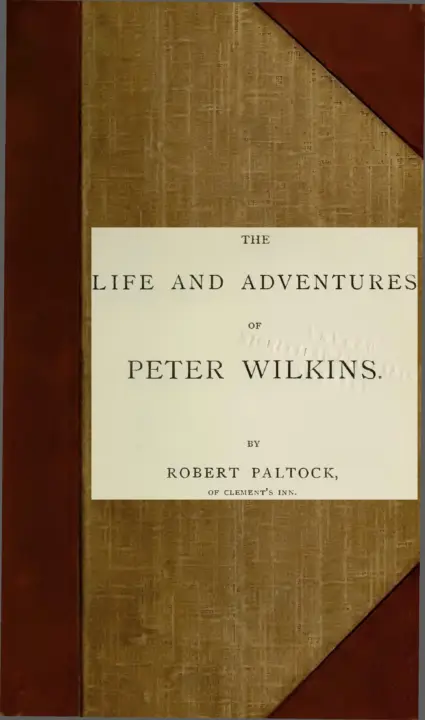
The Life and Adventures of Peter Wilkins, Volume 1 (of 2)
Robert Paltock
THE CLASSIC COLLECTION · 1751
"The Life and Adventures of Peter Wilkins, Complete (Volumes 1 and 2)" by Robert Paltock is a novel written in the early 18th century. The story follows the life of Peter Wilkins, a Cornish man who faces various adventures, including shipwrecks, encounters with peculiar flying beings known as Glums and Gawrys, and a unique romance with a winged woman named Youwarkee. The narrative intertwines themes of adventure, exploration, and human connection against the backdrop of fantastical elements. The opening of the novel begins with a brief preface discussing the author and the literary context of the work, revealing it was published during a time when such imaginative tales were gaining popularity. The story then unfolds from Wilkins’ perspective, detailing his birth, upbringing, and eventual decision to leave his home and family behind. He embarks on a series of adventures starting with his initiation at an academy, where his life begins to take unexpected turns due to his interactions with women. The narrative sets the stage for his journey into the unknown, hinting at the fantastical escapades that will follow as he explores a new world filled with extraordinary beings.
Introduction adapted from the source catalogue; source summaries may be automatically generated.
Free to read · English · 148,608 words · No account needed
MAKE TIME FOR A GOOD BOOK
On by default. Untick to stop anonymous reading totals. Each page counts after 10 seconds in view. How this works.
Anonymous counting is on unless you have switched it off.
After I had stood a while in the utmost confusion of thought, and my spirits began to be a little composed, I was resolved to see what damage the hull of the ship had received. Accordingly I looked narrowly, but could find none, only she was immovably fixed in a cleft of the rock, like a large archway, and there stuck so fast, that though upon fathoming I could find no bottom, she never moved in the least by the working of the water.
I now began to look upon Adams as a happy man, being delivered by an immediate death from such an inextricable scene of distress, and wished myself with him a thousand times. I had a great mind to have followed him into the other world; yet I know not how it is, there is something so abhorrent to human nature in self-murder, be one's condition what it will, that I was soon determined on the contrary side. Now again I perceived that the Almighty had given me a large field to expatiate in upon the trial of His creatures, by bringing them into imminent dangers ready to overwhelm them, and at the same time, as it were, hanging out the flag of truce and mercy to them. These thoughts brought me to my knees, and I poured out my soul to God in a strain of humiliation, resignation to His will, and earnest petitions for deliverance or support in this distress. Having finished, I found myself in a more composed frame; so having eaten a biscuit and drank a can of water, and not seeing anything to be done whereby I could better my condition, I sat me down upon the deck, and fell into the following soliloquy--
Peter, says I, what have you to do here?--Alas! replied I to myself, I am fixed against my will in this dismal mansion, destined, as rats might be, to devour the provisions only, and having eaten all up, to perish with hunger for want of a supply.--Then, says I, of what use are you in the world, Peter?--Truly, answered I, of no other use that I can see but to be an object of misery for Divine vengeance to work upon, and to show what a deplorable state human nature can be reduced to; for I cannot think any one else can be so wretched.--And again, Peter, says I, what have you been doing ever since you came into the world?--I am afraid, says I, I can answer no better to this question than to either of the former; for if only reasonable actions are to be reckoned among my doings, I am sure I have done little worth recording; for let me see what it all amounts to. I spent my first sixteen years in making a fool of my mother; my three next in letting her make a fool of me, and in being fool enough myself to get me a wife and two children before I was twenty. The next year was spent in finding out the misery of slavery from experience. Two years more I repined at the happiness of my benefactor, and at finding it was not my lot to enjoy the same. This year is not yet spent, and how many more are to come, and where they may be passed, and what they may produce, requires a better head than mine even to guess at; but certainly my present situation seems to promise nothing beside woe and misery.--But hold a little, says I, and let me clearly state my own wretchedness. I am here, it is true; but for any good I have ever done or any advantage I have reaped in other places, I am as well here as anywhere. I have no present want of food or unjust or cruel enemy to annoy me; so as long as the ship continues entire and provisions last, I shall do tolerably. Then why should I grieve or terrify myself about what may come? What my frighted imagination suggests may perhaps never happen. Deliverance, though not to be looked for, is yet possible; and my future fate may be as different from my present condition as this is from the hopes with which I lately flattered myself. And why, after all, may I not die a natural death here as well as anywhere? All mankind die, and then there is an end of all----An end of all! did I say? No, there is something within that gives me the lie when I say so. Let me see; Death, my master used to say, is not an end, but a beginning of real life: and may it not be so? May I not as well undergo a change from this to a different state of life when I leave this world, as be born into it I know not from whence? Who sent me into this world? Who framed me of two natures so unlike, that death cannot destroy but one of them? It must be the Almighty God. But all God's works tend to some end; and if He has given me an immortal nature, it must be His intention that I should live somewhere and somehow for ever. May not this stage of being then be only an introduction to a preparative for another? There is nothing in this supposition repugnant to reason. Upon the whole, if God is the author of my being, He only has a right to dispose of it, and I may not put an end thereto without His leave. It is no less true that my continuing therein during His pleasure, and because it is so, may turn vastly to my advantage in His good time; it may be the means of my becoming happy for even when it is His will that I go hence. It is no less probable that, dismal as my present circumstances appear, I may be even now the object of a kind Providence: God may be leading me by affliction to repentance of former crimes; destroying those sensual affections that have all my days kept me from loving and serving Him. I will therefore submit myself to His will, and hope for His mercy.
Your reading position is saved on this browser. Take it to another device with a library code. Reading pages adapt to text, rather than matching a printed edition.
BEHIND THE BOOK
This eBook is for the use of anyone anywhere in the United States and most other parts of the world at no cost and with almost no restrictions whatsoever. You may copy it, give it away or re-use it under the terms of the Project Gutenberg License included with this eBook or online at www.gutenberg.org. If you are not located in the United States, you will have to check the laws of the country where you are located before using this eBook. Read the source licence.
The original source file, including credits and licence, is retained by this library. Request an original-format copy at no charge. Please include the book title and Project Gutenberg identifier #51967.
KEEP YOUR CURIOSITY GOING
Coulson Kernahan

Maurice Baring
Frances Wright
Cécile Tormay
Francis Greenleaf Allinson & Anne C. E. (Anne Crosby Emery) Allinson

Frederic Jesup Stimson