The Life and Adventures of Peter Wilkins, Volume 1 (of 2)
Robert Paltock
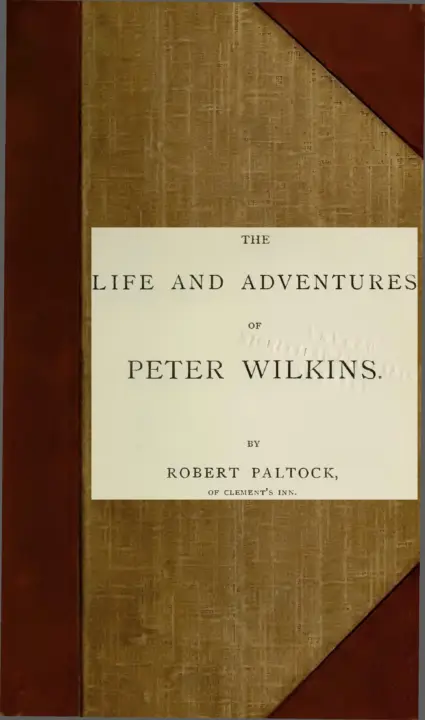
THE CLASSIC COLLECTION · 1751
"The Life and Adventures of Peter Wilkins, Complete (Volumes 1 and 2)" by Robert Paltock is a novel written in the early 18th century. The story follows the life of Peter Wilkins, a Cornish man who faces various adventures, including shipwrecks, encounters with peculiar flying beings known as Glums and Gawrys, and a unique romance with a winged woman named Youwarkee. The narrative intertwines themes of adventure, exploration, and human connection against the backdrop of fantastical elements. The opening of the novel begins with a brief preface discussing the author and the literary context of the work, revealing it was published during a time when such imaginative tales were gaining popularity. The story then unfolds from Wilkins’ perspective, detailing his birth, upbringing, and eventual decision to leave his home and family behind. He embarks on a series of adventures starting with his initiation at an academy, where his life begins to take unexpected turns due to his interactions with women. The narrative sets the stage for his journey into the unknown, hinting at the fantastical escapades that will follow as he explores a new world filled with extraordinary beings.
Introduction adapted from the source catalogue; source summaries may be automatically generated.
Free to read · English · 148,608 words · No account needed
MAKE TIME FOR A GOOD BOOK
On by default. Untick to stop anonymous reading totals. Each page counts after 10 seconds in view. How this works.
Anonymous counting is on unless you have switched it off.
A shooting proposed--All afraid of the gun but one private guard--His behaviour---Pendlehamby, at Peter's request, makes him a general--Peter's discourse thereon--Remainder of his story--The colambs return.
THIS being the fifth morning, I cleaned up my best gun, and prepared my balls, and we all took a walk towards the bridge, every one admiring my gun as we went; but I could get none of them to carry it, and we had at least five hundred questions proposed about it. I told them they need not be afraid of it, for it was only wood and iron; but they knew nothing of iron. I then showed them how I made it give fire, by snapping the cock; they thought it was very strange. I then put a little powder in the pan, and made it flash, and showing them the empty pan, they would not be persuaded but I had taken away the powder before the flash, or else, they said, it was impossible that should be all gone upon flashing only; for they said it was a little nut, using the same word to express both nut and seed. I then desired one of them to put in some powder and snap it himself; but having prevailed with him to try the experiment, if I had not through caution held my hand upon the barrel, the gun had been on the ground, for the moment it flashed, he let go and ran for it.
I had a great inclination to gain the better of their prejudices, and used abundance of arguments to prove the gun as innocent a thing as a twig I took up; and that it was the powder which, when set on fire, the flame thereof wanting more room than the powder itself did, forced itself, and all that opposed it, out of the mouth of the gun with such fury as to make the noise they heard; and being just come to the rock, "Now," says I, "you shall see that what I tell you is true." They told me they desired nothing more than that I would make them understand it, for it was the strangest thing they had ever seen. "Well, then," says I, "observe; I put in this much powder only, and with this rag I stop it down close. Now," says I, "you see by the length of this stick that the rag and powder take up the space only of a finger's depth on the inside of the gun." They saw that plainly they said; "But how could that kill anything?"--"Now, look again," says I, "I put in a little more powder, as I did before when I made a flash, and you see there is a little hole from this powder through the side of the gun to the powder within. Do you observe that this communicates with that through this hole?"--"Yes," said they, they did.--"Now," says I, "when I put fire to this, it sets fire to that within, which fire turning to flame, and wanting room, bursts out at the mouth of the gun; and to show you with what force it comes out, here handle this round ball," giving them a bullet to handle; "you feel how heavy it is: now, can any of you throw this ball as far as that rock?" for I stood a good hundred paces from it.--They told me No.--"And don't you think," says I, "that if the force of the fire made by this powder can throw this ball to that rock, that force must be very great?"--They said, they thought it must, but believed it to be impossible.--"But," says I, "if it not only throws it to the rock but beats out a piece of the stone, must not that be much more violent?" They agreed it must.--Then putting in the ball, "Now," says I, "we will try." I then ordered one to daub a part of the rock, about breast high, with some mud, and first to observe about it if the rock was anywhere fresh broken, or not; who, returning, reported that the rock was all of a colour and sound, but somewhat ragged all about the mud.--"Did you lay the mud on smooth?" says I. He replied, "Yes."--Then lifting up my gun, I perceived they were creeping off; so I took it down again, and calling, reasoned with them upon their fears. "What mischief," says I, "can you apprehend from this gun in my hand! Should I be able to hurt you with it, are you not all my friends or relations--could I be willing to do it? If the gun of itself could hurt, would I handle it as I do? For shame! be more courageous; rouse your reason, and stand by me; I shall take care not to hurt you. It looks as if you mistrust my love to you, for this gun can do nothing but what I direct it to." By such like persuasions, rough and smooth, I prevailed upon the major part of the colambs and officers to stand near me to see me fire, and then I shot; but though my words had engaged them to stand it, I had no sooner snapped but the graundees flew all open, though they closed again immediately; and then we fell to question and answer again. I desired them to walk to the rock; and sent the person who put up the mark before, to see and show us exactly what alteration there was. He told us there was a round hole in the mud, pointing to it, which he did not leave there, and taking away the mud, a thick shiver of the rock followed it. They then all agreed that the ball must have made both the hole in the mud and also splintered the rock, and stood in amaze at it, not being able to comprehend it: but, by all the art I had, I could not prevail with a man of them to fire the gun himself, till it had been buzzed about a good while, and at last came to my ears, that a common soldier behind said he should not be afraid of it if the gentleman would show him how.
Your reading position is saved on this browser. Take it to another device with a library code. Reading pages adapt to text, rather than matching a printed edition.
BEHIND THE BOOK
This eBook is for the use of anyone anywhere in the United States and most other parts of the world at no cost and with almost no restrictions whatsoever. You may copy it, give it away or re-use it under the terms of the Project Gutenberg License included with this eBook or online at www.gutenberg.org. If you are not located in the United States, you will have to check the laws of the country where you are located before using this eBook. Read the source licence.
The original source file, including credits and licence, is retained by this library. Request an original-format copy at no charge. Please include the book title and Project Gutenberg identifier #51967.
KEEP YOUR CURIOSITY GOING
Coulson Kernahan

Maurice Baring
Frances Wright
Cécile Tormay
Francis Greenleaf Allinson & Anne C. E. (Anne Crosby Emery) Allinson

Frederic Jesup Stimson