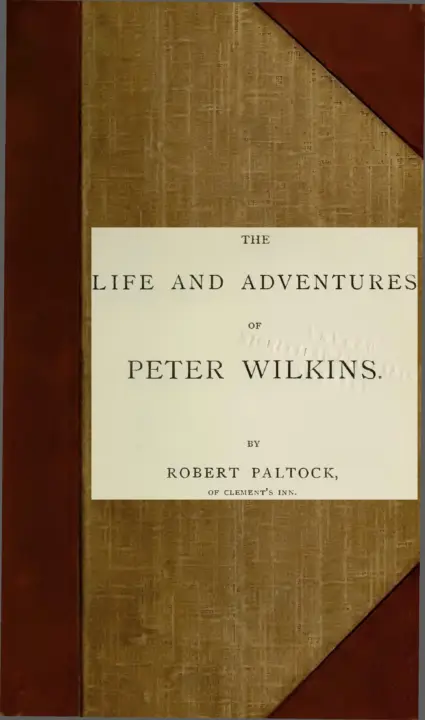
The Life and Adventures of Peter Wilkins, Volume 1 (of 2)
Robert Paltock
THE CLASSIC COLLECTION · 1751
"The Life and Adventures of Peter Wilkins, Complete (Volumes 1 and 2)" by Robert Paltock is a novel written in the early 18th century. The story follows the life of Peter Wilkins, a Cornish man who faces various adventures, including shipwrecks, encounters with peculiar flying beings known as Glums and Gawrys, and a unique romance with a winged woman named Youwarkee. The narrative intertwines themes of adventure, exploration, and human connection against the backdrop of fantastical elements. The opening of the novel begins with a brief preface discussing the author and the literary context of the work, revealing it was published during a time when such imaginative tales were gaining popularity. The story then unfolds from Wilkins’ perspective, detailing his birth, upbringing, and eventual decision to leave his home and family behind. He embarks on a series of adventures starting with his initiation at an academy, where his life begins to take unexpected turns due to his interactions with women. The narrative sets the stage for his journey into the unknown, hinting at the fantastical escapades that will follow as he explores a new world filled with extraordinary beings.
Introduction adapted from the source catalogue; source summaries may be automatically generated.
Free to read · English · 148,608 words · No account needed
MAKE TIME FOR A GOOD BOOK
On by default. Untick to stop anonymous reading totals. Each page counts after 10 seconds in view. How this works.
Anonymous counting is on unless you have switched it off.
In our return home, Nasgig singled me out to return his acknowledgments for my favour; and viewing my gun told me they had no such thing growing in his country. I told him if he had it, it would do no good without my powder. I then, at his request, described what I had heard of our method of fighting in battle in Europe; and mentioning our cannon, he said he supposed they killed every man they hit. "No," says I, "not so bad as that. Sometimes they hit the flesh only, and that is commonly cured; sometimes break a leg or arm, and that may in time be cured--some so well as to be useful again, and others are cut off, and healed up again; but if the ball hits the head or vitals, it is commonly mortal."--"Oh," says he, "give me the head or vitals, then; no broken limbs for me."
After dinner, at their request, I went on with my story, at repairing the castle, and my escape with Glanlepze, and so on to the crocodile; when I repeated his speech to me on that account, and told them it had made such an impression upon me that I had endeavoured to make it the leading thought of my mind, and had set it down upon one of my doors at the grotto that it might the oftener be in my sight when any difficulty arose.
One of the colambs begged pardon for interrupting, but told me, though he understood what Glanlepze meant, he could not tell how I could set what he said down at my grotto, or have it in my sight, and desired me to explain that. I would have told my guest I took it down in writing, if that would not have puzzled the cause more; but to go the nearest way I could, I told him we had a method in my country of conveying to a man at a great distance whatever we have a mind to say to him, and in such a manner that nobody but himself would know what we would have him know. And pausing here a little to consider the easiest method of demonstrating this to their senses, they told me they had gone as far as their conjectures could carry them, but could conclude on nothing so improbable as sending it by a messenger. I told them that in part was my way, but my messenger should not know the message he carried. That gravelled them quite, and they were unanimous that was what could not be done. By this time I had sent for a wood-coal, to write with upon my deal table, and kneeling down to the table, I began to write, "Honoured sir, I send this to gain by your answer to it an account of your arrival at Arndrumnstake." I then called them all to me. "Now," says I, "suppose I want to know how my father gets back to Arndrumnstake, my way is this--I set down so many words as will express my meaning to my father, after the manner you see on this table, and make a little distance between each word, which is the same thing as you do in speaking; for there, if you run one word into another, and don't give each its proper sound, who can understand you? For though you speak what contains all the words, yet without the proper sound and distinction it is only confusion. Do you understand that?" They told me they did. "Then," says I, "these are the words I would have my father know, I being at this arkoe, and he at Arndrumnstake. Honoured sir," and so I read on. "Here," says I, "you must take us to be countrymen, and that he and I understand both the same method. Now look, this word, which ends where you see the gap, stands for honoured, and this next for sir, the next for I, and so on; and we both using the same method, and seeing each other's words, are able to open our minds at a distance." I was now in hopes I had done, and was going on with my story: "But," says one of the colambs, "Mr. Peter, though this is a matter that requires consideration, I plainly see how you do it, by agreeing that all these strokes put into this form shall stand for the word honoured, and so on, as you say, let who will make them; but have not you set down there the word Arndrumnstake?"--"Yes," says I.--"Why then," says he, "none of your countrymen could understand what that means."--"No," says I, smiling; "but they could."--Says he, "You say you agree what strokes shall stand for one word, and what for another; but then how could your countrymen, who never knew what strokes you would set down for Arndrumnstake, know that your strokes meant that very country? for that you could not have agreed upon before either of you knew there was any such place."
Your reading position is saved on this browser. Take it to another device with a library code. Reading pages adapt to text, rather than matching a printed edition.
BEHIND THE BOOK
This eBook is for the use of anyone anywhere in the United States and most other parts of the world at no cost and with almost no restrictions whatsoever. You may copy it, give it away or re-use it under the terms of the Project Gutenberg License included with this eBook or online at www.gutenberg.org. If you are not located in the United States, you will have to check the laws of the country where you are located before using this eBook. Read the source licence.
The original source file, including credits and licence, is retained by this library. Request an original-format copy at no charge. Please include the book title and Project Gutenberg identifier #51967.
KEEP YOUR CURIOSITY GOING
Coulson Kernahan

Maurice Baring
Frances Wright
Cécile Tormay
Francis Greenleaf Allinson & Anne C. E. (Anne Crosby Emery) Allinson

Frederic Jesup Stimson