THE CLASSIC COLLECTION✦An outlaw’s diary: the CommuneCLASSIC FREE BOOKS
An outlaw’s diary: the Commune
Cécile Tormay
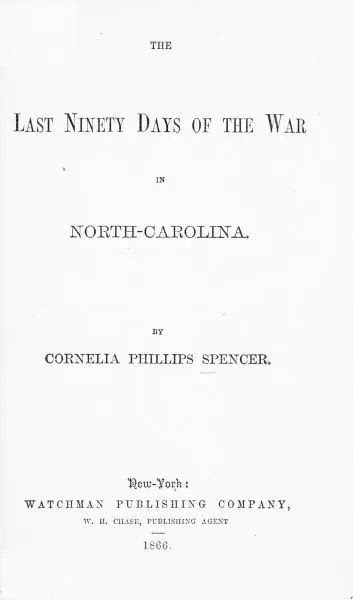
THE CLASSIC COLLECTION · 1866
"The Last Ninety Days of the War in North-Carolina" by Cornelia Phillips Spencer is a historical account written in the late 19th century. This work reflects on the final days of the Civil War, specifically examining North Carolina's role and experiences during this tumultuous period. The author aims to preserve the truths of the time, focusing on the state’s leaders, the war's impact on its citizens, and the complexities of secession and conflict as perceived locally. At the start of the narrative, Spencer sets the stage by discussing the challenges of accurately documenting the Civil War's history, noting the tensions and passions that still linger post-conflict. She introduces key figures, including Governor Zebulon Vance, and highlights North Carolina's precarious position during the war and her people's call to arms despite reservations about secession. Through personal correspondence and public attempts, such as delegations for peace, the opening portion paints a portrait of a state grappling with its identity and loyalties while laying the groundwork for a detailed exploration of its contributions and the hardships endured as the war drew to a close.
Introduction adapted from the source catalogue; source summaries may be automatically generated.
Free to read · English · 72,078 words · No account needed
MAKE TIME FOR A GOOD BOOK
On by default. Untick to stop anonymous reading totals. Each page counts after 10 seconds in view. How this works.
Anonymous counting is on unless you have switched it off.
STATE OF PARTIES--THE FEELING OF THE PEOPLE--THE "PEACE" PARTY--IMPORTANT LETTER FROM GOVERNOR VANCE IN JANUARY, 1864--HIS REËLECTION--THE WAR PARTY--THE PEACE PARTY--THE MODERATES--GOVERNOR GRAHAM'S LETTER OF MARCH, 1865--EVACUATION OF RICHMOND.
He who would write a history of public events passing in his own day will find, among the many obstacles in the way of a clear and correct delineation, that he is continually met with doubts and hesitations in his own mind as to the impartiality of his views and decisions. The prejudices of party feeling must inevitably confuse and blind to some extent even the clearest judgment; and while a consciousness of this renders the faithful historian doubly anxious to exercise strict impartiality, he will find himself embarrassed by the divisions and subdivisions of opinion, bewildered by conflicting representations, and in danger of becoming involved in contradictions and inconsistencies. In the first chapter of these sketches it was remarked, with reference to the North and the South, that there was too much to be forgotten and too much to be forgiven between them, to hope at present for a fair and unprejudiced history of the war on either side. In relation to the parties that existed among ourselves during the war, it is equally true that the time has not yet arrived for a fair statement or comparison of their respective merits or demerits. While there is much that may be written and much that has been written which may with propriety be given to the public, there is much more that must at present be suppressed or receive only a passing notice. More especially is this true in regard to the secession party and its adherents. Yet in presenting even these slight sketches of the state of things during the war in North-Carolina, it would be impossible to ignore them, and unfair to represent them as without influence among us. For while it is incontestably true that the great mass of our people engaged reluctantly in the war, and hailed the prospect of peace and an honorable reünion, yet there was at the same time hardly a town in the State or an educated and refined community which did not furnish their quota of those who, without having been original secessionists, yet had thrown themselves with extreme ardor on the side of the Southern States rights, and were ready to go all lengths in support of the war, and who are even now, though helpless and powerless, unwilling to admit that they were either in the wrong or in the minority. With many of them it was the triumph of heroic sentiment and generous feeling over the calmer suggestions of reason, for they were chiefly among our most refined and highly cultivated citizens. As a party, if not numerous, they were well organized and compact; they were socially and politically conspicuous, and did most of the writing and talking. They differed from the great body of their fellow-citizens, chiefly in the intensity of their loyalty toward President Davis and his government--being resolved to support him at all hazards--and in the implacable temper they manifested toward the common enemy. One who mingled freely with both parties, and by turns sympathized with both, and who would fain do justice to both, will find it impossible to adjust their conflicting representations, and at the same time observe the prudent reticence which our present circumstances imperatively demand. Two of the most prominent and influential leaders of the war party, Governors Ellis and Winslow, have passed beyond the reach of earthly tribunals, and of the living actors it is obvious that no mention can now be made. Very different but no less cogent reasons impose a similar reticence in relation to the more numerous but not more respectable or influential organization known as the "Peace Party" of the last eighteen months of the war, and as "Union men of the straitest sect" at this day. Of this party, Governor Holden is the admitted founder and the present head, and Senator Pool his most prominent exponent. A representation of their principles and their history should be made by themselves. They possess all the materials and all the abilities requisite for the work, and they owe it to themselves and to the public to place it on record for the judgment of their cotemporaries and of posterity. They and they alone are competent to the performance of this duty in the best manner. The precise date of the earliest formation of this party is given in the following letter from Governor Vance, which, is inserted here, not only as affording a clear view of the principles which guided his course of action, but as enabling the reader to comprehend Governor Graham's policy, exhibited in the further extracts from his correspondence.
Your reading position is saved on this browser. Take it to another device with a library code. Reading pages adapt to text, rather than matching a printed edition.
BEHIND THE BOOK
This eBook is for the use of anyone anywhere in the United States and most other parts of the world at no cost and with almost no restrictions whatsoever. You may copy it, give it away or re-use it under the terms of the Project Gutenberg License included with this eBook or online at www.gutenberg.org. If you are not located in the United States, you will have to check the laws of the country where you are located before using this eBook. Read the source licence.
The original source file, including credits and licence, is retained by this library. Request an original-format copy at no charge. Please include the book title and Project Gutenberg identifier #62332.
KEEP YOUR CURIOSITY GOING
Cécile Tormay

Moritz Busch
John L. Ransom
Frances Wright
Cécile Tormay

Mabel Potter Daggett