THE CLASSIC COLLECTION✦An outlaw’s diary: the CommuneCLASSIC FREE BOOKS
An outlaw’s diary: the Commune
Cécile Tormay
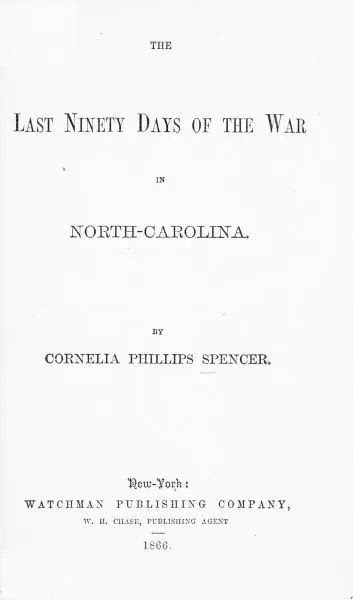
THE CLASSIC COLLECTION · 1866
"The Last Ninety Days of the War in North-Carolina" by Cornelia Phillips Spencer is a historical account written in the late 19th century. This work reflects on the final days of the Civil War, specifically examining North Carolina's role and experiences during this tumultuous period. The author aims to preserve the truths of the time, focusing on the state’s leaders, the war's impact on its citizens, and the complexities of secession and conflict as perceived locally. At the start of the narrative, Spencer sets the stage by discussing the challenges of accurately documenting the Civil War's history, noting the tensions and passions that still linger post-conflict. She introduces key figures, including Governor Zebulon Vance, and highlights North Carolina's precarious position during the war and her people's call to arms despite reservations about secession. Through personal correspondence and public attempts, such as delegations for peace, the opening portion paints a portrait of a state grappling with its identity and loyalties while laying the groundwork for a detailed exploration of its contributions and the hardships endured as the war drew to a close.
Introduction adapted from the source catalogue; source summaries may be automatically generated.
Free to read · English · 72,078 words · No account needed
MAKE TIME FOR A GOOD BOOK
On by default. Untick to stop anonymous reading totals. Each page counts after 10 seconds in view. How this works.
Anonymous counting is on unless you have switched it off.
JOHNSTON'S RETREAT--GOVERNORS GRAHAM AND SWAIN MISUNDERSTOOD--WHEELER'S CAVALRY--CONFEDERATE OCCUPANCY OF CHAPEL HILL--THE LAST BLOOD--"STARS AND STRIPES"--ONE IN DEATH--GENERAL ATKINS--SCENES AROUND RALEIGH--MILITARY LAWLESSNESS.
When the retrograde movement of General Johnston's army was at last fairly understood--the supply-trains moving slowly along the roads of Orange, and General Wheeler's cavalry, acting upon the maxim that all that they left behind them was so much aid and comfort to the enemy, taking care to leave at least as few horses and mules as possible--then deluded people, who had all along hugged themselves in the belief that their remoteness was their security, began to shake the dust from their eyes, and open them to admit a view of the possibility of Sherman's army reaching even their secluded homes.
The mission of Governors Graham and Swain was not generally understood, even by their near neighbors. That any available attempt to check the ruin and devastation that had hitherto accompanied that army could be made, or was even consistent with honor and our allegiance to the Confederate Government, very few believed. A distinguished Confederate general, standing on our sidewalk, as his division of infantry marched through on Friday, fourteenth, said, in reference to the commissioners, that they were a couple of traitors, and ought to be hung. General Wheeler's cavalry held the village of Chapel Hill until mid-day of April sixteenth, Easter Sunday. Not a house in the place but was thrown open to show them kindness and hospitality. There were rough riders among these troopers--men who, if plunder was the object, would have cared little whether it was got from friend or foe. How much of this disposition to subsist by plunder was due to the West-Point training of their General, it would perhaps be inquiring too curiously to consider. A few such reckless men in a regiment would have been enough to entail an evil name upon the whole; and at the time of which I now speak there were more than a few in General Wheeler's command who were utterly demoralized, lawless, and defiant. Having said this much, because the truth must be told, I will add that of that famous band by far the greater part were true and gallant men. We mingled freely with them, from General Wheeler himself, who slept in the drenching rain among his men, and was idolized by them, to his poorest private, and the impression made by them was altogether in their favor. There were men from every Southern State, and from every walk in life. There were mechanics from Georgia and planters from Alabama: one of the latter I especially remember, who had been a country physician in the north-east corner of the State; a frank and steady, gray-haired man, whose very address inspired confidence, and whose eldest boy rode by his side: there were gay Frenchmen from Louisiana and lawyers from Tennessee, some of whom had graduated at this university in the happy days gone by, who revisited these empty corridors with undisguised sadness, foreboding that not one stone would be left upon another of these venerable buildings, perhaps not an oak left standing of the noble groves, after Sherman's army had passed. Many of these men had not been paid one cent, even of Confederate currency, in more than a year. Few of them had more than the well-worn suit of clothes he had on, the inefficient arms he carried, and the poor and poorly equipped horse he rode. A lieutenant, not four years before a graduate of this university, who had not seen his home within a year, and who had not long before received intelligence that his house in Tennessee had been burned to the ground by the enemy, and that his wife and child were homeless, when the certain news was brought by Governor Swain of General Lee's surrender, covered his face with his hands to hide a brave man's tears. He told us that a twenty-five cent Confederate note was all that he possessed in the world besides his horse. The privates generally discussed the situation of affairs calmly and frankly, and with an amount of intelligence that the Southern and South-western yeomanry have not generally had credit for possessing. They one and all agreed that, if the end was near, they would not surrender. "No, no," said a red-cheeked Georgian boy of nineteen, "they won't get me;" and one six-foot-six saturnine Kentuckian assured me that he would join the army of France, and take his allegiance and his revolver over the water. I trust he is on his little farm, by the Licking River, as I write, and has found him a wife, and is settled down to do his whole duty to the country once more.
Your reading position is saved on this browser. Take it to another device with a library code. Reading pages adapt to text, rather than matching a printed edition.
BEHIND THE BOOK
This eBook is for the use of anyone anywhere in the United States and most other parts of the world at no cost and with almost no restrictions whatsoever. You may copy it, give it away or re-use it under the terms of the Project Gutenberg License included with this eBook or online at www.gutenberg.org. If you are not located in the United States, you will have to check the laws of the country where you are located before using this eBook. Read the source licence.
The original source file, including credits and licence, is retained by this library. Request an original-format copy at no charge. Please include the book title and Project Gutenberg identifier #62332.
KEEP YOUR CURIOSITY GOING
Cécile Tormay

Moritz Busch
John L. Ransom
Frances Wright
Cécile Tormay

Mabel Potter Daggett