THE CLASSIC COLLECTION✦An outlaw’s diary: the CommuneCLASSIC FREE BOOKS
An outlaw’s diary: the Commune
Cécile Tormay
THE CLASSIC COLLECTION · 1866
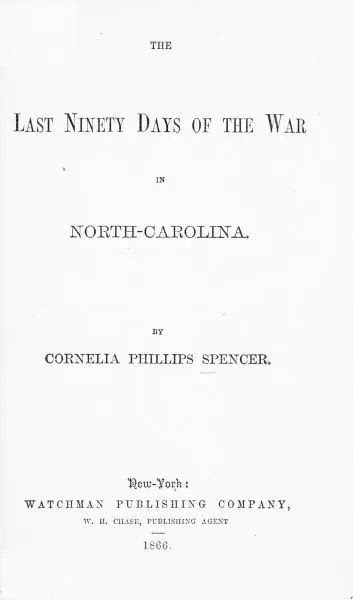
"The Last Ninety Days of the War in North-Carolina" by Cornelia Phillips Spencer is a historical account written in the late 19th century. This work reflects on the final days of the Civil War, specifically examining North Carolina's role and experiences during this tumultuous period. The author aims to preserve the truths of the time, focusing on the state’s leaders, the war's impact on its citizens, and the complexities of secession and conflict as perceived locally. At the start of the narrative, Spencer sets the stage by discussing the challenges of accurately documenting the Civil War's history, noting the tensions and passions that still linger post-conflict. She introduces key figures, including Governor Zebulon Vance, and highlights North Carolina's precarious position during the war and her people's call to arms despite reservations about secession. Through personal correspondence and public attempts, such as delegations for peace, the opening portion paints a portrait of a state grappling with its identity and loyalties while laying the groundwork for a detailed exploration of its contributions and the hardships endured as the war drew to a close.
Introduction adapted from the source catalogue; source summaries may be automatically generated.
Free to read · English · 72,078 words · No account needed
MAKE TIME FOR A GOOD BOOK
On by default. Untick to stop anonymous reading totals. Each page counts after 10 seconds in view. How this works.
Anonymous counting is on unless you have switched it off.
RICHMOND, January 28, 1865.
My Dear Sir: The intervention of F.P. Blair, who has passed two or three times back and forth from Washington to this city recently, has resulted in the appointment to-day by the President of an informal commission, consisting of Messrs. A.H. Stephens, R.M.T. Hunter, and J.A. Campbell, to proceed to Washington and confer with a like band there, on the subject-matters of difference between the Northern and Southern States, with a view to terms of peace. The action of the Senate was not invoked, it is presumed because the appointment of formal ministers might be considered inadmissible until the question of recognition should be settled in our favor. I trust that a termination of hostilities will be the result. From several conversations with Mr. Hunter, in concert with whom I have been endeavoring to reach this form of intercourse since the commencement of the session of Congress, I am satisfied that the first effort will be to establish an armistice of as long duration as may be allowed, and then to agree upon terms of settlement. Upon the latter I anticipate great conflict of views. The Northern mind is wedded to the idea of reconstruction, and notwithstanding the violence of the extravagant Republicans, I am convinced would guarantee slavery as it now exists, and probably make other concessions, including of course, amnesty, restoration of confiscated property, except slaves, and perhaps some compensation for a part of these. On the other hand, while the people of the South are wearied of the war, and are ready to make the greatest sacrifice to end it, there are embarrassments attending the abdication of a great government such as now wields the power of the South, especially by the agents appointed to maintain it, that are difficult to overcome. The commission is a discreet one, and upon the whole is as well constituted as I expected, and I trust that good will come of it. I have not seen any of the gentlemen since hearing to-day of their appointment, and I learn they are to set off to-morrow. I am therefore ignorant of the instructions they may carry, if any have been given. The Vice-President was not on terms with the head of the Government until a reconciliation yesterday. Although the North would seem to be bent on war unless and until the Union be restored, they yet regard us as a formidable foe, and I suspect the ruling authorities estimate our power as highly as it deserves. The Secretary of State here, I understand, says they have been frightened into negotiations by the articles in the Richmond Enquirer, threatening a colonial connection with England and France; while others, I hear from Mr. Rives, assert that the North is much troubled by the proposition to make soldiers of slaves. I have no faith in either of these fancies, but have no doubt they regard us as far from being subdued, and are willing to treat rather than incur the preparations for what they conceive necessary for final success. An intelligent prisoner, Mr. Roulhac of Florida, recently returned, informs me that by the influence of his mercantile acquaintance, he was paroled and allowed to spend six weeks in the city of New-York, and to travel to Washington, etc. According to his observation, there is an abatement in the feelings of hostility to the South, and a disposition to peace, but upon the basis of reconstruction. Mr. Singleton of Illinois, who has been here at times for two or three weeks, and is a supposed quasi diplomat, but from the company he keeps is more of a speculator, gives the same account. The Virginia delegation in Congress, having in view the Secretary of State, declared a want of confidence in the cabinet, but struck no game except their own Secretary of War. He has resigned, and Breckinridge, it is announced, is to succeed him, ... a representative of a State which has not ten thousand men in our army. No reports are given from official sources of the fall of Fort Fisher. Private accounts represent it as a disgraceful affair.... Mr. Trenholm insists on adding one hundred per cent to the taxes of last year, including tithes. He is a good merchant and has talent, but is not versed in the finances of a nation. General Lee has addressed a letter to a member of the Virginia Senate, advocating the enlistment of slaves as soldiers, with emancipation of themselves and families, and ultimately of the race. With such wild schemes and confessions of despair as this, it is high time to attempt peace, and I trust the commission above named may pave the way to it....
Your reading position is saved on this browser. Take it to another device with a library code. Reading pages adapt to text, rather than matching a printed edition.
BEHIND THE BOOK
This eBook is for the use of anyone anywhere in the United States and most other parts of the world at no cost and with almost no restrictions whatsoever. You may copy it, give it away or re-use it under the terms of the Project Gutenberg License included with this eBook or online at www.gutenberg.org. If you are not located in the United States, you will have to check the laws of the country where you are located before using this eBook. Read the source licence.
The original source file, including credits and licence, is retained by this library. Request an original-format copy at no charge. Please include the book title and Project Gutenberg identifier #62332.
KEEP YOUR CURIOSITY GOING
Cécile Tormay

Moritz Busch
John L. Ransom
Frances Wright
Cécile Tormay

Mabel Potter Daggett