THE CLASSIC COLLECTION✦An outlaw’s diary: the CommuneCLASSIC FREE BOOKS
An outlaw’s diary: the Commune
Cécile Tormay
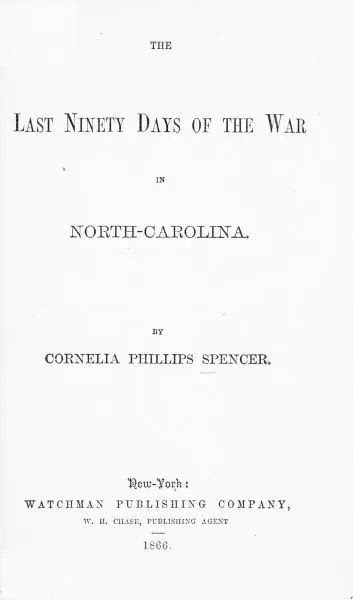
THE CLASSIC COLLECTION · 1866
"The Last Ninety Days of the War in North-Carolina" by Cornelia Phillips Spencer is a historical account written in the late 19th century. This work reflects on the final days of the Civil War, specifically examining North Carolina's role and experiences during this tumultuous period. The author aims to preserve the truths of the time, focusing on the state’s leaders, the war's impact on its citizens, and the complexities of secession and conflict as perceived locally. At the start of the narrative, Spencer sets the stage by discussing the challenges of accurately documenting the Civil War's history, noting the tensions and passions that still linger post-conflict. She introduces key figures, including Governor Zebulon Vance, and highlights North Carolina's precarious position during the war and her people's call to arms despite reservations about secession. Through personal correspondence and public attempts, such as delegations for peace, the opening portion paints a portrait of a state grappling with its identity and loyalties while laying the groundwork for a detailed exploration of its contributions and the hardships endured as the war drew to a close.
Introduction adapted from the source catalogue; source summaries may be automatically generated.
Free to read · English · 72,078 words · No account needed
MAKE TIME FOR A GOOD BOOK
On by default. Untick to stop anonymous reading totals. Each page counts after 10 seconds in view. How this works.
Anonymous counting is on unless you have switched it off.
While General Sherman's wagons were wallowing in the mud between Fayetteville and Goldsboro, vain attempts were being made in Raleigh to galvanize into some show of action and strength the fragments of an army that were concentrating there. General Lee's desperate situation in Virginia was not understood and realized by the multitude, nor that the Confederate territory was fast narrowing down to the northern counties of Central North-Carolina, and that Raleigh was the last capital city we could claim. Beauregard, Johnston, Hardee, Hoke, Hampton, Wheeler--names that had thrilled the whole Southern country with pride and exultation--they were all there, and for a time people endeavored to believe that Raleigh might be defended. General Sherman's plans appeared to be inscrutable. When he left Columbia, Charlotte was supposed to be his aim; but when he fell suddenly upon Fayetteville, then Raleigh was to be his next stage. The astute plan of a junction with Schofield at Goldsboro, which appears now to have been pre-arranged while he was yet in Savannah, did not dawn upon our minds till it was too late to prevent it. The fight at Bentonsville was a desperate and vain attempt to do what might possibly have been done before, and in that last wild struggle many a precious life was given in vain. With sad anxiety for the fate of those we loved, with sinking hearts, we heard, from day to day, from Averasboro and from Bentonsville, of the wild charge, the short, fierce struggle, and the inevitable retreat, little thinking that these were indeed the last life-throbs of our dying cause.
There was one from our own circle, whose story is but a representative one of the many thousand such that now darken what was once the Sunny South. He had joined the army in the beginning of the war, and his wife and children had fled from their pleasant home near New-Berne, on its first occupation by the Federal forces, leaving the negroes, plantation, house, furniture, and all to the invaders. They had taken refuge at Chapel Hill among old friends; and in a poor and inconvenient home, those who had counted their wealth by thousands were glad of a temporary shelter, as was the case with hundreds of families from the east, scattered all over the central part of the State. The energetic wife laid aside the habits of a lifetime and went to work, while her brave husband was in the army. From New-Berne to Richmond, from Charleston to the Blackwater, we, who had known him from boyhood, traced his gallant career, sharing his wife's triumphs in his successes, and her fears in his perils. Her health in unaccustomed toils began to fail, but we looked forward hopefully to the time when she might return to her beautiful home on the sea-shore, where a blander air would restore her. So we read his loving, cheerful letters, and believed that the life which had been spared through so many battles would yet be guarded for the sake of the wife and the curly-haired little ones. On the twenty-second of March, riding unguardedly near a thicket, our friend received the fire of a squad of sharp-shooters concealed there. He fell from his horse and was carried to a place of safety, where he lay on the muddy ground of the trampled battle-field for a few hours, murmuring faintly at intervals, "My wife! my poor wife!" till death mercifully came. He was wrapped by his faithful servant in his blood-stained uniform and muddy blankets as he lay; a coarse box was procured with great difficulty, and so the soldier was brought back to his family. His last visit home had been just before the fall of Fort Fisher; and when the news of the attack came, though his furlough was not out by ten days, yet he left at once for Wilmington, saying, "It was every man's duty to be at the front." He had returned to us now, "off duty forever." Loving hands laid him slowly and sadly down to a soldier's honored rest, while his little children stood around the grave. The wife made an effort to live for these children. She bore up through that woful spring and summer, and the thin, white, trembling hands were ever at work. But the brown hair turned gray rapidly, the easy-chair was relinquished for the bed, and before winter came the five children were left alone in the world. The wife had joined her husband. The ample estate that should have been theirs was gone. Strangers were in their home by the sea, and had divided out their lands; nor is it yet known whether they will be permitted to claim their inheritance.
Your reading position is saved on this browser. Take it to another device with a library code. Reading pages adapt to text, rather than matching a printed edition.
BEHIND THE BOOK
This eBook is for the use of anyone anywhere in the United States and most other parts of the world at no cost and with almost no restrictions whatsoever. You may copy it, give it away or re-use it under the terms of the Project Gutenberg License included with this eBook or online at www.gutenberg.org. If you are not located in the United States, you will have to check the laws of the country where you are located before using this eBook. Read the source licence.
The original source file, including credits and licence, is retained by this library. Request an original-format copy at no charge. Please include the book title and Project Gutenberg identifier #62332.
KEEP YOUR CURIOSITY GOING
Cécile Tormay

Moritz Busch
John L. Ransom
Frances Wright
Cécile Tormay

Mabel Potter Daggett