THE CLASSIC COLLECTION✦An outlaw’s diary: the CommuneCLASSIC FREE BOOKS
An outlaw’s diary: the Commune
Cécile Tormay
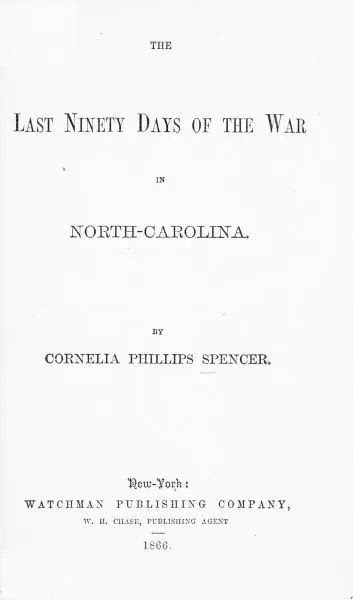
THE CLASSIC COLLECTION · 1866
"The Last Ninety Days of the War in North-Carolina" by Cornelia Phillips Spencer is a historical account written in the late 19th century. This work reflects on the final days of the Civil War, specifically examining North Carolina's role and experiences during this tumultuous period. The author aims to preserve the truths of the time, focusing on the state’s leaders, the war's impact on its citizens, and the complexities of secession and conflict as perceived locally. At the start of the narrative, Spencer sets the stage by discussing the challenges of accurately documenting the Civil War's history, noting the tensions and passions that still linger post-conflict. She introduces key figures, including Governor Zebulon Vance, and highlights North Carolina's precarious position during the war and her people's call to arms despite reservations about secession. Through personal correspondence and public attempts, such as delegations for peace, the opening portion paints a portrait of a state grappling with its identity and loyalties while laying the groundwork for a detailed exploration of its contributions and the hardships endured as the war drew to a close.
Introduction adapted from the source catalogue; source summaries may be automatically generated.
Free to read · English · 72,078 words · No account needed
MAKE TIME FOR A GOOD BOOK
On by default. Untick to stop anonymous reading totals. Each page counts after 10 seconds in view. How this works.
Anonymous counting is on unless you have switched it off.
General Gillam deserves especial notice at the hands of the historian. All concurrent testimony represents him as most supercilious, insulting, and unfeeling. His headquarters in Lenoir, were at Mr. Albert Hagler's. The family were all crowded off into one room, while the gallant General and his staff appropriated all the rest of the premises, including kitchen and stables. To Miss Sarah Hagler, an accomplished young lady, he was especially impertinent, though she parried his attacks with the civility of a lady. On one occasion he said to her rudely, "I know you are a rebel from the way you move--an't you a rebel?" She replied, "General Gillam, did you ever hear the story of the tailor's wife and the scissors?" "Yes." "Then I am a rebel as high as I can reach." Coarseness, however, can not always be met playfully, and Mrs. Hagler incurred his anger to its fullest extent when, in reply to his violent denunciation of the Confederates for starving their prisoners, she ventured to suggest that the Federal authorities might have saved all this suffering had they agreed to exchange and take them North, where provisions were plenty. The General's reply to this was the giving his men tacit license to plunder and destroy the houses of Mrs. H.'s married daughter and niece, who lived very near her, and who, she had supposed, were to be protected, from his headquarters being at her house. No houses in the place suffered more severely than theirs. The house of her daughter, Mrs. Hartley, was pillaged from top to bottom. Barrels of sorghum were broken and poured over the wheat in the granary, and over the floors of the house. Furniture and crockery were smashed, and what was not broken up was defiled in a manner so disgusting as to be unfit for use. Mrs. Clark, the niece, was driven out of her house by the brutality of her plunderers. Her husband, Dr. Boone Clark, was a captain in the Confederate service, had been wounded in the battle of Leesburg, early in the war--an admirable and most graphic account of which engagement he wrote for the Raleigh Standard soon after. In several subsequent battles he had received severe wounds, and though partially disabled by one of them at this time, he was endeavoring to raise a company of cavalry for home defense, as marauders, under the notorious Keith and Blalock, were constantly threatening to pillage Lenoir. These facts were known to some of Gillam's men, and they evidently enjoyed the opportunity to plunder his house and insult his defenseless wife. He himself was at home, sitting at table, when the raiders dashed in town. Seizing his gun, he ran out and secreted himself behind some adjoining buildings, and though a colonel did him the honor to enter his house almost immediately, and with a squad made a thorough search for him, his retreat remained undiscovered, and at night he left for more secure quarters. The raiders swarmed through the house that evening and night, breaking open trunks, wardrobes, drawers; searching for arms and carrying off all the valuables, and destroying what they did not want. Finding a coat of the Captain's, they cut it to pieces. They destroyed all the provisions, all the furniture, crockery, and wearing apparel. They tore up fine silk dresses into ribbons for their hats, or cut large squares out and carefully wrapped up quids of tobacco in them and deposited them on the mantel-piece. The little daughter's hat and garments were placed on the floor, and loathsomely polluted. They even took the lady's thimble from her work-box, and carried off the likeness of her deceased mother, paying no regard to her entreaties. They constantly addressed her, as she sat weeping and motionless amid the wreck they were making, in the most profane and obscene and insulting language, repeatedly calling her a liar and other degrading names. They compelled her and her little daughter to remain and witness the destruction; and, finally, when there was nothing more to break and steal, one of them approached her and thrust his fist in her face. As she raised her head to avoid it, he struck her forehead, seized her by the throat, cursing her furiously. She begged him not to kill her; he let her throat loose then; seizing the neck of her dress, tore it open, snatched her gold watch, which hung by a ribbon, tore it off and left her. Half dead with fright, she rushed to the door with the child, and amid curses and cries of "Stop her!" "Don't let her go!" got out of the house, ran down to her aunt's, and fell fainting on the threshold. After she was recovered, the ladies begged General Gillam to interfere, but he refused, saying, "There were bad men in all crowds." In the case of Mrs. Hartley he turned his back to the ladies without a word. Mrs. Clark then appealed to Lieutenant Jerome B. Rice of the Signal Corps, and also to Lieutenant Theodore Mallobry in the same command. These were gentlemen, and manifested a determination to protect her. One of them returned to her house with her and viewed the utter destruction of her household property with every appearance of shame and indignation. As they entered the house a soldier--the last of the gang--ran out. The Lieutenant had him arrested and carried to headquarters. When Mrs. Clark was called on to identify him as one of the robbers, he denied having been near her house. "Why," said she, "that is a piece of a silk dress of mine round your hat now." "Is it?" said he, coolly taking it off and handing it to her; "well, then, you may have it back." This was in the presence of General Gillam, for whom, by the way, it was generally observed, the men seemed to have no respect. General Brown sent a strong guard to Mrs. Clark's house; but it was too late to save any thing, and she had no redress.
Your reading position is saved on this browser. Take it to another device with a library code. Reading pages adapt to text, rather than matching a printed edition.
BEHIND THE BOOK
This eBook is for the use of anyone anywhere in the United States and most other parts of the world at no cost and with almost no restrictions whatsoever. You may copy it, give it away or re-use it under the terms of the Project Gutenberg License included with this eBook or online at www.gutenberg.org. If you are not located in the United States, you will have to check the laws of the country where you are located before using this eBook. Read the source licence.
The original source file, including credits and licence, is retained by this library. Request an original-format copy at no charge. Please include the book title and Project Gutenberg identifier #62332.
KEEP YOUR CURIOSITY GOING
Cécile Tormay

Moritz Busch
John L. Ransom
Frances Wright
Cécile Tormay

Mabel Potter Daggett